Showing posts with label animation appreciation series. Show all posts

Monday, June 10, 2013

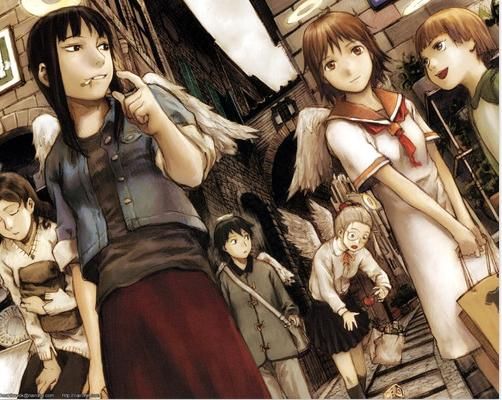
Animation Appreciation: Haibane Renmei


Sometimes, earnestness and elegance can make you take an absurd imagine completely seriously; ditto for the story that’s built around it. Haibane Renmei’s (High-bah-NAY Ren-MAY’s) main visual, that of otherwise ordinary people sporting halos and tiny angel wings, might look ridiculous by itself, but the thirteen-episode anime transforms it into something wondrous and moving.

The viewpoint character is Rakka, the newest Haibane, and through her viewers understand the rules of her world. Haibane are “born” from cocoons in the city of Glie, and named for the dream they had before “birth”; Rakka is named for a dream of falling. She is provided with a halo, wings break from her back, and she must find her place at the Haibane nest of “Old Home”, an abandoned school.

Haibane live a mostly idyllic existence, but must take jobs in the town, and must only use discarded goods, except for their food. A wall also surrounds the town of Glie, which must never be touched and can never be crossed, since no one in town has any flying machines, and the Haibane themselves cannot fly.

Each Haibane is aware that they had a past life in the world outside, but that they cannot remember who they were. They all await their “Day of Flight”, in which a Haibane disappears for parts unknown. Rakka must overcome her own shock at a friend’s “Day of Flight”, and find it in herself to help Reki, a troubled older Haibane who has never taken the Day.

Although it is only thirteen episodes long, Haibane Renmei proceeds at a slow, leisurely pace. Nothing is loud or bombastic, and many things go unexplained. When the emotions cut deep, they are still subdued. It’s a sweet and intriguing experience, and weirdly soothing.

The exact nature of the Haibane is never explained, save that it’s likely they are not explicitly
Christian creations, since anime tends to use Christian imagery for special flavour instead of religious expression. However, that doesn’t mean that the Haibane cannot be tied to more general notions of sin and release.

A common theory is that the Haibane represent suicides and/or premature death, since suicide is likely not applicable to the “Young Feathers”, the gaggle of tiny toddler Haibane that also live in Old Home. It is thought that their new names have something to do with how they died. The “Day of Flight” is read as their ascent to heaven, perhaps after overcoming the “sin” of dying before their time, and the rules that Haibane live under are “punishment”. Or it is a morally neutral condition, and is simply the restoration of the natural order.

The soft nature of the series might make it hard to notice, but Haibane Renmei teaches some harsh lessons about grieving. That no matter how sad you are, you must accept that people are gone. Both Rakka and Reki struggle with the notion of the Day of Flight, but must learn to accept that it has happened, and will keep happening..

These theories still leave unanswered questions (such as why Haibane age), but that is one of the popular theories. However, Haibane Renmei is one of those works that leaves a viewer content to accept that some things will remain mysteries.

Nothing of what has been said makes Haibane Renmei a bleak series, but simply gives it an extra distinction. Just because a series says some pragmatic things does not mean that it’s bleak.

Another interesting thing about Haibane Renmei is that nearly all of the characters are female, including all of the main characters. Each of them are distinct and memorable, with very different personalities.

Old Home only houses women women and small children, but the Haibane of Abandoned Factory are co-ed, which means it’s not one of those weird things where only women can be Haibane.

Nor is it one of those other weird things, where a primarily female cast are really a set of “types” for the male audience to choose from, something that has become popular in recent years. Rakka and her friends exist “for themselves” and not for emotional titillation. The distinction is difficult to define, and ultimately relies on intuiting it.

Haibane Renmei is a good series. It’s got an interesting premise, a soothing atmosphere, and quickly became one of my favourite anime. I’ve heard it’s recently been re-released, so go check it out.

Thursday, June 6, 2013

Animation Appreciation: FLCL / Fooly Cooly


“Anime is weird” is a stereotype I consider shed. With it might go a lot of the sense that anime is an inherently “cool” thing, but at the same time, now you or I can’t consider anime as this foreign, impenetrable thing. When there is a weird anime, it’s weird on an individual level.


And boy, is FLCL (read as “Fooly Cooly” or “Furi Kuri”) weird. But I mean that in a good way (when don’t I, really?) because it’s tremendous fun to watch and there is a story to be told.


Naota Nandaba is a very serious junior high student, trying so hard to be mature for his age, especially when the adults around him are so immature. Unfortunately, he has to contend with the inappropriate affections of Mamimi Sameji, his absent brother’s (ex) girlfriend (?), and the fact that a pink-haired, yellow-eyed woman on a Vespa has smacked him with a guitar and now robots come out of his head sometimes. And just what IS Medical Mechanica, the mysterious organization that’s set up shop in town with giant steam iron-shaped headquarters?


Yeah.


The message of FLCL isn’t profound: learn to act your age, or you’ll end up a wreck of a human being like Commander Amaro, a guy who thinks he’s grown-up but really isn’t. Naota should be a kid now, so that he’ll grow up later. But the series is stuffed with so much vivid imagination and bizarre innuendo that many can walk away happy.


There are many things I love about FLCL: its strangeness and the way it all manages to hang together despite that, the distinctive look and feel of the animation and art, the soundtrack by Japanese band The Pillows (“Ride on Shooting Star...”), and of course the robots. But the best thing is Haruko Haruhara, aka Raharu, that alleged alien who blindsided Naota in more ways than one.


After whacking Naota, Haruko comes to live with the Nandaba family, claiming to be a wandering maid. In some other anime, this would be a dream, but FLCL makes it that much MORE awkward because of Naota’s younger age and Haruko’s clear self-interest. She flirts with Naota outrageously, but her true purpose is far more mercenary.


All of this is disturbing, and doesn’t come off as entirely ironic, but parts of it are funny. Yet what truly saves Haruko is what her agenda is, and the fact that she is so delightfully uncouth. She picks her nose, wriggles her toes, and scratches herself...when she’s not involved in a frenzy of destruction or sexuality. A female character with this bearing is sadly rare, but Haruko manages to pull it off. Even when she’s obviously fetishized, Haruko comes off as totally in charge and totally hilarious.


Haruko’s entrance into Naota’s life ironically reveals his need to be a child, and she seems to have some genuine affection for Naota, but she also likes messing with him. I’m glad that she wasn’t just a special “alien girlfriend”, or purely evil, but was a complex character.


FLCL is only six episodes long, but it tells you..not everything, but enough to follow the story once you realize what’s happening. There is a beginning, middle, and end, and the entire thing is a damn joyful ride. Haruko is the best thing about FLCL, but everything else hardly lags. There’s nothing else like it, and that’s why it’s impossible to forget.

Tuesday, April 16, 2013

Animation Appreciation: The Venture Brothers


Geek humour has often been criticized for using pop culture references as a crutch: because there's a ready-made audience that will clap like trained seals at the first nerd reference, some just make the minimum effort at actually telling good jokes.

As a result, pop culture-based humour seems to have acquired a bad rap on its own. It's overused, overdone, masturbatory. But as well as its other virtues, The Venture Brothers manages to create a rich world from its initial mixture of Johnny Quest and superhero send-ups. The parody element never goes away, but it's part of a world that also includes character development, continuity, and one of the blackest senses of humour you've ever seen.

The Venture Brothers isn't really about the titular Brothers, fraternal twin boys who, in the beginning, believe they're like the Hardy Boys or other boy adventurers. Hank and Dean don't realizing how ignorant, stupid, and out-of-the-loop they really are, both with the outside world and what's going on around them. This status quo changes, but they're never the main characters.

No, the real focus of the story is their father, Thaddeus "Rusty" Venture, a bitter waste of a scientist who never had any glory days. Many things have screwed him up, and the result is someone how hates the world and struggles to find recognition as a super-scientist. While he does so, Rusty is as awful a father to his boys as his father was to him, but generally doesn't give a crap.

Rounding out "Team Venture" is bodyguard Brock Samson, a stone-cold badass who can destroy anybody with his body and a knife, but nonetheless is a better father to the Venture boys than Rusty ever was.

The antagonist is "The Mighty Monarch", a butterfly-themed villain who shares Rusty's bitterness and craziness and a hate for the other man that is as deep as it is unexplained. His partner is Dr. Girlfriend, later Dr. Mrs. The Monarch, a deep-voiced woman and the brains of the outfit.

The cast is populated with a lot of other characters, parodic and original. One of the strengths of the pop culture side of The Venture Brothers is that characters are not just lifts of characters from other stories, but seem to be composites of various things, along with individual traits that make them richer creations. The references are the foundation of the series, but they are done well.

But the appeal of The Venture Brothers is more than that. Even if it's a very funny series, as it goes on, it builds up enough plot and continuity to be one of those works that demonstrate American animation can tell serialized stories. The Venture Brothers is a just plain great story, one that covers generations of adventurers / fuck-ups. It keeps adding character after character, and most of them are great.

Another thing about The Venture Brothers is how beautifully bleak it is. Yes, it's hilarious, with great one-liners, slapstick, and wit. But the central theme of the series is failure, and most of the humour depends on knowing how crazy, ugly, and hateful most of the cast is, and how many of them are heading for a dead end. In some cases, these things are the character's own fault, while others are caught in the middle—and in other cases, we are unsure. And it is so incredibly hilarious.

The Venture Brothers is a show that feels like a labour of love. It's a series made by people who love popular culture and love storytelling and made a show that brings it all together into something new and amazing. Something that's well-crafted and caustic and doesn't use popular culture as a crutch, but integrates it into a well-made whole. The newest season is coming up, and I can't fucking wait.

Tuesday, February 26, 2013

Animation Appreciation: Street of Crocodiles


Anyone who is interested in creepy stop motion involving dust, broken baby dolls, and discarded metal parts should look long and hard for the original masters of the craft, the Brothers Quay.

Stephen and Timothy Quay are American-born, European-based stop-motion animators, who started making short films with Nocturna Artificialia in 1979, and since then have created many short films, as well as contributing to several other artistic and commercial projects, and directing two full-length live-action movies.

They draw influence  from various sources, including Franz Kafka, Polish movie poster art, and Bruno Schulz. Nearly all Quay shorts are dialogue-free (except for, sometimes, meaningless background chatter), and have the strangeness of bizarre dreams. All of it feels completely natural and unassuming, the product of people simply making what they wished to make.

I have many favourite Quay films, including The Epic of Gilgamesh, or This Unnameable Little Broom, The Comb (From The Museums Of Sleep), Stille Nacht III: Tales From Vienna Woods, both of their videos for His Name is Alive, and In Absentia, but the best one is their most famous work, Street of Crocodiles.

Street of Crocodiles is based on a short story/chapter in the book The Cinnamon Shops by Polish writer Bruno Schulz. In the original story, Schulz describes his town in a dreamlike but harsh fashion, showcasing the bleak and stagnant nature of the area, a place in which nothing of meaning or impart happens or can happen.

The Quays adapt this into a dark vision of urban decay. The puppet protagonist (called the "Schulz-puppet" in the audio commentary) wanders through a dust-coated, mechanical market, full of useless machines, lost junk and literal dead ends. He is accosted by a tailor and his assistants (represented with hollowed-out baby-doll heads and travelling on wheeled platforms rather than legs), who take him apart and put him back together.

I wonder sometimes if anyone will read this and think that Street of Crocodiles sounds like pretentious garbage. But it's not. Sometimes a person's mind will just produce something weird and bizarre on its own, without trying to posture or hoodwink.

And there is a logic, a cohesion to the story of Street of Crocodiles once you treat it as operating like a dream or a nightmare, instead of a standard narrative, and then understand it's a story about the emptiness and uselessness of this urban environment.

Street of Crocodiles is my favourite Quay film because I'm always fascinated by abandoned urban environments and mechanical death, and I appreciate the dreamlike nature of the story. However, it's only my favourite by a very narrow margin, and I'd recommend checking out all the Quay works that you can.

Animation Appreciation: Princess Mononoke


I hate myself a little for declaring the darkest Hayao Miyazaki film to be my favourite one (like many, I credit the director as the brains behind a film, so Yoshifumi Kondo's Whipser of the Heart is not a Miyazaki movie to me, despite his extensive involvement), but damn, it's a great movie.

Princess Mononoke is the story of a changing era, one rooted in both reality and fantasy, and it is, like many fantasy stories, about the thinning of magic as technology marches on.

 However, it refuses to settle on simple answers or simple portrayals. For me, Princess Mononoke was an early lesson in showing both sides of a conflict while still having a definite preference. Also in being less heavy-handed with the themes, allowing them to come out through the personalities of real characters, rather than mouthpieces.

And the ending is bittersweet.

Princess Mononoke is the story of Ashitaka, prince of the dwindling Emishi people. A boar-god (for this is the days when animals were kami, great and sapient gods of the forest), infected with hate, has given Ashitaka a tainted mark. Ashitaka's destiny is to leave home and find a cure before this mark grows, destroying his body and mind.

Ashitaka ends up in the midst of a war between Iron Town and the kami of the surrounding forest. On the side of the kami is San, the adopted human daughter of Moro, the wolf, while Lady Eboshi leads Iron Town, a metalworking fortress/camp and a place for the outcasts and the downtrodden. And there is the emperor, never seen, but his desire for the head of the Forest Spirit will change all of their lives.

It's clear Miyazaki sides with the world of nature, as Ashitaka falls in love with San and tries to protest Lady Eboshi's actions, while Eboshi, despite her compassion for human outcasts, aids in taking the Forest Spirit's head. By using a "neutral" character as a viewpoint, and giving Eboshi many positive traits (so much that Eboshi is my favourite character in the movie), the film is not ham-fisted.

Furthermore, while it's true that Iron Town is destroyed, the Forest Spirit gets its head back before it dies, and Eboshi is minus one arm, it isn't a whole victory. Eboshi promises to rebuild Iron Town, San and Ashitaka will stay apart, and we all know what Japan is like today.

It all suggests the battles have simply forestalled the inevitable. Industry will come, take over more of the forests, and the animals will become ordinary beasts. Lord Okoto, the other boar kami, has already said that it's happening, and he also dies in battle. While the characters have not worked for nothing, the story isn't as simple as the heroes triumphing over villains, or the reverse.

While I dislike rabid anime fans who believe the Japanese can teach Americans about complex storytelling, Princess Mononoke teaches some great lessons about writing. This is how you communicate themes gracefully. This is how you have sympathy for all of your characters and create a richer world by doing it. This is how you keep the audience guessing as to your ending.

Creating Ashitaka also helps. He isn't a completely neutral character, but he is a newcomer to the area and doesn't instantly choose sides, and so we can see both sides of the conflict through him. And thankfully, he doesn't become a cipher because of this role. Ashitaka is naive, but he has convictions and a strong will, so he isn't overshadowed.

It's also interesting that Ashitaka is male, and San and Eboshi are female. Usually it is the female character who is the stabilizing force between two warring males. Princess Mononoke reverses this role, and that in itself makes the film noteworthy. Women (including San's adoptive mother , the wolf Moro) are some of the most powerful and the most vicious beings in the script.

The story adds failure to this mix, as despite his moderate influence, Ashitaka cannot mediate. He tries to tell Eboshi about the thin ground she is treading on, but she does not listen. Ashitaka tries to "free" San, but ultimately cannot. She acknowledges her feelings for him, but will not leave the wolves.

Yet the film is not bleak. Ashitaka is cleared of his mark, and there are trees growing—there is even room to cheer for the hardy residents of Iron Town, who promise to rebuild. There is hope for the future, but the hope may involve adapting to change, accepting it, or you may end up nothing but dead meat.

Visually, Princess Mononoke is incredible. Gorgeous forest backgrounds, detailed costumes and animals, and huge, breathtaking vistas. Most of the CGI is also well-integrated, though there are a few hiccups. The Forest Spirit is a particular standout, a strange, eerie creature that operates in complete silence and embodies nature as a neutral and unpredictable force.

The dub is famous for being written by Neil Gaiman, and being the first of the many celebrity-voiced dubs produced by Disney (at this point, released through Miramax). I had this on English VHS for the longest time so the dub is burned into my brain, but in several places it sounds stiff and unnatural, despite the efforts of so many great people. It's not a bad dub, it's just not amazing.

But is this a beautiful film. Princess Mononoke simply deserves every ounce of praise it gets.

Saturday, February 16, 2013

Animation Appreciation: The Simpsons


The Simpsons is something that has been so integrated into American and Canadian culture that any discussion of it will be redundant. Everyone knows what this show is, everyone knows how long it's been around, and how it is so quotable. But my interest in The Simpsons has undergone a personal revival, and it makes the series easy for me to talk about, even if I'm not bringing in anything new.

While the better days of the series are behind it, the best seasons of The Simpsons are still what define the series in my head. I grew up with The Simpsons like everyone in North America did, but I've only grown to have a strong respect for it as an adult. This means that watching the series again was a whole new experience.

The Simpsons is a series that functions on multiple levels, and despite the belief that it celebrates lowbrow comedy, each of the best episodes are packed with allusions and references, deliver jokes by the ton, and contain both earnest human feeling and point-blank satire. Usually nothing gets too callous or too sappy, and the best episodes get better as you age, able to see more and more of the show's different levels of humour.

The Simpsons is also a great example of the way that you can take stereotypes and build something amazing out of them. The Simpson family are a deliberate throwback to the sitcoms of yesterday, and can certainly be distilled into a set of quick, stereotypical descriptions. The type of character each Simpson is, based on their age, gender, and occupation, does nothing to surprise the viewer. But the way the series tells its stories makes up for that. Much has been written about the way that (pre-jerkass) Homer is a far richer character than you might think, but that case can be made for all of them, including Maggie.

My personal favourite Simpsons are Lisa and Homer, again in their better days. Lisa I like because I can relate to being the smart outcast, but the fact that she's allowed to be wrong, and allowed to be childish, is what really sells her. Homer, well, we all dislike the fat idiot dad, but at least Homer is caring (but stupid), he's actually called out, and we can respect his passions as long as we forget these things are treated as strictly male indulgences.

For the many, many, great second and third-tier characters, I don't feel any emotional attachment to any of them, but the way that they make Springfield a populated world is great, and they sure are funny. Springfield is a great stand-in for Every-(North) America, a town with every popular institution found in almost every city, and most of its critiques don't truly feel dated. But it'd all be worthless if the characters weren't fun, didn't draw you in.

There are a lot of animated sitcoms out there, but it's unfair to treat it as a tired format when it produced something like The Simpsons in its glory days. It's a show that, if it doesn't have it all, sure has a hell of a lot of stuff.

My cut-off dates for "The Good Simpsons" are season 1-9, though I haven't watched season ten in a while; while season one is rough, I still enjoy it. Many of The Simpsons' strengths are beginning to show, and it's fun to watch them take shape. The episodes are also genuinely entertaining: "Moaning Lisa" is one of my all-time favourites, for the way it deals with ennui in a delicate, respectful way.

(The first season is also not particularly focused on Bart—Bart's a great character, but the idea that season one was "The Bart Show" comes from mistaking the kid's breakout popularity with prominence on the show itself.)

Furthermore, while the first season animation style is more rubbery than the series needs, it reminds me of certain Canadian animated shorts, like the work of Richard Condie, and that can only be a good thing. In fact, the Scrabble scene in Condie's famous "The Big Snit" was an influence on the Scrabble scene in "Bart the Genius".

When it comes to episodes past these seasons, no, I haven't watched every one and made notes to prove why they don't work. I just find the episodes that I have seen to be harsh and garish. They can still make observations about human culture or have a good line or so, but there's no heart or teeth to the show anymore. It just doesn't look or sound or feel "right", and is often struggling to be relevant the same way long-running newspaper comics do.

There's just this fundamental drop in quality that can't be overlooked, can't be explained away by nostalgia or by unreasonably high standards. It's nothing excessive to believe a series has lost its touch. I don't watch those other seasons of The Simpsons and keep my opinion on them hidden, but I agree with anybody who believes The Simpsons ain't as good as it was.

But once upon a time it was a great show, and deserves to be celebrated as that. To be looked back on, and seen again, and again. It might be hard to see The Simpsons again with fresh eyes, but I encourage everybody to do it.

Sunday, February 10, 2013

Animation Appreciation: The Collective Animated Shorts of the National Film Board of Canada


I am cheating again. But I have to cheat: there is none out of my favourite shorts that I would pick above the others, and the entire library deserves kudos.

It always breaks my heart when animation fans, upon finding a Canadian-produced cartoon they don't like, declare all Canadian animation to be garbage and that our country should stay far away from doing it. We're just as capable as any other land mass of making great cartoons, and this oughta prove it.

In addition to the films and documentaries it's known for, The National Film Board of Canada has been producing and distributing animated shorts since 1941, in a multitude of forms, styles, and purposes.

They range from moralistic children's animation to sleek art pieces, from original stories to local folktales, and are brought to life cel, computer, and various solid materials. Television series showed these shorts to the public, while others have been broadcasted singly on public television, or released in themed video collections. Many can be found online, though not always legally.

Here are my personal favourites and their directors:

Two Sisters by Caroline Leaf
The Owl Who Married a Goose by Caroline Leaf
How Wings Are Attached to the Backs of Angels  by Craig Welch
Bead Game by Ishu Patel
Paradise by Ishu Patel
Getting Started by Richard Condie
The Big Snit by Richard Condie
Why Me? by Derek Lamb and Janet Perlman
Strings by Wendy Tilby
When the Day Breaks by Amanda Forbis and Wendy Tilby
La Merle by Norm McLaren
Blankety Blank by Norm McLaren
Walking by Ryan Larkin
Street Musique by Ryan Larkin
Sleeping Betty by Claude Cloutier
The Log Driver's Waltz by John Weldon
The Sand Castle by Co Hoedman
Hunger by Peter Foldes
Mr. Frog Went A-Courtin' by Evelyn Lambert

It's impossible to choose one of these as my most favourite, because they all offer different things, and are done by different directors. Still, I'm thankful that my country's given me these options, and these fantastic shorts. I've probably even forgotten a few of my favourites, but there was the big list.

Friday, February 8, 2013

Animation Appreciation: Super Dimension Fortress Macross


In January of 2008, Space: The Imagination Station (the Canadian equivalent to the ex-Sci-Fi Channel), started airing Robotech at a breakneck pace of two episodes every weekday afternoon. This didn't last long, but kicked off a long and happy interest in the first component of this anime mash-up: the 1982 giant robot series Super Dimension Fortress Macross.

Make no mistake, while there is a something which drives my interest in all things Macross, the entire show is worth watching and worth praising, and I am entertained by all of its facets.

In the year 1999, an alien war fortress crashed to Earth. Ten years later, the remains of the fortress have been rebuilt into the Macross. On the day of the launch, the fortress is attacked by aliens called the Zentradi. Hikaru Ichijo, a young stunt pilot, finds himself accidentally recruited into the army and decides to stay there, while he gets involved in a love triangle between Misa Hayase, his older military superior, and Lynn Minmay, a young up-and-coming pop star.

Meanwhile, it seems that the war with the Zentradi won't be won by guns alone. The Zentradi develop a fascination with human culture and the male soldiers start defecting, beginning a chain reaction that leads to a military alliance and the Zentradi striking back against their superiors.

Very few works can hit that sweet spot of appealing to multiple audiences while staying true to a single story and motif. SDF Macross appeals to fans of war and mechs, to fans of romance and character drama, and those in between. Both of these sides feed off each other, work together, and make the story stronger.

But if you tried to define the tone of SDFM, it would be easy. SDF Macross is, despite its images of war, violence, and death, ultimately an idealistic series. It's one where love and music and accidentally appealing to mutual humanity are what win the day.

The series is also capable of slapstick comedy and pessimism, which only enhances the idealistic parts. When a series is capable of moving outside its "comfort zone", that informs us that it is capable of looking at the world from many viewpoints, and becomes richer for it.

But while I appreciate all of SDF Macross, my main interest is in the Zentradi, who have been a minor obsession of mine for several years, and probably will stick out as one of my favourite things ever. All of this wouldn't be possible except that SDFM had a well-developed secondary cast that was as able to capture the imagination of viewers as the main characters did.

The Zentradi are essentially giant humans, and at first appear to be your standard "Warrior Alien" types. But after a while, we find out that they don't have a "warrior culture" but in fact have been grown and shaped into this role like bonsai trees, without any choice on the matter. Their new option to shrink down and become "human" is not always easy, but it's something worth chasing.

The Zentradi story arc combined goofy comedy with genuine feeling, told us about the power art and imagination can have to captivate the deprived, and that even comical characters don't just have to be comic relief.

All of this was like catnip to me.

My favourite character was Exedore Formo, who was sort of the Spock of the group but not really (making "Messenger" my favourite episode). However, I loved all of the allied male characters. The only allied female character who gets any screentime is Milia Fallyna, and I have issues with how she was handled. I don't consider myself a fan of her, but wish I did, and wish that the female Zentradi were more explored.

SDF Macross fizzles near the end, as the series suddenly had an order of new episodes after the conventional climax, while originally the series' running time had been cut down. Some of the material in these episodes work, but some does not.

Restarting the love triangle in order to create drama just makes Hikaru look like a cad and Misa look passive-aggressive. I don't mind the rebellion of allied Zentradi, but the almost complete sidelining of the secondary cast, and the pointless lack of success that certain characters had at fitting in, was very unappealing. This material had to be rushed out, and not meant to reflect the mentality of the series.

Super Dimension Fortress Macross was adapted into an animated film in 1984, called Super Dimension Fortress: Do You Remember Love? For most, it's a feast: lavish new animation, a story rewritten and compressed so that it fits the pacing of a film instead of being a clunky mess. It's darker and edgier, but one done well.

I don't refute any of these claims, just that the film has never gotten along with me. The Zentradi story is reduced by necessity, and they are all given ugly new designs and personalities, ugly in different ways for the genders and which spread to later Macross media. I can't care enough about anything else to enjoy the movie otherwise.

Furthermore, I find that no other Macross production has captured a similar "spark", and in fact until the very recent Macross Frontier movies, there was nothing I actually felt I was a fan of. I found things to like in many of the other Macross works, but never enough to declare myself satisfied. I wasn't looking for a new SDFM, but something to enjoy on its own terms, and didn't find it until then.

Despite how much I love Super Dimension Fortress Macross, for various reasons the Macross universe feels like an "incomplete" media universe, with a lot of things left unexplained, and a lot of older characters getting the shaft for no apparent reason. I don't apologize for this anymore, and treat myself as having always been open-minded.

I don't think SDF Macross needs a remake, for the usual reasons. The re-animated footage for the Macross Fever game is a thrill to watch, especially because "my" Zentradi are back for the first time in decades, but the principles stay intact. What we have here is a gem of an anime, and it's also better to concentrate on new things. Anybody wants to see the old SDFM, it's there for the taking, evergreen and tremendously fun.

Oh, and the Robotech dub was okay, too. If it weren't, I wouldn't be here.

Thursday, February 7, 2013

Animation Appreciation: Daria


It's cliche for a geek girl to say she's a fan of Daria, but the show also has an appeal that transcends age and time in life. I was in high school at about the same time Daria was, but the series is a great character study, and also a mockery of evergreen human faults. Both of these things ensure that it remains forever fresh to me.

Daria was originally a character on Beavis and Butt-head, a fact I didn't find out until years later because Daria began her series by moving to a different town, and the tone and art style of both shows were very different. Daria herself is smart and sardonic, but also apathetic, poking fun at the human foibles around her, in the name of nothing more than doing it—but at times, a sincerity of belief does appear. Her best friend is artist Jane Lane, and Daria is similarly not "popular".

Telling stories from the point of view of the outcast is a well-worn trope, as it allows for characters to comment on the faults of society in ways more frank than the upper echelons could. But outcast characters in this role have so rarely been young girls.

Daria serves the standard dramatic purpose of the outcast, but by being a girl, and being a main character, she gives something to the female audience that we rarely get: assurance that sometimes it's okay to say when the emperor has no clothes.

At the same time, Daria is not a perfect character, and her foils are not strawmen. In fact, Daria is a great character exactly because she does have flaws, she makes mistakes. If she were merely wish-fulfillment, she wouldn't be as engaging.

There are plenty of episodes like "The Misery Chick" and "Through a Lens Darkly" that have Daria experiencing a crisis, or try to take an analytical look at her worldview. Her crush on Trent Lane, despite his many faults, also serves to make Daria more complex.

Furthermore, the people in Daria's life aren't that simple. Her mother understands her better than Daria thinks she does, and characters like Kevin, Brittany, and Mr. O'Neil are dumb but well-meaning and usually nice. Mac and Jodie are also respectable characters, and it's not tokenism that makes them that way.

Of course, you'll always find spoilsports who claim that Daria is being unnecessarily rude, the series itself is too harsh on anything it makes fun of, or the series is all about an overblown teenage persecution complex. Nope: assholes and crazies are everywhere in life, and sometimes they're right, but not always. Taking in the world compliantly is no way to deal with it, and comedy is often useful for providing this sort of challenge.

Furthermore, much comedy involves the lower groups mocking the higher groups, and that is the position that Daria herself comes from in the high school hierarchy.

Unlike, say, Lisa Simpson (who nonetheless once was a great character), Daria is mostly apathetic and apolitical, and has a few bad habits, like junk food and trashy TV. As such, we know she's not meant to be a perfect role model, but just a character like any other. It makes her annoyances feel more real to us. We can believe that when something bothers her, it bothers her, not the writers.

Our culture hasn't gotten worse, but many things about it have not changed. Yes, some parts of Daria are dated (including anything to do with computers, especially the episode "Cafe Disaffecto"), but others...yeah. We still have to deal with many of the things discussed in the series.

And by "we", I mean female viewers. I'm not saying that men can't understand this, but Daria deals with issues of body image and pressures on women that resonated with a lot of female viewers, including myself. Being nasty towards these things is not rude, but adding a needed honesty, an alternate voice to the world.

And besides that, Daria is very, very funny. Again, some things are dated, but not enough that the show can't get laughs. It's more soft chuckles than belly laughs, but these are still worthwhile.

How do I feel about Tom Sloane coming in? Parts work, and parts don't. I can see Daria and Jane going for the same type of guy, and Daria being weird around the idea of her friend having a boyfriend, and then about having a boyfriend herself, no matter how she got said boyfriend. I'm also glad the "Tom Thing" wasn't resolved speedily, and also that the series was honest about why Trent wasn't a good match for Daria.

On the other hand, Tom is such a bland character. His personality is a good match for Daria, but he's almost always right, and has none of the flaws to balance the expose of Daria's flaws that happen in the last two seasons. Their relationship feels lopsided, like Tom is only a vehicle for Daria to have new experiences and not a full character in his own right.

And sometimes the last two seasons seem written to address non-existent flaws in the earlier stories, as they press hard to suggest that Daria's attitude is not just "who she is", but the result of assorted social problems and the building of a wall around herself.

Some of these episodes are effective, but they leave a sour taste because they feel like they're trying to correct what was never a problem—Daria was never an invincible character. She was never always right. And sometimes, you just naturally grow into someone different from the norm. I like these episodes, but I prefer the immortal Daria line, "But I'm not miserable. I'm just not like them".

So, Daria has stood my personal test of time. I'm long out of high school, but I'm always going to appreciate what the show has to offer. It's about more than being a teen, more than what goes on inside that little American microcosm. It's a story about a well-developed and funny character, who gives a lot of us someone to empathize with.

Wednesday, February 6, 2013

Animation Appreciation: Whisper of the Heart (Mimi wo Sumaseba; If You Listen Closely)


Like many anime geeks, I worship at the Church of Ghibli; according to me, the studio's reputation is entirely deserved. Hayao Miyazaki and others have made many great family films, written with natural human emotion despite their strange settings, and the themes provided with a light touch.

However, there are few Ghibli movies that "speak" to me on a personal level, that have something beyond their basic goodness to absorb me in a personal sense. Those that do, they do with grace. One of them will be addressed later on, but another, which eclipses it, is the 1995 film Whisper of the Heart.

Based on a manga by Aoi Hiiragi, Whisper tells the story of Shizuku Tsukishima, a dreamy, bookish junior high girl. Shizuku loves nothing more than to read stories, and whenever she takes a book out from the library, that same name is always on the card before hers: "Seiji Amasawa".

While she doesn't actively search for the owner of this name, she wonders who it will be, and does end up running into Seiji, in a story about an antique shop, first love, and finding one's gift as an artist, as well as cats, a doll, and John Denver's "Country Roads".  The plot is building to nothing larger, but nothing smaller, than a series of events in one girl's young life. But these events are rendered with such honesty and beauty that they are captivating.

The sense of reality is also brought out by the art and animation, which create a realistic, detailed picture of modern Japan, from the Tsukishimas' cluttered apartment to the treasures in the "Earth Shop" to the library and the convenience store. Shizuku's fantasy sequences also boast distinct painted backgrounds by Japanese artist Naohisa Inoue, based on his paintings of the imaginary land "Iblard". His work can also be seen in the short film "Iblard Time", which are stills of his painting with some animated add-ons.

Even though I was much older than Shizuku the first time I saw this movie, I had an instant connection to it. The way that Whisper of the Heart depicts the fear and frustration of a budding artist is timeless, and there are scenes that feel so true to life they're tearjerkers. The fact that Shizuku and I share a lot of interests also helps to make the film resonant.

Furthermore, I appreciate the film's subtext about finding beauty in the everyday. Shizuku is not ditzy or stupid, but is always ready to look for "adventure", to treat something like finding a new antique store as a wondrous event. Shizuku lives in the moment, sees the world with bright, clear eyes, and it's sweet and inspiring.

At the same time, there is a sense of pragmatism underlying Whisper, as Shizuku goes through a dangerous period where she neglects her studies to finish her novel (doubly resonant in Japan, where high school entrance exams are a huge part of a child's future). Shizuku finishes it and promises to return to her studying, while the story tells us that Shizuku needs more work, that she is young and untried but full of potential. Seiji's grandfather tells her this using the analogy of emerald pieces inside beryl, visible inside a geode.

A dose of practicality can be used to enhance a story's idealism, and it works great in Whisper of the Heart. I can't help but think that in ten years, Shizuku and Seiji will marry as they promised, and it will be awesome because they have worked hard to achieve their dreams.

The original manga by Hiiragi is very fun, and the characters are very similar, but the dramatic punch was mostly the work of the film version. Shizuku experiences no insecurity regarding her writing, no tension regarding her schoolwork, and Seiji does not move away to study his craft (violin making in the film, painting in the manga). Both stories are about ordinary life, but the film version is the one that punches me in the gut.

Though often billed as the work of Hayao Miyazaki, who did write the screenplay and direct some of Shizuku's fantasy sequences, Whisper of the Heart was directed by Yoshifumi Kondo as his debut. Kondo was a Ghibli up-and-comer who tragically died of aortic dissection (aneurysm) in 1998, at age 47.

I have to admit, I got a little bit misty-eyed when writing this review. It's rare to find a work of art that speaks to you so perfectly, one that comforts and reassures, but also reminds you that you need to work hard to achieve your dreams. Whisper of the Heart is, without question, my favourite Studio Ghibli film. I don't know yet if it's my favourite movie, period, because I feel like I should choose something more adult and sophisticated, but it still is something special.

Tuesday, February 5, 2013

Animation Appreciation: Gargoyles


Image from D. Taina's Gargoyles Imagery Resource

Gargoyles, now, Gargoyles is interesting because, firstly, it doesn't create that particular emotional resonance that a lot of these works will have. Its plot, themes, and ideals don't "speak" to me on that individual level, but simply are the things that any decent person or series would believe in. However, Gargoyles is just so damn good that it ceases to matter.

In Gargoyles, everything just comes together to form a beautiful picture. Not flawless, of course, but close enough that it can inspire poetic waxing if I'm in the right mood. The characters, the stories, the voice acting, the music, the animation, the design, the world-building…it's just gorgeous.

Okay, so, in the past, humans knew of, and had dealings with, a species of winged humanoids called gargoyles, who, along with gargoyle beasts, turn to stone during the day. The last survivors of a decimated Scottish clan were frozen in stone by a spell that would last until their home castle "Rose above the clouds". "Fortunately" for them, a rich man named David Xanatos did exactly that, took apart and rebuilt the thing atop his building in the New York of 1994, and the gargoyles awaken to the modern day and a new storyline.

Gargoyles blends science fiction, fantasy, mythology, and history, with a strong vein of Shakespeare running throughout. Unlike many cartoons, these unrelated genre elements blend seamlessly, and make the series feel like it's strong enough to tackle a wide variety of motifs.

The cast of heroes begin as a set of clichés that anyone who watches American action cartoons would feel familiar with: The Leader, the Old Guy, the Young Guy, the Fat Guy, the Little Guy, the Pet, and even the obligatory human female. However, each member of the Manhattan Clan grows and changes in this new world, becoming well-rounded characters.

Goliath and Elisa's relationship is particularly noteworthy. While there's little to say with the Beast and Beauty trope anymore (and it's never as progressive as people think it is), Gargoyles makes that relationship work. It takes a realistic but uncommonly-depicted amount of time to for their bond to develop, and Goliath and Elisa must confront what they could never give each other. Their differences, in short, are given weight, which makes for more effective storytelling than the strangely effortless fantasy-xenophilia we see elsewhere.

It's the most satisfying if Goliath and Elisa never change their species and never have a biological child, both of which canon has dictated. It tests these characters' love if they can deal with such a situation and come out together without scars.

But it is the villains who are the most striking. My personal favourite is Demona, who has so much power but never has the strength to confront the truth about herself. She is driven by a destructive hatred she refuses to let go of, and becomes all the more compelling for it. Her long relationship with Macbeth is probably the best story in the series, all the greater because Demona, when she allied with Macbeth and he was crowned King, had a second chance to get the world, but lost it again because of her hatred and paranoia.

I think Xanatos is as cool as everybody else does, I just don't feel that emotional attachment to him. He's smart, he's suave, he always stays one step ahead of everyone, but also becomes a family man, challenging the notion that characters who take on adult roles can be boring.

Further challenging common television "wisdom" was the seamless and natural introduction of Angela, Goliath and Demona's biological daughter, reminding television viewers of how strange it is that new cast additions are considered gimmicks rather than an organic party of a story that's growing.

While the characters are not given equal development, and some smaller roles can be one-note, I can't think of a one that I dislike. The only possible exception is Brooklyn, whose failed romances provoked more sympathy from the rest of the fandom than from me. Thankfully the show was wise enough to realize these things were Brooklyn's fault instead of casting him as an innocent victim. Most of my dislike for Brooklyn actually comes from the way the fandom treats him, rather than how the character actually is.

(I always root for Broadway and Angela—it's a pairing that suggests certain awful clichés, but it works for the individual characters involved)

The titular gargoyles are one of the most fascinating things about the series. They are developed more than most cartoon fantasy races, given an alternative parenting still and a well-defined collectivist culture. Their designs are also great, with a seemingly endless array of faces, sizes, shapes, and colours, especially the unsung background characters. Unfortunately, there was less diversity among female gargoyles, but that is changed a bit in the comics.

That's not to say there aren't a few hiccups. Not all episodes are created equal (I hardly ever watch "Vendettas", f'r instance), and even though the animation usually tries for fluidity, not all of it is great, either. It also seems like there was a bit of a communication breakdown when it came to telling the audience that gargoyle parenting was not supposed to be considered damaging, but that problem is equally on the viewers' end.

The "World Tour" arc is also a mixed bag. I support the controversial decision to split the cast off and focus primarily on Goliath, Elisa, Bronx, and Angela being sent to places around the world. But not every episode is good—some have an obvious moral of the day and become trite, while others are just a little dull. Many episodes were designed to expand the Gargoyles universe, but that means little if there isn't an entertaining story to go along with them. Even so, most of the world "World Tour" episodes are good, and none of them are unwatchable.

I'm not including The Goliath Chronicles in this evaluation. Like Greg Weisman, like almost all fans, I've disowned this sequel/re-invention. I sat through a few episodes as a I can't sit through a single episode of Chronicles because it feels so stilted and unnatural, changing a grand series into warmed-over pap.

I've read the canon comics and I love those: it's still a crime that we never got more. While David Hedgecock's pencils were ugly, the story shone through, and it was interesting to see long-held ideas finally come to print. The non-canon Marvel and Disney Adventures comics, printed when Gargoyles was new, were entertaining when I was a kid, but now they look terrible to me. They just didn't "get" the show, and the art usually sucked, too.

And maybe Gargoyles is a hard thing to "get". Many people were involved in the making of Gargoyles, but there is a sense of some overreaching vision that makes the series hang together, one that was the product of the original team. Hats off to Greg Weisman and all of them, who couldn't be replaced.

It's unfair, maybe, to give any weight to the extensive background material this show has accumulated, but right now it's impossible for me to separate myself from it. If you've never read up on Greg Weisman's future plans and exhaustive gap-filling, now's the time. Please visit the "Ask Greg" Archives and go from there.

All in all, one great show. It's one of the few things I think should be brought back—maybe not remade, but there are so many spinoff ideas that have already been conceived, one of them could work. Gargoyles 2198, for example. But even if nothing more happens with Gargoyles, its quality is assured. It may be strange in some ways to say it, but it is my favourite American-produced animated show.Gargoyles is just that good.

Thursday, January 31, 2013

Animation Appreciation: Neon Genesis Evangelion/End of Evangelion


This series is still my number one anime, animated series, and television show. Even though it's been a decade since I finished the series, I'm always ready to wax eloquent about Neon Genesis Evangelion. Because I'm older and now swimming in notions of what makes good writing, I better understand the series's structural problems, but that doesn't change a thing.

Neon Genesis Evangelion is a 1995 anime series produced by Gainax and created by Hideaki Anno. In the year 2015, Shinji Ikari is summoned by his estranged father to pilot the creature known as Evangelion-01, defending Tokyo-3 and the rest of the post-apocalyptic Earth from bizarre beings known as "Angels".

Angels always come one at a time, while among the human cast, other shadowy western religion-themed conspiracies abound. End of Evangelion is the 1997 concluding movie, although the television series also has its own concluding episodes. No one knows quite how the two endings fit together.

Why is Evangelion so lovable? Not because it's a series that unfolds with the greatest care, sophistication and detail. Looked at in terms of plot it's a bit of a tangled mess, a story told with the most minimal of details, some filler, and a finale that never wraps up neatly. But in return, it is also a series that is both very bizarre and very "real", with a strange setting that is nonetheless steeped in powerful human emotion.

These things make up for Evangelion's arguable lack of quality. This arrangement makes the series distinct,  and is a major part of the reason I consider it my number one. Other works may be better written, but they don't offer that same strangeness.

Evangelion has suffered from hype backlash in recent years, as many newer anime fans have never seen it, and others act like they were the first to see the "truth" of Evangelion, that it was a calculated attempt to gain the minds and wallets of fans who would latch onto any phony "depth".

For me, the very opposite is true: Evangelion is characterized by its honestly, its showing the human psyche in all its loud messiness, while still retaining a handhold on a conventional plot structure…usually.

We all know the religious references in Evangelion were just because they looked cool, and that a show might have weird crap and frenzied thought because that's what the director enjoys, not because they wish to swindle the audience.

But back to emotional dysfunction. Evangelion allows its characters, especially Shinji Ikari, to "lose it", to grind the plot to a halt because they have emotionally self-destructed, or, alternatively, are having strange visions, exploring their own psyches.

Some hate the series for this, but I love it. These scenes never feel calculated, though those few small rambles about rain and mountains are definite hiccups. In the wrong hands, these moments could be tedious, but as they are, they cut deep.

This appeal is shown in the original TV series ending, in which the larger plot is discarded in favour of characters talking to each other, either in a black void or over still frames, with a few surreal bits of animation and one alternate reality sequence where Shinji experiences a conventional (if a little bawdy) alternate reality.

The end game is that Shinji realizes he needs other people around him to confirm his own existence, and that is better to have that than to have nothingness. It was controversial, but one of my favourite things ever.

It would be lying, however, to say all this is a merely clinical appeal, and there is no real affection involved. I count Shinji Ikari as one of my most favourite characters of all time, and find most of the fanboy rage over him to be silly, especially since most of the cast is equally damaged, though somehow not as fascinating. Shinji and the one-episode humanized Angel Kaworu/Tabris are the only characters I say I "like", but all are entertaining.

Fact is, no matter how much you like a character or series for their emotional screwiness, eventually there has to be some genuine fondness underneath it all, or you'll abandon the series. And Evangelion may be bleak, but it's still tremendous fun to watch. Part of the reason is that the series also has some cute comedy in the first half, but also because it's all just so interesting.

That is not to say Evangelion is flawless, just that, for me, its particular appeal overwhelms these flaws. It breaks so many rules of good writing, yet it all works. For example, the discarding of the conspiracy plots, or the vague description of the Angels' nature and goals serve to unbalance some viewers, but I just don't care.

Shinji's school friends, all comparatively normal and functional, do leave off-screen after a great disaster and nothing more is heard from them, but that does contribute to increasing darkness of later episodes, so I don't mind.

The largest flaw, some would claim, is the character of Shinji Ikari. Amateur writers are encouraged to create protagonists who, while not perfect or without trouble, nonetheless soldier on through their world. They can't stop and agonize too much, and their perils exist to demonstrate their resilience.

And Shinji, it goes without saying, is not that sort of character. He inspires outright anger from people, as if they feel cheated. And I don't give a damn. You don't have to follow these rules, so long as the story is compelling.

Some have argued that Evangelion is emotionally unrealistic, which is untrue. It's just that, for various and very good reasons, emotional expression in fiction is usually more restrained. To show a great and ugly breakdown is unusual, but while it is not pretty, it is not divorced from reality. The genuine expressions of certain people can indeed look over-the-top, but that doesn't mean they are.

In Evangelion characters do grow and change, but don't totally overcome their problems, do not give the audience that catharsis. For example, the power of Shinji Ikari choosing reality over Instrumentality is worth little to some viewers, since inEnd of Evangelion his only reward is a burnt-out world where he has not been cured.

In the TV series, Asuka faces her past and it undoes her. Rei Ayanami only trades loyalty to Gendo for loyalty to Shinji, and may not have had a chance to be an independent being at all. And so on. Nobody gets out unscathed.

This is only indefensible if one believes that the audience must get release, deserves a payoff for sitting through angst. And perhaps they do want it, but a story doesn't exist to make an audience feel good. It exists to be told. And Evangelion manages to succeed without offering a conventional release.

That is another reason why Evangelion stays memorable: its appeal can transcend all standard knowledge of how to handle emotion, plot, and character and still come out wonderful. Evangelion can serve as a reminder that nothing about writing is set in stone. That we all need to develop our own standards and formulas, but do not have to treat them as sacred, and that something good can be made while breaking rules.

Some say that Evangelion is only a series for a particular time in one's life, as it captures teenage angst and those nameless fears that exist regardless of actual social stability. However, the adult characters haven't overcome their problems either, and the suggestion is that age alone can't free people from the problems that haunt them. Again, it's part of Evangelion not restraining emotion and having it work out beautifully. It can still be a series for all seasons.

Neon Genesis Evangelion also just looks really good. The series is infamous for its limited animation, and I won't argue against that. There are many simple or flat moments in terms of expressions and movement. But the look of the series—the designs of characters, Angels, Evas, equipment, backgrounds, and surreal sequences—is so vibrant and eye-catching that I almost forget it. And sometimes, the limited animation manages to edge itself into a sort of elegant minimalism. Sometimes.

I'm only speaking of the original TV series and movies, not the new Rebuild of Evangelion series of films. While these have been praised for better plotting and more restrained emotion, even as signs of Anno's improved outlook on life (!), I find them choppy in construction, thin on emotional intensity, and embodying tropes I'd rather Evangelion didn't. Also, Shinji was worryingly annoying, which is the opposite of most viewer's reactions. I don't think he was as changed as much as others are claiming, but something just isn't there anymore.

I wish I could celebrate these movies along with the rest of the fandom, but I just can't. I can't get into them. It forced me to accept that sometimes, a work has such an intense impact on you, that no other version of it will do, no matter the objective improvements. There is no reason to apologize for these feelings, as long as you are reasonable about expressing them.

All of this, however, only applies to the first two movies. The third has only recently released in Japan at the time of this writing, and what I've heard of it makes it sound intriguing.

But whatever happens, the original Neon Genesis Evangelion is still great, something that stands above all others. It's weird, it's crazy, and it's poignant as all hell. Any flaws in its construction are overwhelmed by that truth.

Wednesday, January 30, 2013

Animation Appreciation: Introduction

It's time for a new blog series at Pterobat. "Animation Appreciation" will be a series of short essays about my favourite animated works.

With animation, I have no interest in entering the profession, so I just address the media as a fan. My interest always comes from the writing and characters before the animation quality and art design, though I also take visuals into account when discussing a series's appeal.

At the same time, I have a little bit of critical thinking skill, so I'll only be naming those cartoons that I have actual respect for, leaving out some favourites of mine that don't have enough in the way of perceived quality. Distinguishing between love and respect is a useful tool, and both things can exist independently when it comes to interest in a work.

However, the series still won't serve as a professional or historical overview of the animated medium, as many personalized lists accidentally do. I'll be missing what I know are several important works simply because I don't have a personal preference for them.

I'll discuss my reasons for enjoying each series, and address some of the nerd debates related to each work. There will be a rough sense of rank here, but only rough: those works that demand a higher place will get it, but this won't be done in numerical order, except that there is a number one and a number two.

The term "animation" will cover cel, computer, and stop motion, include TV, film, and direct-to-video material, and cover works from multiple countries. I went through my "anime is superior" phase years ago, and now try to pretend it didn't exist. These days, I don't believe in focusing on the need for change in any country's animation at the expense of enjoying what's already there.

Unfortunately, I'm also seriously out of the loop on anime and manga, and have a list of at least fifty works that I haven't yet gotten around to seeing yet. So if it comes out that there seems to be a lack of anime for a geek talking about animation, that's the reason why. I also haven't gone far beyond Japan and North America, though I wish I had. Because both of these things will change in the near future, I'm leaving this series open-ended.

Any other writing projects that I've committed to will still continue to be written at their regular rate.