Showing posts with label animation. Show all posts

Friday, October 11, 2013

Was the Zentradi Alliance Self-Destructive?: Part 2


All right, the flip side: if Zentradi aren’t inherently dangerous to humans, what about the other way around?  After all, the Zentradi are often described as being "defeated" by humanity. It's possible to view the Zentradi story as one of forced assimilation, akin to what real cultures have experienced, and therefore the Zentradi as victims. Or their story can be seen as one of emasculation of powerful warriors, domesticated by humankind.

But while the Zentradi story can be compared to such real assimilation in order to study where Macross stands in relation to the culture of 1980s Japan, the specifics of the event are not analogous to any kind of human-human cultural assimilation. In the case of the Zentradi, unlike real human civilizations, they had nothing to lose and everything to gain.

While "warrior races" are common in science fiction, the Zentradi are different from that norm.  Fictional warrior cultures tend to have developed societies alongside their war-making, as well as codes of glory and honour. Zentradi, in contrast, have nothing but their military.

Again from Aaron Sketchley:

The entire society of the Zentraadi, who were originally Protoculture weapons, was a military organization that was controlled by strict military regulations. From the time that they were born, they were brainwashed and psychologically manipulated by the Protoculture in order to not take productive actions or do cultural things. Even after being separated from Protoculture control, only the uppermost individual of a main fleet knew of culture only as recorded knowledge, and the system didn't change. However, the Zentraadi who met mankind each awoke to culture due to the culture shock of such things as songs.

However, the Zentraadi weren't a completely uncultured race. The Zentraadi were created by the Protoculture as a combat race, and as such, they must be able to have a strong mutual understanding of each other in combat, so the Protocultures arranged a language and letters for them and gave it to the Zentraadi. As language and letters are things that establish the foundation of culture, one could say that the Zentraadi language and letters existed as the groundwork that received Earth's culture.

However, their language and culture is specialized in simplification, or military affairs, as the Zentraadi didn't create an advanced culture themselves (the language and letters are assumed to have been based on the Protoculture language and culture).

In reality, words that aren't directly related to military affairs don't exist in the Zentraadi language, such as "love", "marriage", or "mother". This is thought to have been caused by male and female Zentraadi living separately, and new Zentraadi being produced by cloning technology.  (http://sketchleystats.webatu.com/Trans/MCRworldguide/10BZentraadi.php)

While Exsedol once said there was a Zentradi proverb that combat was life, later events of the series suggest these words were meant to be hollow ones, since the ideal of combat is soon discarded or shifted by the sympathetic Zentradi--those that remain in the military make a choice to serve the human military instead. This is presented as a positive thing, and Exsedol himself shows an interest in the human world.


The statements from Macross Chronicle paint a bleak picture of the Zentradi life, and these, along with the content of the TV series, makes it easy to define the Zentradi alliance as a net positive for their race, and something completely different from the assimilation of existing cultures.

The Zentradi knew nothing of love or sex, and their only rewards are a boost in rank or the thrill of killing; this is a life they have not chosen, but were simply slotted into. These characters were, in short, lacking many of the fundamental experiences that make life wonderful. They were slaves, some of whom make that choice to rebel because they have seen something genuinely better.

If a lot of Macross material refers to the Zentradi as being “defeated” by humanity, that’s only because it’s technically true: the Zentradi do abandon their goals due to a challenge by their enemies. It also sounds more dramatic than “defected”.

But the Zentradi never chose to support the cause they were born for, so it’s no loss for them to abandon it. And while the two sides fought, the engineer of this “defeat” was actually song, and it did this by accident and was also wilfully accepted by the enemy.  It’s not an ordinary defeat, and so the use of the word “defeat” can’t be used to show why the alliance wasn’t meant to be a positive ending for the Zentradi.

There are also enemy Zentradi who get vanquished in the more traditional sense; the definition “‘Zentradi” includes both friends and enemies. “The Zentradi were defeated” doesn’t demean the alliance. For some of the Zentradi, it really is true. For others, it's technically true, but the details are more complex and it’s ultimately a good choice for them.

Furthermore, some view the pre-human contact Zentradi as embodying a machismo that gets destroyed when they fall for Minmay and are no longer badass warriors unbound by pansy interests like love and song. It's similar to the view of the character Kamjin Kravshera, who eventually finds himself concerned with the Zentradi's reputation despite being a hedonist himself. But whether it’s coming from a character or a real person, it’s untrue: Zentradi are strengthened, not emasculated, by human contact.

As has been said above, the Zentradi led a deprived, repressed existence. Yes, their armies had great physical and mechanical strength, but it’s hollow because there’s no glory in slavery. Physical strength is not enough to make a group of characters worth cheering on. They have to be "into" it, be dealing with something they chose, to become idealized figures.

Because of that, the Zentradi who allied with  humanity are the real badasses. Even if they did so just in pursuit of pleasure, they were strong enough to resist Bodolza, and to stick with their new lives. It sounds trite, but the courage to resist a system is more laudable than just being able to blow shit up because one’s absent creators told you to.

To some, "self-destruction" refers not to the disassembly of any Zentradi defeat or emasculation, but to the deaths of many Zentradi soldiers at the hands of humanity and the allied Zentradi. It's the trope of making peace with the enemy, but the climax of the story still involving fighting those of the enemy that peace can’t be made with. It’s often considered a contradictory or hypocritical trope.

In the case of Super Dimension Fortress Macross, the allied Zentradi and humans respond immediately and violently to Bodolza’s forces coming to destroy all of them. One could argue that this was justified because of the swiftness of Bodolza’s retaliation. The alliance has no choice but to respond equally swiftly. On the other hand, humanity could be condemned for not even trying to open negotiations.

Yet if Macross isn’t a totally sunny series, humanity might have had no time to do anything else but defend themselves. It might be the consequence of telling a story where nothing is totally perfect. But again, that lack of perfection doesn’t mean the positive aspects are invalid.

As long as some portion of the Zentradi benefitted from the alliance, the moral contradictions of Space War 1 don’t meant that the Zentradi/human alliance was meant to be self-destructive.

This is also true when you bring up the fact of Macross’s background, where it’s said that most contact between spacefaring humans and new Zentradi after the first war usually did not end in a Zentradi awakening. Circumstances could be better, but it is not all bad.

To view the Zentradi/human alliance as dangerous and self-destructive is to only look at the story in the most simplistic way. It is to assume that the presence of conflict automatically means the entire event was worthless. It is to believe that a series would squander all its time establishing sympathy for characters, and then yanking it away in the most clumsy manner possible.

At this point, I want to mention the Robotech universe, including the non-canon material published in the 1990s. This was where my interest in the Zentradi started, and so I’ve always got to mention it.

The novels and comics present a much more downbeat view of the Zentradi than the Macross universe does, though without the guts to mess with the canon Zentradi. Instead, they create numerous original characters to advance their cynical viewpoint.


The friendly Zentradi are whittled down into a small faction that settles into a nice space colony on the planet Fantoma after a life fraught with post-war infighting--they are also mostly unable to reproduce with humans, a fact that contradicts previous material.

The most shocking conceit was that after the internal wars died down, the last of the Zentradi who  live on Earth retire to the decrepit Factory Satellite and wait around to die off, refusing aid or contact from Earth: the best they can do is fight the incoming Invid invasion by sacrificing the satellite and themselves.

These things happen in the novels The Malcontent Uprisings, The Master’s Gambit and Before the Invid Storm, three midquel novels which are much more nihilistic and violent than the rest of the book series, and not only in regards to the Zentradi.

The novels were penned by two authors, Brian Daley and James Luceno, under the psuedonym Jack McKinney. Brian Daley died before the series finished, and James Luceno penned the three midquel novels alone, and larger portions of the books near the end of the original run. I’ve often wondered if the most extreme pessimism in the collaborative novels is due to Luceno, and this interview with him (http://www.megascifi.com/Q_A_WITH_JAMES_LUCENO.html) seems to confirm it:

JIM: The appeal for me, at any rate, was that the Zentraedi were an engineered, “vat-grown” race, created not only for exploration and, ultimately, warfare, but also one deprived of the ability to access a full range of emotions. As against, say, STAR TREK Vulcans, who had trained themselves to suppress or sublimate emotions, the Zentraedi were closer to cyborgs; until, of course, contact with humanity both provided at least some of them with a sense of what they might have been and doomed them as a race. This facet, more than the Imperative, is what made them interesting as characters, coming slowly unglued by music, interpersonal contact, and love. If only every “villain” was so easily seduced and redeemed.
In my original notes about the Zentraedi—jotted down sometime while I was working on the Malcontent Uprisings—I found the following quote, lifted from Orson Scott Card’s Ender’s Game:
"If one of us [one race or another] has to be destroyed, let’s make damn sure we’re the ones alive at the end. Our genes won’t let us decide any other way. Nature [emphasis, mine] can’t evolve a species that hasn’t a will to survive. Individuals might be bred to sacrifice themselves, but the race as a whole can never decide to cease to exist.”

Say what one will about the dubbing quality of Robotech, there is nothing in it that changes the ultimate story of the Zentradi  or undermines its benefit for both sides. Describing the Zentradi as “becoming unglued” and “doomed as a race” is a complete reversal of what actually happened. He seems to view the Zentradi alliance with Earth as another stage in their race’s defeat, and not their freedom. That the Zentradi only “might have been” a full people.

Since there are Robotech creations, they involve other authors interpreting Macross, and have little more authority than fan interpretations. But it doesn’t mean that Robotech initially presented the Zentradi story on pessimistic terms. The dub of Super Dimension Fortress Macross, whatever its other issues, presented the Zentradi story as positively as the original did. It was only later authors that twisted things.

Those Zentradi characters lucky enough to ally with humanity became a real people with human contact. Others, sadly, were only shown the initial shock of human emotions because they were approaching enemies, but that shock was only a pathway to a new life.

Overall, as long as the human/Zentradi alliance remains a part of future Macross series, and as long as we have good Zentradi and part-Zentradi characters on the side of humanity, the alliance can’t be something that should have been avoided. Not only because the earth would have been otherwise destroyed, but because the Zentradi would also have never been able to experience their own humanity.

That’s what makes the Zentradi one of my all-time favourite fictional races (though that doesn’t mean I like all the individual characters equally). It’s a feel-good story without falling into simplistic sappiness, with the value of art and freedom being paramount, but also a bit of comic relief.

Monday, September 16, 2013

The Legend of Korra: Spirits


I saw the Legend of Korra premiere, and was happy with it. Not pushed into throes of ecstasy, but I'm very interested to see where it goes next.

Starting out with a new direction was inevitable, since the series wrapped up its conflicts in the first season.  Parts of that were unsatisfying: I was fine with Korra regaining bending so quickly, and gaining Airbending, but her romance with Mako had no chemistry, and Asami had to be dumped to do it. Furthermore, Amon was a great idea and a great villain, but we never saw exactly *how* Benders were oppressing non-Benders. It's easy to imagine how it could happen, but remember the golden rule is still show, don't tell.

Now we have a story where the plot and the new characters are more interesting than the current characters. I still want to like Korra, but she doesn't seem to have been changed by her experiences. You can see what they're *trying* to do with her character, but it's not fleshed out enough.

Korra's problem (from an in-universe viewpoint) is that she's too concerned with the physical side of her powers and her world. The crux is that she has to learn to be in touch with the spiritual aspects of it, and by association, be less hot-headed.

This looks to be a key point in the upcoming season, but her spiritual experience in the first season finale doesn't seem to have rubbed off on her yet. Her first impulse on meeting hostile spirits even in the sacred forest is to cold-clock 'em, even after everything Unlaq has been telling her. I hope Korra's character development will actually start to happen, instead of being promised.

Mako is still bland, Bolin is simplistic comic relief. Being that this is the second season, I'm still hoping Bolin will be more fleshed out, the way that Sokka was.

Asami continues to be dynamite, wasting no time in trying to get the family business back in full swing, and investigating new technologies to do it. This time, we see the beginnings of movies in the Avatar world, which is wonderful because unlike many fantasy worlds, that of AtLA is looking towards the future and embracing progress.

I still enjoy the characters of Tenzin and his nuclear family, though. Too often in children's entertainment, families and parents are regarded as un-fun, not deserving of attention, but LoK fleshes out them into real characters instead of props, proving that a character can be a parent and still have a personality, and also without idealizing what families go through. Tenzin’s kids can still be total brats.

We meet Tenzin's other siblings, and Bumi and Kya look like fun characters with a lot of potential. The way they play off Tenzin is great, and they are all distinct from each other, which is the best way to create a family of characters.

The expanding on Korra's family, however, makes me wish that the writers knew more about what they were going to get in terms of episodes, so that matters could have flowed better. As it is, it comes off as, "Remember the uncle and cousins you had that we never mentioned before?"

Other viewers say they called Unalaq as a villain, but he's really more nuanced than most "evil uncles". At this point, he comes off more as a corrupt extremist with a valid point, rather than out-and-out evil. Hopefully he isn't lying about the anger of the spirits or faking something for his own gain, because that would be lazy and predictable.. By having a core of truth to his beliefs, Unalaq would become more credible as a villain.

However, it's also good that in defiance of fantasy conventions, Unalaq, the character who looks to the past, is cast as evil and misguided. It connects nicely with Asami's interest in upcoming technologies, forming a larger contrast to stereotypical fantasy.

Despite how useful a character Unalaq could be to the plot, the conflict that leads up to Korra deciding to be Unlaq's protege is very stereotypical and insincere, and with a lot of talking heads. A teenage girl shouting at her father and father figures about how she wants something more and to make her own choices is morally correct but also overdone. Compared to how real the relationships among the other characters can feel, including previous interaction between Korra and Tenzin, this is a disappointment.

But I want to see more. I’m still hopeful that the good parts of this series will come to overshadow the issues, that the potential will come out as LoK grows more comfortable in its skin.

As always for the Avatar series, everything looks gorgeous, with a cinematic quality to it.
The modernized setting is still one of the best parts of Legend of Korra, and it would be great to see more television fantasy embrace such settings. Some have expressed disappointment with the lack of traditional fantasy grandeur in the Korra universe, but it’s not the setting that creates or destroys grandeur, but the writing. And Korra isn't trying for that traditional grandeur. It's creating its own sort of world.

Sunday, July 21, 2013

Sym-Bionic Titan Series in Review


I've finally gotten around to seeing another cartoon series I’ve been meaning to watch for years, and my final verdict is that Sym-Bionic Titan is a good show, but no so good I’d desperately campaign for it to be renewed.


Sym-Bionic Titan is directed by Genndy Tartakovsky, of Dexter’s Laboratory, Samurai Jack, and the first Star Wars: The Clone Wars series. I’ve always admired his directing style, which manages to take stylized, simple designs and give them gravitas. His name, as well as the presence of giant robots, was what drew me to the series.


Watching Tartakovsky’s style in action is doubtless the best part of Sym-Bionic Titan. The greatest scenes feel cinematic, have a grandeur that is unexpected for a flat, “simple”-looking cartoon. The other aspects of the show are not... bad, but they’re usually formulaic and predictable. There are exceptions, there aren’t enough to ensure the series didn’t fade from my mind after I watched it.


Sym-Bionic Titan is about three heroes fleeing their war-torn (human alien-type) planet for Earth, where they are pursued by a new monster for every episode. The heroes are Ilana (Tara Strong), princess of Galaluna, her bodyguard Lance (Kevin Thoms), and a robot, Octus (Brian Posehn). They take a house in the suburbs and assume the identities of high school students, with Octus acting as their classmate and their father in two different holographic guises. Ilana and Lance can both summon mecha suits from their watches, and merge with Octus to form a gigantic robot, in order to fight enormous monsters sent by a traitor to their kingdom and his alien allies.


Sym-Bionic Titan is a mostly smooth fusion of anime homage and American high school stories. The “anime” part depends to a large degree on the robot shows of past decades (defining which shows, I’ll leave to the experts), in which giant robots are treated like superheroes, and battle enemy robots and giant monsters. However, Tartakovsky has also cited other anime as his inspirations.


High school settings in anime are also extremely common, but the high school side of Sym-Bionic Titan is very American, with dumb jocks, moody goths, nasal nerds, and bitchy cheerleaders (though we find out that one isn’t so bad). The high school stuff is serviceable, competently produced but not groundbreaking.


There is a little continuity between episodes. G3, a mysterious government organization, as well as a trigger-happy general are both hungry to find out more about this Titan, but episodes can go by without seeing them. Octus, as the teenage “Newton” (who looks shockingly like Peter Griffin) gets into a romantic relationship with Kimmy the cheerleader, and his apparent death forms the major conflict for the final episodes.


A lot of the episode plots are conventional for TV cartoons, such as the cute but dangerous creature, the transformation/assimilation of one of the heroes, the whole-episode flashback to the past, the monster that can regrow from a single fragment, etc. It puts a few interesting twists on these formulas, like the grotesqueness of the possession episode, but again, it’s not rocking my world.


The series does play with conventions in a few places. While Lance is normally quiet and intense, he has moments of genuine joy and enthusiasm. Octus acts very human, but is blase about it. Ilana is proactive and enthusiastic about aiding people, and feels like a true figure of authority rather than a generic “princess”, one who suffers because she cannot help her citizens. (And her mecha suit Corus even has some offensive capability, which is more than I was expecting). The Titan crew also ends up working with G3, despite how sinister the organization first seemed. But these breaks aren’t common, and usually you can follow the beats of the series easily.


Octus and Kimmy’s romance is, at this point in popular culture, completely conventional. It’s not badly written, just predictable. And yes, it’s also the source of the infamous “booty dance” scene, where Kimmy turns up the radio and shakes it, trying to convince Octus to do her homework rather than be her tutor. Sym-Bionic Titan does manage to push the envelope at times, and is good for that.


For the most part, Sym-Bionic Titan is an earnest show, putting forth everything straight as an arrow without irony or parody. The assumption that current popular culture has lost earnestness is a load of noise, but it’s still engaging to see a series being approached with such heart. It can get quite dark and serious, but like Tartakovsky’s other action series, there are moments of light comedy.


Thankfully, the typical Tarakovsky-show designs are fused with homages to the stereotypical Super Robot style, giving the series a distinct rather than imitative look. The robot and monster designs are all very cool, and combined with the Tartakovsky touch, it’s clear that this is a series that uses anime as just one of its many influences, in the same way that Avatar: TLA does, rather than slavishly trying to imitate anime and coming off as artificial.


Overall, I enjoyed Sym-Bionic Titan, but I was just expecting it to be better than it was. I was hoping, at least, for its visual quality to be able to transcend how by-the-numbers it was. Instead, the directing quality helped spice up the series, but didn’t make it as mind-blowing as I hoped. Cliches produced with loving conviction are still cliches, and sometimes that particular hurdle can’t be overcome for a viewer. I liked the series, but I wanted to like it more.

Sunday, June 23, 2013

Rubbertack is Back

http://myfantasyart.com/2013/06/20/robotech-trailer-unveils-brand-new-film-love-live-alive/

One thing that’s been lost on my current blog and Tumblr is that my Zentradi obsession started with seeing the Robotech dub in 2008, and that a couple years ago, I spent my time tearing way through every old, forgotten Robotech novel and comic I could find. I still like some parts of those, hate others (especially the lack of good original characters and the suggestion that the Zentradi/human alliance was self-destructive), and overall would say that I don’t hate Robotech as a concept and a franchise.

However, I quickly understood that continuing Robotech past the 1990s wasn’t going to go anywhere storywise. The legal restrictions were much tighter, with the new sequel comics killing off every old character they could, and releases of new material getting more and more sporadic. The Shadow Chronicles, the animated film from that era, apparently took forever to make but was still boring crap, and the long-questioned sequel failed to materialize.

Recently, it’s been said that Robotech will finally...uh...be...moving ahead with “Love, Live Alive”. The original “Love, Live, Alive” was a sequel OVA to Genesis Climber Mospeda, the anime that was dubbed into the third part of Robotech. It mostly consisted of animated music videos, with a tiny amount of original footage.

Yet the trailer shows new footage from the “Shadows” universe that is the new Robotech, which is probably exciting to the small core of die-hard fans that have been waiting to see the Shadows universe continued, and this will probably supplement the short animation from the original LLA. Hey, guys, knock yourselves out.

But I just couldn’t keep going with this, and I can’t get back into that fold. I know that nothing will really change with this franchise. It’ll always keep scrabbling in its current rut.

Part of me thinks that modern Robotech would be inherently doomed no matter what talent was behind it, since a good story usually would tie up all its loose ends, deal decently with all its characters and its plot points, and Robotech can’t even manage that because it doesn’t have access to these things. Dancing around the characters or setting the story in the far-flung future wouldn’t be solving this problem, but avoiding the issue. It’s a trap.

Yet I don’t want to let the writers off the hook that easily. It still might have been possible to create something decent and fulfilling despite the legal restraints, but it looked like Tommy Yune and everyone else didn’t even try. The minds behind Robotech in the 21st century just keep promoting the same junk over and over again, going to cons with all the other active companies to pretend they are actually doing something.

Meanwhile, Harmony Gold spends money and makes empty promises, with the only things to show for it being some sporadic toy and RPG manual releases, a few comics, and one extremely boring movie. All of it sucks, can’t even be enjoyed on an emotional level.

It was painful and pathetic to watch, and after a while I stopped feeling hurt by it. I also stopped feeling sorry for the fans who still believed Robotech would make something of itself. After all that had happened, anyone should have been able to see the writing on the wall. The franchise is dead, but somebody’s still dangling its corpse on marionette strings.

As to the prospect of a live-action Robotech movie, well, that’s also a nigh-impossibility. Asking it to be one forgets that, unlike other popular eighties cartoons, Robotech wasn’t made as a single work by a single company, but three separate anime redubbed to be one series. That makes it harder to adapt than, say, Transformers. I wish people would remember that.

Tuesday, June 11, 2013

TMNT "Random" Reviews: "Son of Return of the Fly II"


Fred Wolf Episode #79
Written by David Wise
Directed by Bill Wolf
Original Air Date: September 8th, 1990

--According to Wikipedia, this is the first of the episodes that aired after the series moved to CBS, but not the first episode of season four. I've got no idea either way, since I never kept track of the series’ change from syndication to network when I was young. I also can't say I notice any radical changes in tone or presentation from the earlier episodes, but I tend to be slow on the uptake when it comes to things like this. Only the very radical changes to a TV series’ tone and format do I notice.
--But this is officially my favourite Baxterfly episode, surpassing "Enter: The Fly" if we're talking about qualities besides "what came first" (with “Landlord of the Flies” being the worst). "Son of Return of the Fly II" is just so goddamn hilarious, one of those episodes of the original cartoon that hits the mark of being so ridiculous it's great, episodes that are too few in number. It’s also fairly well-plotted with some expressive animation.
--I can't look at the title "Son of Return of the Fly II" without thinking of the joke that "The Venture Brothers" made with "Return to the House of Mummies: Part 2", in which there deliberately never was a part one, just to make it more surreal and confusing. This episode’s title, however, is simply mashing up common B-movie titles like always. I enjoy that about most Baxterfly episodes: it’s cute.
--However, the early parts with Mr. Mellish and the Solid Energy Generator are dull, and there’s not much to say about them. A little payoff comes at the end, but otherwise, we’ll skip it.
--And does Baxter quote the Wicked Witch of the West when he says, "What a world!"?
--Crying Baxterfly might make you soft towards him, but you also realize that the reason he's crying is that he can't go back to Earth and get his all-important revenge. Still, it's an unusual thing for this series to show a villain doing, and I’m a little bit sorry for Baxter, of course.
--The crying also demonstrates how much more childlike Baxter’s new characterization is, though Baxter doesn’t act as infantile in his later episodes. And he’s hardly ever a bastion of maturity anyway, but in this episode his immaturity really sticks out.
--Of course, it's never explained how the ship's computer transformed into a desktop PC, or how Baxter got out of the inter-dimensional spider's web, which was the peril they were in at the end of the previous Baxterfly episode. But it doesn't matter that much, really, except to make me wonder if the ending of "Bye Bye Fly" was originally intended to serve as Baxter's gruesome offscreen fate. Whew.
--To add to the disconnect between this episode and the previous one, the computer's mannerisms seem different. He seems more mature, with a deeper voice and a leadership role, as well as now constantly calling Baxter “pal” and “buddy”.
--I enjoyed the previous episodes where Baxter acts largely on his own, him not being quite so reliant on the computer in "Bye, Bye Fly", but the whole thing with the computer is just wonderfully strange: Seth Brundle and HAL 9000 in a weird co-dependent relationship. The more I rewatch these episodes, the funnier that gets.
--Part of the humour comes from the possibility that the computer would betray Baxter if the need arose, meaning that Baxter's life would get even more hilariously terrible when his only ally betrays him.
----The relationship also sort of adorable, in a twisted way.
--Because it’s so much fun, I really wish the computer had a damn name. The fan name "Zee" or "Z" is used often, but nobody knows where it came from, and I'm reluctant to use it because it's fanon.
--(Also, when the computer gets that energy body, it looks like he's naked. There; now you can’t unsee that)
--Baxter going after the sugar makes me giggle. It also reminds me of the scene in Cronenberg's "The Fly" when one of the first clues that Seth is changing is how much sugar and cream he puts in his coffee. This connection is probably unintentional, given that there's a lot of evidence that the writers only drew on the original "The Fly".
--The computer's constant complement-feeding comes off as incredibly smarmy, especially since he can obviously can see how dumb Baxter is. But the fact that this is kept up without Baxter being sold out is interesting, since one character secretly manipulating another long-term is subtle by FW standards. And by those same low standards, the relationship is refreshingly ambiguous.  
--Baxter's side of it seems to be genuine, though, as he seems to chase the main villains back to Channel 6 because he knows they're going after the computer, and joins in the tug-of-war over the computer man. He calls the computer "My friend" and says, "Thank you," to him.
--Which is always funny to me because I remember the human Baxter hating artificial intelligence for some inexplicable reason in "The Mean Machines", and being unusually pissy about it. The writers probably don't remember the difference, but I like it.
--The funniest parts are by far how incredibly addled Baxter is. He's asked to kidnap April, and instead kidnaps Vernon, *twice* (“That’s not even a woman”), can't remember her name for more than a second, and keeps walking through walls. I know it's not the good way to write a villain, but I laugh so hard.
--At the same time, it's a tiny bit sad that a former scientist, even one as nebbish and evil as Baxter was, keeps losing his faculties, is unable to perform the simplest tasks, and doing things like thinking a portal or a plot device are food.
--The fuss made over Baxter's footprint has always struck me as weird, if for no reason other than Baxter's feet look almost the same as the Turtles' and nobody seems to notice. But naturally, Splinter is the first one to figure stuff out.
--As I said above, I think Baxter's computer is a parody of Hal 9000, and his taking over the station could be another homage to the film. Especially since "Invasion of the Turtle Snatchers" already had a reference to 2001: A Space Odyssey.
--"Because I'm a big fly!" Impeccable logic, there, Baxter.
--I love the clock tower trap: very Adam West Batman. Though I also can't help but think of the Edgar Allan Poe story, "A Predicament", when a woman gets her head cut off by the hand of a clock.
--Raphael seems to be quoting Joan Rivers when he asks, "Baxter, can we talk?"
--Another indication of Baxter’s childishness is when he yells to the absent Shredder: "You come here now! Or else you'll never have revenge against Turtles! Never, ever, ever!"
--"By Ninja Law…." I can believe the Shredder made that up.
--I love Baxter smacking Shredder and Rocksteady's heads together using both sets of arms.
--"Only the most highly-skilled ninja master could get out of these ropes." [Leo cuts Donnie free] "Hi, Leonardo." Love that exchange.
--Veteran fans of the Fred Wolf cartoon like to point out that certain episodes had a more fluid, cartoony art style, and I’m pretty sure “Son of Return of the Fly II” fits into the slot. It suits the comedy in the episode, and is actually all-around nice and expressive, including rare background movement.
--I love the computer's facial expressions, too. He looks very smug and evil.
--Oh, hey, you can see Bebop's eyes near the end for a few seconds.
--The "Destruction of other people's property...." running joke is great here. Raphael being annoyed with Donatello over it also cracks me up every time.
--The twist that Mr. Mellish is a mercenary, money-hungry bastard and could have blown up that chip at any time but didn't because of the potential profit is also great. It's a little sharper than the show's normal humour, but that's also the style of cartoon humour that I prefer, and one I wish the old show dipped into more often.
--And there goes Baxter, stuck between dimensions. This is why I can't get so broken up over "Revenge of the Fly", when several Baxter episodes had already ended like that. It's just that his episodes stopped, not that there was real finality. And this encourages emotional attachments to have only the lightest touch, which also means it’s hard to get upset.
--Why the heck is Vernon shaving in the office, and just after a major incident? It's a really bad set-up for that final joke this show often makes, when it looks like the enemy of the episode might be back, but it turns out to be something harmless.
--But overall, this was the kind of hilarious, insane episode that makes the OT memorable. It's also well-plotted and executed enough to stand out on a different level. And again, my favourite Baxterfly episode.

Monday, June 10, 2013

Animation Appreciation: Haibane Renmei


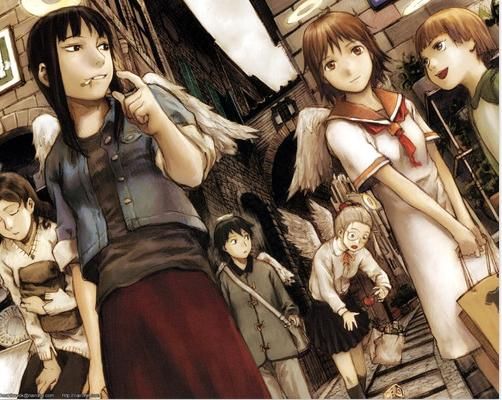
Sometimes, earnestness and elegance can make you take an absurd imagine completely seriously; ditto for the story that’s built around it. Haibane Renmei’s (High-bah-NAY Ren-MAY’s) main visual, that of otherwise ordinary people sporting halos and tiny angel wings, might look ridiculous by itself, but the thirteen-episode anime transforms it into something wondrous and moving.

The viewpoint character is Rakka, the newest Haibane, and through her viewers understand the rules of her world. Haibane are “born” from cocoons in the city of Glie, and named for the dream they had before “birth”; Rakka is named for a dream of falling. She is provided with a halo, wings break from her back, and she must find her place at the Haibane nest of “Old Home”, an abandoned school.

Haibane live a mostly idyllic existence, but must take jobs in the town, and must only use discarded goods, except for their food. A wall also surrounds the town of Glie, which must never be touched and can never be crossed, since no one in town has any flying machines, and the Haibane themselves cannot fly.

Each Haibane is aware that they had a past life in the world outside, but that they cannot remember who they were. They all await their “Day of Flight”, in which a Haibane disappears for parts unknown. Rakka must overcome her own shock at a friend’s “Day of Flight”, and find it in herself to help Reki, a troubled older Haibane who has never taken the Day.

Although it is only thirteen episodes long, Haibane Renmei proceeds at a slow, leisurely pace. Nothing is loud or bombastic, and many things go unexplained. When the emotions cut deep, they are still subdued. It’s a sweet and intriguing experience, and weirdly soothing.

The exact nature of the Haibane is never explained, save that it’s likely they are not explicitly
Christian creations, since anime tends to use Christian imagery for special flavour instead of religious expression. However, that doesn’t mean that the Haibane cannot be tied to more general notions of sin and release.

A common theory is that the Haibane represent suicides and/or premature death, since suicide is likely not applicable to the “Young Feathers”, the gaggle of tiny toddler Haibane that also live in Old Home. It is thought that their new names have something to do with how they died. The “Day of Flight” is read as their ascent to heaven, perhaps after overcoming the “sin” of dying before their time, and the rules that Haibane live under are “punishment”. Or it is a morally neutral condition, and is simply the restoration of the natural order.

The soft nature of the series might make it hard to notice, but Haibane Renmei teaches some harsh lessons about grieving. That no matter how sad you are, you must accept that people are gone. Both Rakka and Reki struggle with the notion of the Day of Flight, but must learn to accept that it has happened, and will keep happening..

These theories still leave unanswered questions (such as why Haibane age), but that is one of the popular theories. However, Haibane Renmei is one of those works that leaves a viewer content to accept that some things will remain mysteries.

Nothing of what has been said makes Haibane Renmei a bleak series, but simply gives it an extra distinction. Just because a series says some pragmatic things does not mean that it’s bleak.

Another interesting thing about Haibane Renmei is that nearly all of the characters are female, including all of the main characters. Each of them are distinct and memorable, with very different personalities.

Old Home only houses women women and small children, but the Haibane of Abandoned Factory are co-ed, which means it’s not one of those weird things where only women can be Haibane.

Nor is it one of those other weird things, where a primarily female cast are really a set of “types” for the male audience to choose from, something that has become popular in recent years. Rakka and her friends exist “for themselves” and not for emotional titillation. The distinction is difficult to define, and ultimately relies on intuiting it.

Haibane Renmei is a good series. It’s got an interesting premise, a soothing atmosphere, and quickly became one of my favourite anime. I’ve heard it’s recently been re-released, so go check it out.