Showing posts with label comics. Show all posts

Thursday, June 13, 2013

Some Words About Jim Woodring


I can’t remember when I first heard about Jim Woodring; it must have been on one of my many tries to Understand the History of All Mediums that Involve Writing. I always meant to read his comics, but because there’s so much out there, it takes something distinctive to remind you to read someone’s work.

In this case, it was hearing about the time Jim Woodring made a giant fountain pen and tried to use it. Good enough.

So far, what I’ve read of Jim Woodring are his Frank stories, but not even all of those. The Frank stories are a series of silent (mis)adventures with a small cast of creatures and some walk-ons, set in a place of minarets and rolling hills called the Unifactor. The usual protagonist is Frank, an old-school cartoon creature of deliberately undefined species. Often by his side is Pupshaw, a pyramidal ring-tailed creature who serves as Frank’s “dog” but is far more powerful than he, and who has a boyfriend of similar make named Pushpaw.

Manhog is a disturbing man-pig-thing who is hurt in gory and pathetic ways but also might be the victim of karma. Sometimes there is a devilish critter named Whim, and vajra-like creatures called Jivas come through the sky. There are others like Quacky, Faux Pa, Lucky, Real Pa, Cart Blanche, and the Jerry Chickens. Also, lots and lots of frogs and frog-like beings.

The Unifactor stories are soundless, told in pantomime, and are short and simple in the compilation book I have, called (yeah) “The Frank Book”, though longer stories exist in other graphic novels. There is no doubt a deeply personal unspoken language in these tales, but they can be enjoyed on a surface level. I know that I liked them very much, since I love surreal settings and weird creatures.

I just love the people who can think and write like this. When faced with a bizarre, dreamlike, or stream-of-conscious mode of storytelling, I nearly always believe that it was what the author naturally desired and sought. They weren’t trying to swindle anyone with fake “depth”, but simply told the story they wanted. Sometimes earnestness produces weirdness and not simplicity.

Of course, for Woodring it all hasn’t been wonderful. Profiles of him tell the story of a childhood plagued with hallucinations, sickness, and paranoia. It’d be dangerous to believe this is what made him the great artist that he is today.

But I look forward to reading more of his books.

I’ve posted it before, but the video above is a collection of excerpts from Visions of Frank, a 2007 DVD that contained animated Frank shorts by independent Japanese animators. The DVD itself seems to be vanished, which is a shame.

Saturday, May 25, 2013

Quick Thoughts on IDW’s Baxter Stockman Micro-Series (One-Shot)

I am so, so lazy. I told myself I’d get caught up on the IDW Teenage Mutant Ninja Turtles series before this thing came out, but I never got around to that. I still know some plot details of the IDW comic, and will, *will* get around to reading the whole thing eventually, but I went in anyway. Not completely cold, but I won’t pretend I’ve actually read the preceding comics.
It’s a good little story, telling a complete tale and setting up a future. It’s a  present-day tale of IDW Stockman being deceptive with his mad science run amok, interspersed with flashbacks of Stockman playing chess with his father at different times in his life. In the end Stockman seems to outwit Krang and gather important data in preparation for usurping his master, because Stockman wants control of the impending Technodrome. Not to rule the world, but to control and distribute the technology for his own purposes.
Well-played, Stockman.
There’s always a “but” and my problem is that, though the storytelling is competent and it whets the appetite for more, there’s something about the comic that feels cold and detached. I don’t know what it is, but it doesn’t make me want to run out and buy all the IDW comics yet. Something’s missing, and I don’t know what.
I used to think that Baxter Stockman was one of the recurring TMNT characters that wasn’t bound into a strict archetype--he started out as a simple (but likely tongue-in-cheek) portrayal of a mad scientist, but his animated versions pretty consistently embody failure beyond just “curses foiled again”, and an arrogance beyond typical villainy.
But IDW Baxter seems to embody that particular arrogance mentioned above, and he could be headed for failure, so perhaps Stockman’s other media portrayals have simply become the archetype, leaving the original Mirage incarnation to be more the exception than the rule..
Yet IDW Stockman is also distinct because his moments of fear and henchmanly submission are an apparent ruse, AND he has larger villainous ambitions that seem to have survived for a long time, instead of degenerating into simply surviving and getting revenge on things. I support this only as a means of making different versions of the character distinct; I don’t think Baxter Stockman “needs” to have more villainous oomph, because I don’t mind if he fails at supervillainy as long as he’s an entertaining character. But Stockman shouldn’t be the same every time, and for this I praise IDW.
I liked that his father isn’t simply the harsh dad cliche: he seemed strict and sometimes contradictory, but believed he was doing good. Though Baxter, being the lovable asshole that he is, repays in kind by booting Mr. Stockman out of his own company in the final flashback.
And yes, we get the “flyborg”, the experiment that Baxter uses to stage a rampage / diversion as part of his plan, with a potential army waiting in green tanks. I’m not saying I’m “too cool” for Easter Eggs, but something about this one made me cringe. I’m in favour of using transformation to represent Baxter Stockman’s failure, but I don’t think it *needs* to happen to him all the time. I didn’t even need a homage.
It’s also so obviously an Easter Egg it hurts. If you want to fuse an insect with a robot for offensive purposes, why choose a common housefly? Why not something stronger, more armoured?
Also, while I wouldn’t bet the whole farm on it, I assume this means that Baxter Stockman will remain human in the IDW-verse, which I’d prefer. I love Baxterfly and Baxterborg, but there’s a world of possibilities out there for the character, even if you want to keep him embodying failure and self-destruction. Baxter Stockman still isn’t as set in stone as some other TMNT characters, and writers should take advantage of that.
Besides not clamouring for Stockman to be transformed, I find it a little...silly to see the IDW comic continuously bringing elements exclusive to the old cartoon into a more serious universe. I giggle every time I see a picture of the gritty gun-toting Neutrinos, or that steampunk-ish homage to Krang’s android body. Believe me, I know concepts can be remade into anything, but I can’t help it. It’s a side effect of being tired of the TMNT fandom’s urge to deny or bypass the original cartoon’s wonderful / painful silliness. It just makes me think of dopey fanboys who are secretly insecure about the things they like, and want to prove these things are “gritty and adult”.
Mea culpa.
Also, I still love the main cover for this issue. The variant cover, with Baxter playing “chess” with figures of the characters, is pretty trite compared to the excellent play on M.C. Escher’s “Hand with Reflecting Sphere.”

Saturday, March 9, 2013

I Emerge with a Complaint

I haven't been blogging much because I've been caught up in writing and trying once again to bring my life back in order. I just don't have the mojo right now. But in the meantime, enjoy this:

When the now-defunct comic company Dreamwave adapted episodes of the 2003 Teenage Mutant Ninja Turtles series, they did so in an interesting way: they would tell side stories set during the early episodes, so that each of these episodes got extra details.

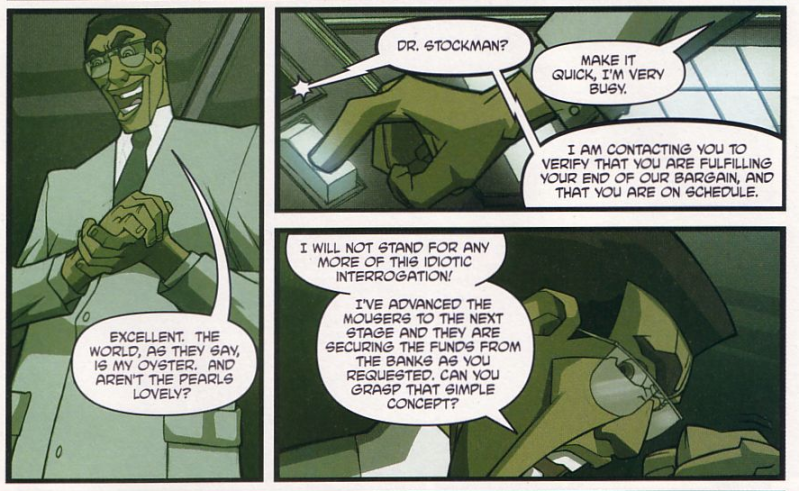
However, when it came to the third issue...guh. It opens with a monologue by Baxter Stockman that goes like this:

"THere's always a woman. Always, without exception, somewhere in the mix. That's who we do it for. Men are supposedly in charge. But if women ever realized how much they run things, we'd be dead. They chew away at us, night and day. They keep us off balance. And no matter how we insulate and protect ourselves..they still chew their way in. And they somehow know just how to get to you. How to tear into you, find that which is most valuable...and swallow it whole."

The monologue is juxtaposed over some Mousers chewing their way into a bank to rob it.

Stockman, what would your mother think?!

I know that plenty of real-life guys have this attitude, usually neckbeards with a persecution complex. It's the kind of thought that, sadly, not only a man could have, but it's complete bullshit either way. Anybody with half a working brain can look at history and see how wrong and insulting that view is.

To have it worm its way into a children's comic is just...disgusting. Worse when it's spoken by my favourite character in the series.

Now, I never shy away from Stockman's flaws, but this simply doesn't ring true. First because it comes from a series for chlidren that barely acknowledges sex, beyond "boys and girls like each other", so it seems out of place for something vomited up from the bowels of the Internet to show up in it.

Second, I think Stockman would view himself as above such "mortal" concerns. The guy's got one hell of an ego, and if Stockman hasn't actually gotten rid of any issues he had as a teenager, he sure would pretend to himself that he has. He'd block it out and pretend he was Mr. Perfect. He wouldn't still be chewing over his crappy high school life.

Which is what this comic issue amounts to, by the way. A flashback to Stockman's teen-hood where he was the usual picked-on nerd, and making devices to get even with the bullies and jocks. To add to the creep factor, li'l Stockman had a crush on a girl named April, who dated one of the boys who bullied him, and it's implied to be the reason he hired April O'Neil to work with him.

(And we're supposed to believe the Shredder recruited Stockman right out of high school?)

And this was written by Peter David, of all people...*the* Peter David. Everything else Stockman does and says is perfectly in-character, with the right amount of pomposity and cheese, so I don't know what went wrong there.

And the artwork is terrible. Seriously, look at this:


Stockman might be an awful person in many ways, but he's not creepy in that specific way. I'm just going to block this out, like the way I blocked out the fact that Transformers: Kiss Players takes place during my favourite era of G1.

Wednesday, January 16, 2013

Brief Thoughts on "Marceline and the Scream Queens"


It's also been hard for me to get back into single-issue comic collecting after so many years of concentrating on trades. To me it always makes more sense to wait for the issues to come out first, but at the same time, I know I'm missing out on a lot as it comes, while the nerd Joneses are always ahead.

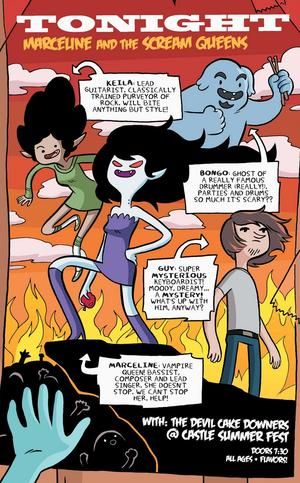
To change that, I decided to start small and pick up all six issues of Marceline and the Scream Queens, the Adventure Time
miniseries about Marceline the Vampire Queen and her rock band: vampire Keila, shapeshifter Guy, and ghost Bongo.  And Princess Bubblegum is along as manager while they go out on tour. There will be spoilers here, so tread slowly.

Once again, I have to admit I'm not as up to speed on Adventure Time
as I want to be, so take my impressions lightly if you like. Marceline and Princess Bubblegum (or "Peebles", or "P.B.", and other assorted nicknames), are two of my favourite characters on the show, so it was fun to read a story about them. Furthermore, I just enjoy reading stories about artists, since whatever they actually do, I can relate to a lot of their experiences.

Marceline and the Scream Queens naturally includes some of that, with Marceline's insecurity and rage over getting a bad review being a major plot thread. Her feelings are not overblown or overdone, and there are plenty of other things that happen along the way, so no one needs to worry about Marceline being too angsty—not that I ever would have.

Like everything Adventure Time this comic is fun to look at, with there being so many weird settings and creatures. Meredith Gran's pencils have an appealing childish scrawl, and each issue has a short backup strip illustrated by a different artist, and it's also fun to see their takes on the series's art style.

The previously-established characters act and sound in-character, though I was surprised at the presenting Marceline's father as a stereotypical "goofy dad", when he and Marceline have had such a strained relationship in the TV show.

Where it really does start to come unglued are the lines that seem a little too knowing, a little too adult, like the comic is trying to bring those subversive parts of the TV series closer to the surface to excite older fans.

Writing is a tricky business, but I'm usually not in favour of giving a fan-favourite aspect of a series more attention in order to delight the die-hard audience. Marceline and the Scream Queens just has these moments that make me laugh, but also squirm a little at how much they seem like playing to the older audience. Like this exchange from the final issue, in which we found out who wrote the review that upset Marceline so much:

Princess Bubblegum: Then why couldn't you write a positive review?

Lumpy Space Princess: Um..because that's not how you like something. You like something by telling everyone you hate
it.

It so obviously sounds like something for nerds, for we who have seen so many of our buddies hate what they claim to love, or vice versa, that it makes me roll my eyes a little. I mean, it's funny and on-the-nose, but it just doesn't quite fit with Adventure Time as we know it.

(As proof of my nerd bona fides, I'm the same person who wonders whether Marceline technically being Keila's sovereign has any effect on their relationship. I suck.)

You could say all of this is not as bad as Ice King writing "fanfiction" in the TV show and having it become an entire genderswapped universe, meaning that the TV series is really the leader in fan pandering. However, the famous genderswap universe worked as a neutral experiment, before that "in-story fanfiction" explanation was trotted out. Some of the stuff in this comic doesn't stand out well enough on its own.

(And now the genderswap universe is getting its own comic series, too. Huh.)

The other biggest example of fan pandering I can think of is the Earl of Lemongrab back-up strip, which is largely about the character screaming his catchphrase  "UNACCEPTABLE!" over and over again as he goes through his day and runs into various annoyances. Look, I've clapped like a trained seal at the recitation of nerdy catchphrases, too, but doesn't mean there can't be anything else. Lemongrab had a pretty interesting story they could've played around with.

Besides all that, I couldn't quite buy that Princess Bubblegum would cast aside her royal duties and put Finn and Jake in charge of the Candy Kingdom so that she could follow Marceline on her tour. I realize Marceline and P.B. have a complex, conflicted relationship, which I do enjoy, but I still tilted my head a little.

Since Peebles's decision kicks off the story, I'm not ready to dismiss it as fan pandering, but I can't accept it as something neutral, either. Marceline x Princess Bubblegum is a very popular fan pairing, and I can see why, but it's still not canon, so this comic can't help but feel like it's courting the internet. Nothing explicit happens between the two, but once you know the background it's impossible to not think Bubblegum was written into the story to excite shippers.

But all in all, this is a good comic. Fun characters, fun art, and I'd love to see a trade. Please?

Friday, November 30, 2012

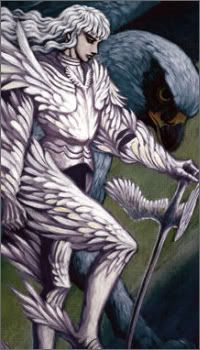
Guilty Pleasures: Griffith


Griffith from Berserk is a great villain. His razor-sharp intelligence, immense ambition, and alluring elegance all pull viewers in and make them want to root for him, to consider Griffith the kind of villain that both dreams and nightmares are made of. All the fanboys who can't take a male villain seriously just because he's pretty, step away. Y' got no power here.

I appreciate him for all that and more. I like the fact that Griffith makes the "beauty is only skin deep" thing work for a male character, which is harder to do these days. In modern times, beautiful men are already perceived as suspect and decadent more often than they are seen as virtuous, but Griffith sells the idea that this double standard doesn't exist. What he is turns out to be is a genuine shock to the characters, who believed in him.

So what's the problem with this amazing villain? The problem is that Griffith committed rape. There's no way around this: Griffith is Femto, and Femto is Griffith, with his rape of Casca and mutilation of Guts a reflection of Griffith's desires. Griffith needed to assert his dominance over Casca and Guts, "punish" them for being "above" him, because he felt he should be the one in charge, and others his servants.

Ultimately, that is what Griffith wants: for others to be below him, and to use them. He could have said no to the Sacrifice, and continued his suicide attempt. The fact that he said yes proves that despite Griffith's charisma, and despite his fear and pain, a demon is always what he was deep down, someone who viewed others as the means to an end.

As I've said before, you can try to boil it down to statistics, to say that Griffith should be condemned more for the loyal men he sentenced to be mutilated and devoured by demons, rather than his rape of a single woman, but this isn't rational. The smaller, personal microcosm of evil is the one that punches you in the gut.

I'm saying these things maybe as a way to come to terms with the fact that even after seeing all this, I still like Griffith as a character, enjoying him as a high-quality villain. Griffith might be the guiltiest of guilty pleasures, an interest that haunts me a little, which proves the power Berserk can have when it's operating at its peak. Berserk isn't so shocking that it's immune to critique, but I admire it for being able to create violent events that would be over-the-top in other hands, and making them powerful and poignant.

Wednesday, July 11, 2012

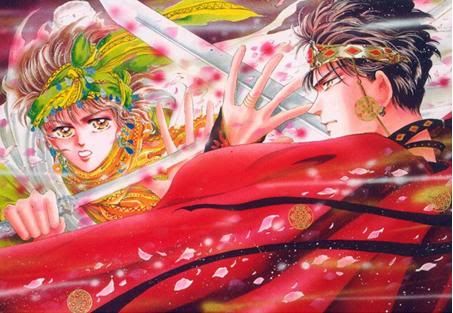
Yumi Tamura's Basara


If this manga could be described in one sentence, it would be "heroic fantasy as seen through a feminine lens". The structure of Basara is a familiar one: a hero rises from humble circumstances to change a world that is under the thrall of an evil king. Yet this version is also heavily inundated with romance (by both the classical and modern definition) and melodrama. Many tears are shed on all sides and by both genders, and the central conceit is that the heroine and hero are actually on opposite sides of a war…but they don't realize it when they fall in love.

Technically Basara is science fiction, as it takes place in a post-apocalyptic Japan that has become in large part a desert. But to the initial eye, these characters seem to come from the distant past, with robes and swords and ancient-looking villages. The exact nature of the disaster is never explained, with the present-day story being far more important.

Japan is under the rule of King Ukon, who has divided his territory among his chidren: the Black, White, Red, and Blue Kings. In a small desert village, a pair of boy and girl twins have been born, and one is prophesied to be the "child of destiny" that will save Japan. Everyone assumes it is the boy, Tatara, and he is celebrated while his sister Sarasa grows up in his shadow.

However, when a raid by the Red King's army leads to Tatara's death, Sarasa disguises herself as her brother, and sets out to gather allies, overthrow the dynasty, and bring peace to Japan. Sometimes she  goes to bathe undisguised at the nearest hot spring, and there she meets a handsome boy named Shuri. They fall in love, meeting at hotsprings and communicating long distance. However, neither realizes they are Tatara and the Red King, sworn enemies.

Basara  is an epic in the truest sense. Unlike some other long manga series, each volume, except for the last two, feels like a single novel split into multiple parts, with the story gathering momentum through each book, and the scope of the world gradually revealed. No space feels wasted, and more importantly, though it is wide in scope with a large cast, Basara remains focused on the emotion and characterization, which makes the larger plot compelling.

Also like most good stories, Basara does not proceed in a straight line to the ending its characters anticipate. Shuri and Sarasa discover the truth in the middle of the story, and King Ukon is not what they would expect when the audience finally meets him.

The girl-disguised-as-a-boy is a classic trope, and thankfully Basara doesn't keep it a secret from her allies until the very end. Sarasa is a compelling heroine, one of those who is obviously destined to win, but shows enough weakness and indecision that they are "human" while still obviously a hero. Sometimes the emotions involved may seem a bit over the top, but that is the nature of this genre of manga. Shuri is also a worthy match, fierce in battle but easygoing out of it, and able to question himself and his role. Both of their characters change and develop over time, and other cast members also change.

And, if you're searching for progressive ideals in fiction, one could do much worse than Basara. It's the sort of story where some concession is made towards a realistic depiction of the status of women in a "medieval" country, but female characters are given plenty of opportunities to shine in both feminine and masculine roles. The story also doesn't suggest that Sarasa secretly pines to return to her "proper" role as a girl. Any moments where she wishes to "just be a girl" are attributed to normal stress, and are about her young age more than her gender.

The art is shojo art, consistent with its manga genre. The young adult characters are often lean and androgynous, with similar bodies once the hair, skin tone, and clothing are taken out of account. However, Tamura can also draw characters of other body types and ages. "Cute" characters such as babies and Sarasa's pet owlet Shinbashi are drawn in a cartoony, scribbled style, which creates an inconsistency. Backgrounds are often amorphous and can make it difficult to see what is going on in the worst cases. However, the costume designs are great, and the art isn't actually bad, it's just a style that may be difficult to get used to, since by 2012, it might be considered "old-school".

The actual story ends at volume 25, while the material continues to volume 27. These last two volumes are a disappointment: Tamura's short comic strips about her characters are fun, but the rest of it, the series of short stories, add things we don't need to see or don't want to see. There are revelations and sequel content that are too cheesy, or too unnecessarily bleak. They can't bring down the rest of the series, but they are disappointing volumes.

Basara is neither a story about the large conflict or the small conflict. Both blend together, both are important, and this gives the series a richer feel than it otherwise would have. It is a crying shame that this series is currently out of print, with volumes 18-20 suffering from enormous price inflations on the secondary market.

Thursday, July 5, 2012

Diagnosing Loki Fangirls

Well, I've been away from blogging for a while, and there's no excuse but that I somehow lost the mojo, which is easy to do since this is a hobby and not the job I intend to have. It's why I can be so lazy to begin with. So, let's get to it.

I saw Thor a while ago, and it was a fun movie--to me, it read like a better version of The Lion King, with a more compelling arc for the lead, a consistently threatening villain, and a more palatable take on all that fantasy racism. I also saw The Avengers before that, feeling I knew enough of the continuity to get by, and I was right. Both films have the kind of spirit I hope my work to have someday: ultimately gimmicky fun, yet also capable of some heartfelt emotion and never losing a sense of humour.

Something I want to talk about, though, is how many fangirls Loki has, and the fan boy "theorizing" as to why it happened.

I want, and try, to make room in my worldview for multiple interpretations of fictional characters, but at a certain point the notion that a character who commits evil deeds isn't a villain becomes something I can't get on board with. Regardless of the reasons these characters have for turning to evil, no amount of sympathetic backstory or understandable motivation can wipe their records clean. Writers should still try to give their villains these two things in order to create a richer world, but usually the roles of hero and villain are usually still clear enough.

The weird thing is not that female viewers have a crush on Loki, but that some of them insist he's not a villain. All of this has been attributed to some kind of hardwired female masochism. Women are inclined to throw themselves at dangerous guys in reality or fiction, trying to change them, trying to interpret them as Not Such a Bad Guy. This is the nasty gender stereotype explanation most often floated for villain fangirls, and it's not supposed to end with fiction.

It suggests women suffer from a fundamental lack of perception as to what a character is "really" like, i.e. a bad person, and that they always desire to "change" a man, an enterprise that would be useless and ultimately hurtful were the character real, but dammit, those silly little women would just keep trying. It's all implied to mirror a drama carried out in real life, a dramatic role that has nothing to do with societal expectations of women, but just the way women are. Women like to hurt themselves by being attached to assholes, whether in reality and fiction.

It's pretty disgusting to see over and over again, and because of this it's tempting to view the stereotypical "villain fangirl" as a straw(wo)man, designed to prop up these myths of female masochism. Yet evidence for this type of nerd exists all around us, so to a point it's real, but the explanations may not be.

Saturday, January 7, 2012

Not Featuring Harlock: Simon Furman's "Space Pirates" and Post-Movie Transformers


The breadth of my interest in a fandom's material tends to decrease the longer I am in it: I go from devouring everything in sight to becoming entirely too choosy. Recently, I've come to very mildly regret almost entirely losing interest in the old Marvel Transformers comics. This, also spurred by receiving The Transformers Vault for Christmas, lead me to buy one of the many reprinted collections with my Christmas money, to see if they still held up.

I picked something from the Marvel UK run, which ran concurrently with the US Marvel comic but had many more issues as filler in between their stories, allowing for a more epic scope. Out of these, I chose the IDW Space Pirates book because it covers familiar territory.

My favourite G1 Transformers have almost entirely been (with the exception of Marvel Shockwave) the ones introduced in the animated Transformers movie. The third season of the cartoon did me a huge favour by making these characters the main cast for its period, but the Marvel Comics almost entirely avoided these characters in their main storyline. There was no overhaul like the cartoon series, in which one cast virtually replaced another. Rather, the comics just added more and more to the cast, with a chance of characters from any era putting in an appearance.  It might be due to more care in the writing, making the story progression more organic.

In the US, those TF:TM characters they did introduce were tertiary until Galvatron appeared late in the run as a major villain. The UK comics, however, had an alternate future universe that seemed heavily based off of the cartoon's season three. This universe frequently crossed over with the main continuity, but was rarely the subject of its own tales, and thus was secondary. At the same time, certain TF:TM characters did exist in the main continuity and showed up frequently, albeit in far different contexts.

At the time, I was hungry for anything featuring the TF:TM characters, and the Marvel UK material was a great way to get my fix. This was before reprinted collections, and I read these comics in small, almost illegible .jpgs off now-defunct websites. I enjoyed them very much, but at some point, I began to drift away from the comics, so that when the paperback collections were released by various publishers, I never picked them up.

I regret that a bit now, since I enjoyed reading Space Pirates, as well as the additional stories that were included in the volume to create some sense of sequence in IDW’s cherry-picked collections of UK series. . If I had more money I would gladly buy the rest of the UK collections, even those without my favourite characters in them. However, despite this enjoyment, Space Pirates and the other stories lack the emotional connection that would make me love these comics as much as G1 season three, even when the comics are better-written

The main problem is that while the plots are far and above the cartoon, Simon Furman's writing lacks a heart, of sorts. I can see some defining character traits, but a lot of the time, the Transformers seem terribly generic except for a few standouts. Their voices start to blend together, which is probably inevitable with such a large cast, but it does dampen the appeal. There's also large amounts of third-person dialogue and clunky exposition, making the comics seem less like a work that could stand on its own to non-Transformers fans who are less inclined to put up with the cheesiness.

Sometimes the characterization is disagreeable rather than dull. Cyclonus, appearing in one of the other stories in this volume, is the worst offender. He's a total moron, probably the most stupid character in the book. It's not just difference from the cartoon that's the problem—he'd read as insufferably dumb to a non-fan, too. One of the worst parts is when he lets slip a secret in a fit of anger, just a few panels after he was told not to.

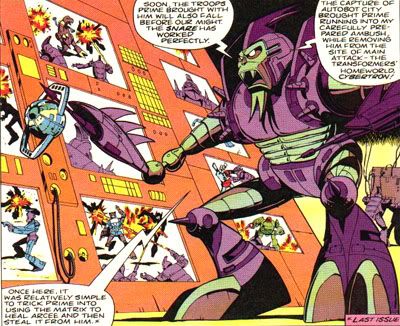
Arcee in Space Pirates is a close runner-up, and since she's the only female Transformer in the cast, it makes Furman suspect in other ways. She deserts her post to go on a joyride, allowing the Quintessons to take over Autobot City, never gets a chance to fight as she is shot, used as bait, then limps around after Hot Rod while he does the important stuff. I never was all that fond of Arcee, and she could be as bad as this in the cartoon, but the comics is supposed to be better-written.

(Of course, what could you expect from the same writer who's taken multiple swipes at the concept of female Transformers and viewers who want to see them? Look at Prime's Rib and Spotlight: Arcee for examples)

I loved Shockwave in other Marvel comics, but here his "logical" personality is replaced by a more generic leadership. One could replace him with Megatron or several other of the comics' many Decepticon leaders, and little would change. Soundwave also talks like a normal character instead of his famous terse monotone, but doesn't get any new personality in return, except for a brief moment where he almost wants to reconcile with the Autobots after they team up against the Quintessons. Was anything ever really done with that? Springer, who is only seen in the main universe, is a generic hardass warrior without his quips or swagger. Scourge is presented as a more generic warrior-leader, obviously the brains of the outfit when Cyclonus is around, and he's kind of boring, too. It's not simply that they are different, but that the differing characterizations aren't that interesting.

When they appear, Cyclonus and Scourge are also working against Galvatron, to the point of wanting to kill him. I realize that Simon Furman is not obligated to stick to the cartoon's portrayal of the characters as Galvatron's loyal soldiers, but I do a mental pearl-clutch nonetheless. Scourge in the cartoon was a traitor once, so I could picture him doing something like this...but even so, it's not my thing.

This is a "Best of" series, so smaller, incidental stories are skipped over, though advertisements for these stories remain. Ideally a series of graphic novels collecting the entire UK run would be preferable, not just the "big" stories, though several complications make that difficult.

I've spent so much time ragging on the Space Pirates graphic novel, what's good about it? Well, all the things I complained of didn't entirely spoil the proceedings. I was still enjoying a comic that read like it could be a multi-part episode of the cartoon's third season, even hearing some of the character's lines in their cartoon voices (even if a few lines didn't sound like something they would say). Essentially, the Quintesson homeworld is in danger of being destroyed, and one of the planets they "scout" for re-colonization is Cybertron. Lead by General Ghyrick (one of those lobster-hands "executioner" type Quintessons), they attack Autobot City and Cybertron itself, hoping to overpower the Transformers and take  Cybertron.

The time rift that almost destroys the Quintesson planet is tied to the larger storyline, but it could easily have been replaced with another plot device. The continuity is obviously different, above all the fact that the planet suffered an entirely different fate in the TV series, but the connections are undeniable.

There is still something to be said for the plot being better than anything the cartoon produced at the time, and it still has some nods to individual characterization, such as Hot Rod's brief moment of self-doubt when he's about to die, or his hot-headedness as Rodimus Prime.

The additional stories I've spoken of, the ones leading into the next volume, are also entertaining, and would never pass for an episode of the cartoon for various reasons. It is nice to get some of the TF:TM Decepticons in this volume, too, though in a different story than the TF:TM Autobots.

I am judging too much based on the cartoon, and the comic is arguably better, but the cartoon is what's been rolling around inside my head for far longer, and I consider its portrayals to be the definitive versions of Rodimus Prime, Galvatron, et. al. This comic may be better-written, but it does not draw me in emotionally as the cartoon did.

As for the artwork, I mostly like it. I enjoy Dan Reed's unconventional Transformers art, and so on. My only complaint is the simplified new colour schemes for some characters: Particularly bad are Hot Rod coloured almost entirely in magenta and silver, and the bipedal types of Quintesson which are a uniform purple and green.

In short, the comics are long on plot, short on character. I can't let go of my attachment to the cartoon, but beyond that there are still things to pick apart. The Transformers comics have a cast of dozens, but as all the memories come flooding back, I can remember few characters that stand out or that I emotionally connected with. At the same time, the stories are gripping, and not completely devoid of emotional investment. I wouldn't be averse to acquiring more copies of the UK comics, though I would start with the ones starring the "future" characters and whatever the mainline Ultra Magnus gets up to.


Saturday, February 19, 2011

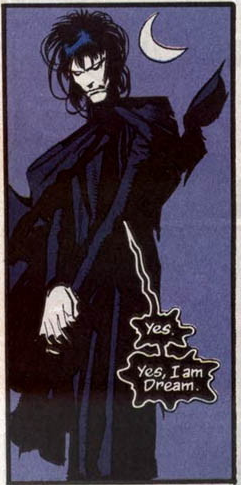
The Peculiar Olympians: Dream


“The Peculiar Olympians” is a series of blog posts about my most favourite fictional characters. They are each here for some combination of sympathy, empathy, inspiration, humour, quality, staying power, and/or significance to my relationship with fandom. These are not all the characters that I like, but they are the ones that have stood out to me the most. The list is also alphabetical and nothing more.

In some cases, I pick a character for this list even when I find their series mediocre. In other cases, the choice is as much about the series as the character. Such is the case with the title character of Neil Gaiman’s. The Sandman. The Sandman is my favourite comic series (including manga, webcomics, and newspaper strips), because it resonates with me deeply as a writer and a storyteller. It is also what reminded me that western comics could be as great as manga.

Referred to as “conceptual entities” and “manifestations of primal truth”, the Endless are seven sibling beings who stand for various aspects of the living condition. Though technically not gods, they are sometimes worshipped as such, and may interact with mortals as well as with various supernatural entities.

Dream is the third oldest and part of the "Elder Three", with his older siblings being Destiny and Death, and his younger Destruction, Desire, Despair, and Delirium, all of whom are known by other names depending on the language or culture they are interacting with. Also called Morpheus, Onieros, Kai'ckul, Lord Shaper, and Prince of Stories, he stands for dreams, nightmares, the imagination, and the act of artistic creation. His realm is The Dreaming, an intricate and dangerous world populated by fanciful beings and presided over by Dream's castle.

Though he can appear as virtually anything, the aspect of Dream seen most often in the series is a tall, gaunt man with chalk-white skin, a wild mane of black hair, and abstract black holes  for eyes (in which colour may flicker), who favours dark clothing of whatever era. This Dream initially appears as proud, stoic, and ruthless, though also devoted and thorough in his duties. He comes to learn more “humanity” slowly, even as he denies this change.

Dream might be less popular than his sister, Death, and not play a major role in every issue, but his is a felt presence, and without him I wouldn’t love the series as much. He is fascinating: what drove this callous but stoic character to orchestrate an elaborate suicide, if that was indeed what happened? Is it true that supernatural beings, unlike men, cannot change, and so must be made into new stories instead?

Naturally I mean the character of the “black” Dream. The “white” Dream, Daniel, is a character that I still like, but he is seen so briefly and more exists to prove a point (perhaps answering the questions I asked above), than to be a character in his own right.

On a final quirky note, since Dream's realm is populated by creatures from myth and legend, it might be fair to infer that Dream rules over fictional characters as well, making him king and father of all the characters on this list. Furthermore, as a symbol of storytellers, of course I feel some natural affinity towards the character. I want to be a writer, and even if I’m not one yet, I’m engaged with writing and literature.

Friday, January 21, 2011

About Two Girls -- A Year-Old Review of "Strangers in Paradise"


Originally posted January 15, 2010. I've since bought the entire Pocketbook collection.

Here's another "backburner" work that I'd been carrying around a desire for over the course of several years, but just now got the chance to explore: Terry Moore's Strangers in Paradise. I took the first pocketbook out from the public library, and downloaded scans of all the rest...but I do plan to buy all the pocketbooks, and hence the complete series, now that I've finished reading it.

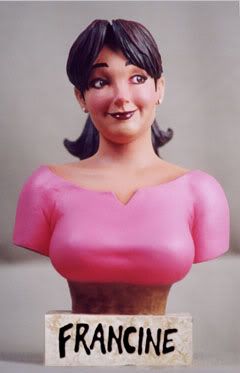
Strangers in Paradise is about the love between Katina "Katchoo" Choovanski and her best friend Francine Peters, a love that takes them several years and several false starts to realize, especially with Katchoo's shadowy past showing up to ruin things at the worst possible times. Part soap opera, part crime thriller, SiP spans over a hundred issues and is by turn humorous and heartbreaking.

Now, you know this blog is about exploding mechanical dragons and shit, but I really don't have a prejudice against works without fantastic elements. It's just that I started out liking genre material, and in the circles I travel in and the sites I visit, it's SF and fantasy which gets the most exposure. So I ventured into Strangers in Paradise without the sense that I was doing something unusual or personally transgressive.

And I really, really enjoyed this comic. There were a lot of tropes and ideas which usually annoy me or at least bring out my inner cynic, but somehow Moore usually manages to pull things off, though sometimes only by the skin of his teeth.

Normally I have difficulty reading stories where romance is the central element. A lot of the time, I end up frustrated, flabbergasted, and finicky about the characters' interactions and decisions, there seeming to need to be extra stupidity needed to move the plot along or create obstacles in a love story than in any other...or worse, no reason why the characters should like each other.

Somehow, though, I found the long build-up and frequent detours in Francie and Katchoo's relationship to be a pretty fun and interesting read, though with a few eye-rolling parts. It helps that there is the rough transition from being best friends to admitted lovers, their contrasting personalities and backgrounds, and the stigma against lesbiansim, makes for a set of pretty believable reasons why they two of them would have so much trouble getting together, even with their behaviour towards each other sometimes seeming outrageously flirtatious right from the get-go--though on the other hand, North American women can apparently get away with a lot more and remain "just friends" than guys can.

Katchoo in particular I was surprised that Moore pulled off so well, given how hard a character she'd be to write: glamourize her toughness and explosive anger as a "bad girl" thing and her painful backstory seems suddenly flimsy; overemphasize her pain and she'd seem too much like a woman in need of "rescuing", but mostly Moore gets the balance right.

Francine is a really fun character, too, although I curse her more than a little bit for being Genre Blind (dammit, TVTropes....) enough to realize that marrying a doctor would lead to many lonely nights, and having Brad Silver cheat on her was a little too easy of a way to remove him from the picture.

The times Moore seems to hint that Katchoo may be right about men, save for the sense that David is "one of the good ones" is unsettling, and it's a sense that, if I recall correctly, has lead to some accusing David of being Moore's self-insert character. David is fleshed-out enough that if he's a self-insert, he's the rare "good one" (again), and there are several other "good" male characters in the books.

A parallel plot (that I thougth was a dream sequence before it went on longer) in which an older Francine is depicted regretting leaving Katchoo behind for a "normal" life but eventually-ish fixes that, felt a little cheap to start with, since I usually don't like time-skips which spoil an ending (though they can also create suspense in and of themselves). But then, these fast-forward tales were contradicted by the actual storyline and the comics' proper ending, leaving me wondering what the point of was. Did Moore change his mind about the ending halfway through? Or was it a deliberate misdirection?

Blending the aspects of crime thriller and sometimes downright cartoony slice-of-life drama isn't done seamelessly, yet the thriller elements, as ill-fitting as they somtiems be, are so important to Strangers in Paradise that I almost can't imagine the series without them.

Darcy Parker may be a nasty villain, but she's also horribly cheesy at times. Having an incestuous attachment to David was pretty much the epitome of gratuitous over-the-topness.

That little fat guy with the curly hair and glasses who keeps showing up is a pretty irritatingly transparent shot at the "other" comics readers. We've all known people like that, but to have basically the same joke told over and over again, just with him in different jobs, gets tiring fast.

Likewise, the "SiP draws REAL women" back-patting is something I could do without. The art in SiP is fantastic, and I truly wish more female characters in comics were drawn (in all the ways that means) like Moore's cast, but you've got to let some of this stuff speak for itself, you know?

And as I said, the art is fantastic. Moore is great with facial expressions, both the realistic and the cartoony variety, and just draws everything well in a realistic but distinct style. This makes the comic's brief ventures into prose and script all the more annoying, though, and I wish he would have avoided that. I don't mind experimental layouts, but switching to prose in comics has always bothered me.

The only real problem I had with his art was that even with all the attention to detail, sometimes it was hard to tell certain characters apart before they spoke speaking. It often turns out that those characters are related by blood, but not always. I know I still mistook Casey for Katchoo, or vice versa, a whole bunch of times.

In short, love the comic, love the plot, and I'm getting the whole collection.

Monday, November 22, 2010

Teh Scott


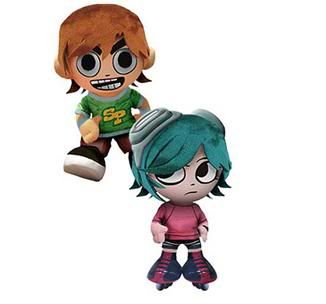
Picture from Entertainment Earth

I finally finished reading the Scott Pilgrim series. It was pretty damn entertaining and addictive, though after the dust clears, it’s hard to find much to say about it except that it was fun to read.

You know the story: 23-year-old and nerdy Scott Pilgrim is slacking his way through life in Toronto, in a band, when he meets and falls for roller-skating, goggle-wearing “subspace delivery girl” Ramona Flowers. However, to have a clear field to date her, Scott must battle and defeat each member of Ramona’s League of Evil Exes, seven ex-boyfriends (well, one is a girl) who have joined together.

Scott bumbles his way into it, getting the job done in a world of magical realism, fourth-wall breaking, pop-up captions, and video game imagery. All this, and trying to deal with his own screwed-up past and present, and the people who live in it.

The “slacker guy gets the love of awesome girl just because” plot is pretty low on my totem pole of story ideas that I despite on sight, but it was still only seeing the opinions of trusted others which convinced me that Scott Pilgrim would be one of those series that transcended the icky nature of its premise.

It pretty much does—Scott isn’t particularly lionized, there is a reason why Ramona can’t defeat her Evil Exes by herself, and basically you forget about the cliché and just work with the characters. What is left is a very funny representation of slacker twentysomethings, the pitfalls of love, and “references to stuff the author obviously likes” that aren’t too grating.

I’m not a gamer, but I understood enough of the video game references to get by (so I hoped), accepted the odd nature of the comic’s world, and was at a lot of points on the edge of my seat. The over-the-top self-referential dialogue so liked by people my age is also out in full force, but that’s a good thing.

The series also gets points for allowing the world to see that explicitly Canadian works can be hilarious and eccentric too, and giving Canada some representation among the nerdy demographic, and not as the usual punching bag. (which I know is tongue-in-cheek, but come on, you guys!)

The books had some manga influence, but not in the aggravating, copycat way that you get when artists are trying only to copy some imagined “genre style”. Rather, the manga influence seems to be just an influence of many on the comic, whose art really looks more like American thick-line animation than anything else. However, while O’Malley tries to give distinctive features to his heavily stylized character designs, sometimes it is still hard to tell characters apart.

I’ll be sure to watch the movie version in the near future.