Showing posts with label transformers. Show all posts

Saturday, April 20, 2013

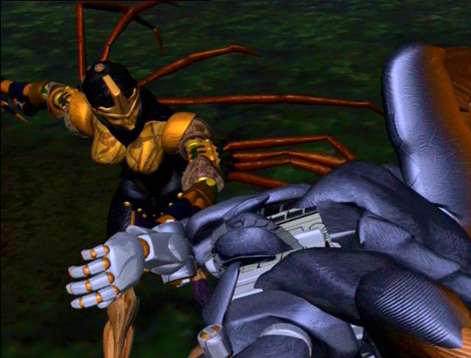
Silverbolt and Blackarachnia: Over a Decade Later


I've been rewatching the second and third seasons of Beast Wars lately: not that season one is bad, but this is just how things have worked out. The series is at the point where I can view most of it was a gauzy, comfortable nostalgia. It never reached its full potential, but it was still a show that I'll enjoy for many more years.

Except...

Except I still have a...a thing against Silverbolt and Blackarachnia's relationship. It took me a while to define what that thing was, and then to understand why the writers didn't have the same problem. My feelings on the subject haven't changed, so I feel like talking about it today.

To start, the issue is not that these are Transformers with genders, having a romantic relationship. Transformers are already so heavily anthropomorphized that to complain about the presence of female Transformers, and of romance, is ridiculous. Everything is done in the service of making these characters more relatable, no matter how little sense it might make, and female Transformers make no less sense than noses or bipedalism

No, I actually like the idea that Beast Wars has a primary romance and that it causes character development. Both of these things are, on their own, net gains, and the writers do produce some heartfelt, moving moments. The major problem is that Silverbolt and Blackarachnia's relationship depends on the sudden casting of a female villain as a victim, and as someone who doesn't know her own mind until a man tells her different.

I still cringe watching episodes from "Bad Spark" onward, where Blackarachnia tries to insist she is really a Predacon despite Silverbolt constantly badgering her to admit she is a Maximal inside, due to actions he interprets as showing an inner goodness. Blackarachnia eventually becomes a full Maximal in mind and allegiance despite her initial resistance, and such a set-up is pretty painful to watch, especially when at the end, she's literally given no choice.

The third season episodes "Proving Grounds" and "Crossing the Rubicon" are together the most significant of all these episodes. "Proving Grounds" is an interesting character piece, in which Blackarachnia storms off because she believes the Maximals are going to force a restoration of her Maximal programming, but in the end is told she was allowed to remain a Predacon if she wishes, a state which Blackarachnia has asserted as part of her personal identity.

And then, in the next episode, "Crossing the Rubicon", the experiment that Blackarachnia has been building up towards backfires and she is in danger of dying. The only course of action is to remove the Predacon shell program, transforming her into a Maximal.

Naturally, the disconnect between the themes of these two episodes goes unmentioned, and by creating essentially a life-or-death situation in "Crossing the Rubicon", the writers erase all potential objections. They create a practical as well as moral need for Blackarachnia to become a full Maximal, and Blackarachnia's only objection is a small, slight expression of insecurity, because she is not one to risk her life for pride, and has accepted her fate.

Still, it tastes bad.

It tastes bad because the entire arc suggests that however passionate Blackarachnia was about retaining her identity, she was absolutely wrong, and Silverbolt was absolutely right. "Proving Grounds" makes it all worse, because everything in that episode suggests Blackarachnia will be allowed to retain her Predacon identity if she wishes, and that this kind of self-determination is a positive thing to promote.

But because of what happens afterwards, the series poured all that emotion into a character's choice and just took it away, or maybe it intended the character to have been wrong about her most treasured belief, all of it undermining the notion of Blackarachnia as an independent character.

I think the reasoning is that since Beast Wars is a series of simple and clear morality, there is no room for a reprogrammed Maximal who considers being a Predacon to be important to her identity. Despite the qualities it's lauded for, Beast Wars is still a series of absolute good versus absolute evil.

In this view, it's okay for Silverbolt to pressure Blackarachnia to admit his truth, because he is trying to push her to the side that is absolutely Right. It is for Blackarachnia's own good, even if she simply doesn't know it. It is all done with the best and most loving intentions.

But Beast Wars is a work of fiction, and in-story justification can't erase the implications of a piece. Even if the morality of the series is rock-hard, it still looks like a character having their identity flipped around and denied by another one, who is also supposed to be their love interest.

And yes, it is worse because Blackarachnia is a female character, when women in fiction are often denied their choices to reach a "happier" outcome. There are all sorts of Unfortunate Implications involved, and they don't need to be spelled out.

This pairing / story arc also depends on suddenly recasting Blackarachnia as a victim. Doing this to the only female villain has similar sexist implications, but it also requires a sudden radical shift in viewer's perceptions.

Until "Bad Spark", we had oodles of episodes that treated Blackarachnia as a villain like any other, not to be spared by the narrative. Perhaps it would have been too depressing to "out" her as a former Maximal, but this also meant that these new truths about the character just...appeared. We now had to accept Blackarachnia as a victim, when we had been reading her as a villain.

To "ease" viewers in, perhaps, by the second season Tarantulas and Blackarachnia are no longer seen as mutually manipulating and trying to destroy each other. Instead, Tarantulas is frequently seen as victimizing Blackarachnia, with her only struggling to keep ahead instead of giving as good as she gets.

But it doesn't work. The same Blackarachnia we are now meant to see as being abused by Tarantulas was the one we spent the first season perceiving as a villain that was evil with impunity. Of course characters have multiple aspects, but these aspects are gradually revealed, building up on what we already know. But for so long, we've only seen Blackarachnia as that one thing, and it's very hard to suspend disbelief.

On Silverbolt's side, several things. The first is that he severely compromises Maximal security in order to get near Blackarachnia via gifts, for the purpose of trying to convince her of her inner goodness. Despite the potential for disaster, Silverbolt suffer for it, except for one briefing with Optimus (a great scene, of course, but it has few repercussions). He turns out to be right about Blackarachnia, and she doesn't put this technology to disastrous use as she initially intended, so all his actions somehow become justifiable.

Furthermore, the narrative that you can change a person by love is seen as so damaging to women that it's ridiculous to see it slip by in a situation where the genders are reversed. The way that Silverbolt tries to justify Blackarachnia shooting him in aggravation is, while funny, a little on the disturbing side, especially when he's proven correct, in a sense. She really was trying to get rid of him without killing him.

Secondly, Silverbolt does not have to change, nor is he pressured to question himself and his identity. He does not even have to question his views of Maximals and Predacons, for the Predacon he loves ends up becoming a Maximal as he wanted, rather than their learning to suss out their differences.

Stories where a character gets everything they want and reaps no consequences for their actions are boring, ugly things, and Silverbolt should at least have had to sacrifice something if Blackarachnia had to. It could be argued that only Blackarachnia was in need of changing, but it still would be possible to do something to make it less one-sided.

I know I don't "get" the absolute morality of Beast Wars, but if you ignore the bedrock assertion that all Predacons are Evil (Dinobot discovered his inner Maximal, remember?), there's no reason given as to why Blackarachnia needs to become a Maximal in form as well as allegiance. If she remained a Predacon but totally opened to her feelings for Silverbolt, at least he would have had to sacrifice a bit of his sanctimony.

Yes, the series shows that after her transformation, Blackarachnia is far more lighthearted and more open about loving Silverbolt. But there was no reason why it had to be written that way. Some kind of emotional compromise would have made the story less-one sided, and the ending wouldn't have been so predictable and unsettling.

All these issues could be wiped away if it's assumed that because Blackarachnia was "meant" to be a Maximal and was only transformed by Predacons, she must be returned to a Maximal state at all costs, with her personal identification as a Predacon being a delusion.

But she was brought online as a Predacon, and one's existing sense of personal identity trumps what they might potentially have been. Blackarachnia's own words about identifying as a Predacon are enough to justify the retention of the identity. What a character actually feels and believes trumps any "what-ifs", and should also trump a narrative of black-and-white morality.

So, while I enjoy romance and character development, the transformation of Blackarachnia was handled too poorly, required too much suspension of disbelief and too much glossing over of her personal convictions. It's the story of a character who didn't know her mind about anything, and another character who had to sacrifice nothing to get what he wanted.

Friday, August 31, 2012

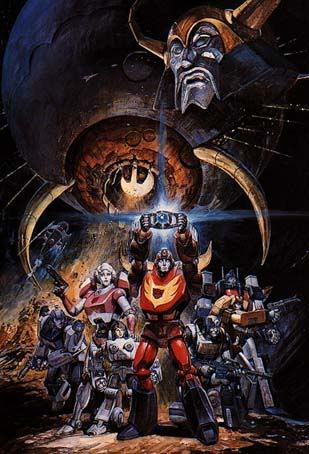
Guilty Pleasures: Season 3 of the Original Transformers Cartoon and the Animated Movie


I have to make clear that I don't specify "season 3" because the early Transformers cartoon was a good show that declined in quality after Optimus died. No, it's just that season 3 is the only season of the original Transformers cartoon that I give a damn about, and how. The original Transformers cartoon never changes in quality, but I prefer the characters and settings of the third season, which were part of my first fandom. Because of that, no matter how much my taste in media gets refined, I can still watch these cartoons.

The Transformers: the Movie was the first G1 thing that I ever watched. I picked it up in 1998, wanting to have context for the references in Beast Wars. I loved it at the time, and still do. The film is noisy, incoherent, and half-baked. Its foreshadowing is laughable, the cast shift is jarring, and it is unconvincing that suddenly now characters would die from blows they walked away from in the TV show, especially with such a weak sense of escalation, but it's so much fun.

I don't give a shit about the older characters, and this movie just looks so good being itself, with lots of shiny, colourful robots having adventures in excitingly weird alien environments, to the tune of earwormy hair-metal and synth. TF:TM just has this borderline hypnotic effect on  me, and I can just sit and watch it, eyes glazed, up until the very end of the credits.

Season 3 had more of the same, but it was different. Although the art as less shiny, it was much more interesting, character-wise. Getting a season to themselves, the "new" Transformers were pretty awesome. Rodimus Prime, with his sarcastic insecurity, was my top favourite, but I liked most of the main cast, except for kid sidekicks Wheelie and Daniel. To this day, I prefer these renderings of the characters over any other interpretations, even if the re-imaginings may be technically better-written, or appeal to a broader audience.

The only other popular 1980s cartoon I enjoy is The Real Ghostbusters (though Inhumanoids had some cool parts), but I don't look down on fans of He-Man, ThunderCats, etc, because it's pretty much the same thing I'm doing here--a series just gets you in a certain way and you can't let go of it.

That doesn't make the G1 Transformers cartoon good, however. I can watch season 3 through a gauze of nerdy nostalgia, but once I get out of that comfort zone, the cartoon becomes just painful to watch. There's bad voice acting, bad animation, nonsensical plots, and poor world-building. It's a dumb show, designed to sell toys.

But there's just a tiny, flickering spark of warmth to the series that lets me understand why I still enjoy it. There are character moments that seem genuinely heartfelt and "real", mostly Rodimus' difficulties, and the way Cyclonus acts in "Webworld" (still the best episode). The settings are wonderfully weird, too, with the alien and robot designs being equally interesting. I wouldn't change a thing about it, including the callous bumping off of the old cast, but it's not something I'd loudly identify with, or recommend to another adult.

Sunday, March 11, 2012

Who Else But You?: The 2012 Transformers Hall of Fame


Well, damn. It looks like the Transformers Hall of Fame has put both of my all-time favourite Transformers on their nominee list: BW Megatron and (technically) Rodimus Prime. Both are on my list of top fictional characters, both are important to my fandom nostalgia. When it comes right down to it, could I really decide?

Eh, actually, if you like over-thinking this sort of thing (and you know I do) the choice is easy. BW Megatron is far more the type that deserves to be in any kind of "Hall of Fame", and for many reasons. He's not only popular, but seems to have had an impact on the franchise, as it has since produced more sophisticated bad-guy leaders that could, in theory, have been cast in his mould.  Rodimus Prime, in contrast, is virtually forgotten, as there is a Hot Rod role, but no place for a leader who isn't Optimus Prime, and no real change to Transformers archetypes that could potentially have stemmed from him.

Secondly, Beast Wars Megatron was a better-written character than Rodimus in any form. While Rodimus Prime was likeable, and he was a great idea for a character, he never really had any consistent character arc. He had his issues with insecurity wrapped up in one episode, only for them to reappear again and be wrapped up again, while other episodes he was totally in control. He didn't go through a period of insecurity and then get over it as part of the plot, it just appeared and reappeared without warning. It's not the fault of the character, but rather that the writers never gave enough of a damn to plot out a real arc for him. I like Rodimus because he can be heart-bustingly insecure and wonderfully sarcastic, but he was off and on with all this, rather than building towards a permanent change.

BW Megatron, on the other hand, became more unhinged as the story went on, his plans ever more grandiose, until he seemed to have gone bugfuck. Some of this depended on retcons, but nonetheless, Megs travelled a straighter and more focused path than Rodimus Prime did. I also love Beast Wars Megatron's personality, but in that area, he's equal with Rodimus, though they appeal for different reasons. BW Megatron is, in short, cut from a better quality of cloth.

And yes, I realize that in theory the "Rodimus" initiation represents all other versions of the character, too, versions that I know nothing about or don't much care for, but since Rodimus Prime is the Peculiar Olympian here, he's what gets discussed.

On a personal level, I also consider the issue of seniority: Beast Wars was my first Transformer show and my gateway drug into fandom, so BW Megs has that cachet. Furthermore, while both shows are not great, BW holds up better (see "better-written character") than the original cartoon (all seasons). All in all, despite the debacle that was Beast Machines Megatron, BW Megatron still would be more deserving of recognition. He's probably going to win this poll, and nothing would be more appropriate.

However, I'm going to randomly put in some Rodimus votes here and there, because he's still one of my homeboys.

They're also adding Arcee into the Hall of Fame, almost certainly because the original Arcee (again, all versions are lumped together, including the modern one that sprang from Simon Furman's horrible head) was the first long-term prominent female Transformers character. So yeah, that's a legit reason, though I wish G1 Arcee had a more developed personality to go along with that. She was always just kind of…there. Sometimes the "warrior", sometimes the damsel in distress, never building up to a whole picture of a character.

Blackarachnia was also nominated this year but never made the final cut, which is a shame. I had my issues with her character arc in certain spots, but it was nice to see a Transformers character who actually had some character development. I didn't expect that to end in a final-cut nomination, though, since "had character development" isn't usually what people who run these things are looking for, and besides that "Blackarachnia" hasn't really become a Transformers name-as-institution like Arcee. Still, she was cool.

Saturday, January 7, 2012

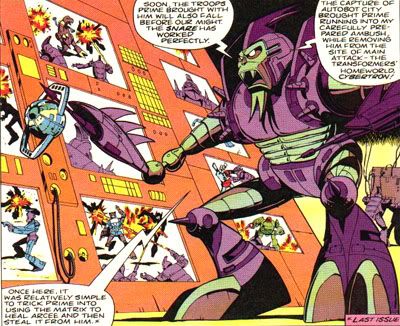
Not Featuring Harlock: Simon Furman's "Space Pirates" and Post-Movie Transformers


The breadth of my interest in a fandom's material tends to decrease the longer I am in it: I go from devouring everything in sight to becoming entirely too choosy. Recently, I've come to very mildly regret almost entirely losing interest in the old Marvel Transformers comics. This, also spurred by receiving The Transformers Vault for Christmas, lead me to buy one of the many reprinted collections with my Christmas money, to see if they still held up.

I picked something from the Marvel UK run, which ran concurrently with the US Marvel comic but had many more issues as filler in between their stories, allowing for a more epic scope. Out of these, I chose the IDW Space Pirates book because it covers familiar territory.

My favourite G1 Transformers have almost entirely been (with the exception of Marvel Shockwave) the ones introduced in the animated Transformers movie. The third season of the cartoon did me a huge favour by making these characters the main cast for its period, but the Marvel Comics almost entirely avoided these characters in their main storyline. There was no overhaul like the cartoon series, in which one cast virtually replaced another. Rather, the comics just added more and more to the cast, with a chance of characters from any era putting in an appearance.  It might be due to more care in the writing, making the story progression more organic.

In the US, those TF:TM characters they did introduce were tertiary until Galvatron appeared late in the run as a major villain. The UK comics, however, had an alternate future universe that seemed heavily based off of the cartoon's season three. This universe frequently crossed over with the main continuity, but was rarely the subject of its own tales, and thus was secondary. At the same time, certain TF:TM characters did exist in the main continuity and showed up frequently, albeit in far different contexts.

At the time, I was hungry for anything featuring the TF:TM characters, and the Marvel UK material was a great way to get my fix. This was before reprinted collections, and I read these comics in small, almost illegible .jpgs off now-defunct websites. I enjoyed them very much, but at some point, I began to drift away from the comics, so that when the paperback collections were released by various publishers, I never picked them up.

I regret that a bit now, since I enjoyed reading Space Pirates, as well as the additional stories that were included in the volume to create some sense of sequence in IDW’s cherry-picked collections of UK series. . If I had more money I would gladly buy the rest of the UK collections, even those without my favourite characters in them. However, despite this enjoyment, Space Pirates and the other stories lack the emotional connection that would make me love these comics as much as G1 season three, even when the comics are better-written

The main problem is that while the plots are far and above the cartoon, Simon Furman's writing lacks a heart, of sorts. I can see some defining character traits, but a lot of the time, the Transformers seem terribly generic except for a few standouts. Their voices start to blend together, which is probably inevitable with such a large cast, but it does dampen the appeal. There's also large amounts of third-person dialogue and clunky exposition, making the comics seem less like a work that could stand on its own to non-Transformers fans who are less inclined to put up with the cheesiness.

Sometimes the characterization is disagreeable rather than dull. Cyclonus, appearing in one of the other stories in this volume, is the worst offender. He's a total moron, probably the most stupid character in the book. It's not just difference from the cartoon that's the problem—he'd read as insufferably dumb to a non-fan, too. One of the worst parts is when he lets slip a secret in a fit of anger, just a few panels after he was told not to.

Arcee in Space Pirates is a close runner-up, and since she's the only female Transformer in the cast, it makes Furman suspect in other ways. She deserts her post to go on a joyride, allowing the Quintessons to take over Autobot City, never gets a chance to fight as she is shot, used as bait, then limps around after Hot Rod while he does the important stuff. I never was all that fond of Arcee, and she could be as bad as this in the cartoon, but the comics is supposed to be better-written.

(Of course, what could you expect from the same writer who's taken multiple swipes at the concept of female Transformers and viewers who want to see them? Look at Prime's Rib and Spotlight: Arcee for examples)

I loved Shockwave in other Marvel comics, but here his "logical" personality is replaced by a more generic leadership. One could replace him with Megatron or several other of the comics' many Decepticon leaders, and little would change. Soundwave also talks like a normal character instead of his famous terse monotone, but doesn't get any new personality in return, except for a brief moment where he almost wants to reconcile with the Autobots after they team up against the Quintessons. Was anything ever really done with that? Springer, who is only seen in the main universe, is a generic hardass warrior without his quips or swagger. Scourge is presented as a more generic warrior-leader, obviously the brains of the outfit when Cyclonus is around, and he's kind of boring, too. It's not simply that they are different, but that the differing characterizations aren't that interesting.

When they appear, Cyclonus and Scourge are also working against Galvatron, to the point of wanting to kill him. I realize that Simon Furman is not obligated to stick to the cartoon's portrayal of the characters as Galvatron's loyal soldiers, but I do a mental pearl-clutch nonetheless. Scourge in the cartoon was a traitor once, so I could picture him doing something like this...but even so, it's not my thing.

This is a "Best of" series, so smaller, incidental stories are skipped over, though advertisements for these stories remain. Ideally a series of graphic novels collecting the entire UK run would be preferable, not just the "big" stories, though several complications make that difficult.

I've spent so much time ragging on the Space Pirates graphic novel, what's good about it? Well, all the things I complained of didn't entirely spoil the proceedings. I was still enjoying a comic that read like it could be a multi-part episode of the cartoon's third season, even hearing some of the character's lines in their cartoon voices (even if a few lines didn't sound like something they would say). Essentially, the Quintesson homeworld is in danger of being destroyed, and one of the planets they "scout" for re-colonization is Cybertron. Lead by General Ghyrick (one of those lobster-hands "executioner" type Quintessons), they attack Autobot City and Cybertron itself, hoping to overpower the Transformers and take  Cybertron.

The time rift that almost destroys the Quintesson planet is tied to the larger storyline, but it could easily have been replaced with another plot device. The continuity is obviously different, above all the fact that the planet suffered an entirely different fate in the TV series, but the connections are undeniable.

There is still something to be said for the plot being better than anything the cartoon produced at the time, and it still has some nods to individual characterization, such as Hot Rod's brief moment of self-doubt when he's about to die, or his hot-headedness as Rodimus Prime.

The additional stories I've spoken of, the ones leading into the next volume, are also entertaining, and would never pass for an episode of the cartoon for various reasons. It is nice to get some of the TF:TM Decepticons in this volume, too, though in a different story than the TF:TM Autobots.

I am judging too much based on the cartoon, and the comic is arguably better, but the cartoon is what's been rolling around inside my head for far longer, and I consider its portrayals to be the definitive versions of Rodimus Prime, Galvatron, et. al. This comic may be better-written, but it does not draw me in emotionally as the cartoon did.

As for the artwork, I mostly like it. I enjoy Dan Reed's unconventional Transformers art, and so on. My only complaint is the simplified new colour schemes for some characters: Particularly bad are Hot Rod coloured almost entirely in magenta and silver, and the bipedal types of Quintesson which are a uniform purple and green.

In short, the comics are long on plot, short on character. I can't let go of my attachment to the cartoon, but beyond that there are still things to pick apart. The Transformers comics have a cast of dozens, but as all the memories come flooding back, I can remember few characters that stand out or that I emotionally connected with. At the same time, the stories are gripping, and not completely devoid of emotional investment. I wouldn't be averse to acquiring more copies of the UK comics, though I would start with the ones starring the "future" characters and whatever the mainline Ultra Magnus gets up to.


Monday, August 8, 2011

It's Silver

(Typed in a brief moment)

So, today is the 25th Anniversary of Transformers: The Movie. Before Michael Bay, before CGI blockbusters...it was. It's the one where Optimus dies and a giant planet eat things. Where there's lots of cheesy hair metal and shiny animation. I never saw it in theatres: I was too young, being only two at the time. But it's important to me.

Beast Wars was my introduction to Transformers, and my favourite of all their series, but it was Transformers: The Movie which triggered my interest in the 1980s Transformers, through a viewing originally meant to get some idea of context for the G1 references in Beast Wars. There was something about TF:TM that sucked me right in, so that I would watch it scads of times on the old Canadian Malofilm VHS, even sitting enraptured through the credits.

As I've noted before, it was the third season of the Transformers cartoon, following the movie and featuring its new cast, that become an iconic part of fandom. The characters and their dynamics captivated me, and remain compelling in some weird immovable way, even as I recognize the weaknesses in the cartoon. The Transformers: The Movie has even more weaknesses in that area, and doesn't establish much of the quirks that made the new Autobots and Decepticons fun. Instead, it's a cliched story that doesn't establish or explain much of anything at all, being a vague Hero's Journey with lots of explosions.

But I love it. Holy hell do I love it. From beginning to end, it's had this hypnotic effect on me. Not caring for Optimus Prime at all, I wasn't impacted by his death. In fact, though the movie does a poor job of establishing his death, I'm impatient for it to happen, so we can focus on the newer characters. That's how much I love TF:TM: I ignore basic rules of storytelling in favour of enjoying it.

Yes.

Sunday, July 10, 2011

On the Move


I like to think myself open to the possibility that a remake or a reboot can be enjoyable, but instead I often default to an instinctive dislike, even when I have no interest in the property at hand. Yet, I caught that nine-minute series of clips of the new ThunderCats cartoon and it looked very exciting, something I’d be certain to watch out for if it came to Canada.

However, I’m not a ThunderCats fan and have little investment into what a remake could mean for the original; my interest is because the new series looks exciting on its own. This isn’t to say that I know nothing of ThunderCats, however. While I was too young for the original broadcasts, I rented some videos at age eleven or so (all starting with a determined but stupid quest to somehow find a Ratar-O toy at retail in 1994).

I liked ThunderCats all right then, but viewing reruns as an adult on Teletoon Retro wiped away all that childhood goodwill. The series had terrible voice acting, weak world-building, a random mixture of fantasy and sci-fi elements, and idiot villains. The only opinion that had changed for the better was that now I appreciated the comparative subtlety of the heroes’ “humans in makeup” design, rather than wishing for them to be more animalistic as I did as a preteen. (Though the original series would sometimes show Thunderans with more blatantly feline features--as a child I idly wondered if they were ever the victim of racial discrimination).

Everything that I’ve seen so far has lead me to hope that the ThunderCats remake will actually make some alterations to the premise, rather than only make the smallest nods to modernity as the 2002 He-Man did. In the ThunderCats remake, I see signs of more complicated and detailed relationships between protagonist and antagonist, and among heroes on the same side, which makes for more interesting storytelling. The He-Man route is fine for others, but my preference is for a remake that turns out to be a thing I’d enjoy watching, and I tend to cringe at archetypal eighties cartoons, with some exceptions. The new ThunderCatscartoon looks like a good piece of heroic fantasy, made with some care behind it.

There’s a heavy anime influence in the artwork, but like Avatar: The Last Airbender there is an unmistakable western-ness in the tone and in some way, the designs. Not being a fan, I don’t have any strong opinion on how the new designs compare with the old ones. I’d probably be satisfied with them if I were, since they are very familiar-looking. As an aside, turning the annoying animal-thing Snarf into a non-talking pet is probably a good idea for several reasons. Not only does it shut him up, it was kind of odd that he looked like an animal but was sentient.

Overall, I’ll probably catch this if it comes to Canada, or turn to…other means if word-of-mouth is good enough.

This interest is more than I can say about Transformers: Prime, sadly. I am a lapsed Transformers fan, but I try to catch up on each of the series following Beast Machines. I dropped whatever I didn’t like, but I enjoyed Transformers: Animated and hoped I could do the same for its successor. But this…the show is very, bland.

There’s been something of a backlash against Transformers fans who dislike the human sidekicks, but Transformers: Prime still brings out my “Robots, dammit!” side (I liked Sari from TF:A, so the slack must be cut). Much of the material, including a notable amount of the problem-solving, seemed to come from the kids’ POV, which diluted the fundamental appeal of a Transformers cartoon, namely that the protagonists are living robots. Filling out the Decepticon ranks with interchangeable drones also isn’t that exciting.

It’s a pity, since the oddly primitive-looking CGI makes me nostalgic for the days of Beast War and Mainframe animation, my gateway into Transformers fandom, leaving me wishing, maybe unreasonably, that some similar kind of magic could have been captured. A friend has told me that Transformers: Prime has some better episodes down the line, which I might want to look into, but I’m currently on the fence.

Despite my nominal excitement over ThunderCats, however, the Transformers franchise is always going to be the king of eighties cartoon “revivals”, because it has never been just about picking up an eighties cartoon and remaking it decades later, but about putting out reams of material ever since 1984. Transformers is a broader, richer multiverse than its stablemates, and has been doing it since before the eighties became retro.

In other Transformers news, however, I’m making clear my intentions not to see Dark of the Moon. Despite some buzz about it being “the good one” among Michael Bay’s Transformers movies, I’ve heard enough to believe that I still wouldn’t like it. The only Bayformers movie I’ve seen was the first one, and that was only because crazy brain fungus told me that I “had to” see it, simply because I was a Transformers fan. It was terribly boring, and I heard enough to stay away from the second. And so on, and so on. I’m just not interested in a raunchy sex comedy/cheesy action flick which that has robots in the background doing stuff.

Sunday, May 8, 2011

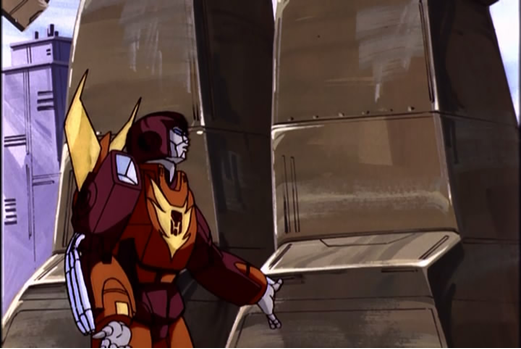
The Peculiar Olympians: Rodimus Prime


“The Peculiar Olympians” is a series of blog posts about my most favourite fictional characters. They are each here for some combination of sympathy, empathy, inspiration, humour, quality, staying power, and/or significance to my relationship with fandom. These are not all the characters that I like, but they are the ones that have stood out to me the most. The list is also alphabetical and nothing more.

On one side is the Predacon Megatron; on the other, the Autobot Rodimus Prime. In many ways they’re each others’ opposite, which makes them a nice encapsulation of my entire experience with Transformers.

My interest in the franchise started with Beast Wars, but an interest in the then-dormant original Transformers material soon followed. Though there was a lot of it, eventually the third season of the original cartoon emerged as my clear favourite in the 1980s corner. This is not for reasons of quality, since the whole cartoon is pretty bad when seen through adult eyes (and perhaps I should have known better as a teen, too), but there was a peculiar emotional resonance to its main characters that remains strong. This lets me cruise through those episodes at a leisurely pace even now. Any episodes outside of this, though, and forget it.

Rodimus Prime was the second leader of the Autobots during the original cartoon’s run. Originally the “teenage” Hot Rod, he was transformed into Rodimus Prime by the Matrix of Leadership at the eleventh hour to destroy the planet-devouring robot Unicron. In the years that followed, leadership began to take its toll on Rodimus, as he grappled with insecurity over being unable to measure up to his great predecessor, Optimus Prime. Other days Rodimus could handle himself just fine, and displayed a caustic sense of humour that Hot Rod never had. However, Optimus Prime was eventually brought back to life, though, and he became Hot Rod again.

I have a yen for angsty and sarcastic characters, making Rodimus Prime a one-two punch. He became an icon of my very first fandom, and a sign of the times I had there. As an adult, my interest in Rodimus Prime hasn’t changed, and I am also more confident in ignoring those who believe the third season was a fundamental drop in quality. Any flaws in the third season of the Transformers cartoon were intrinsic to the series as a whole.

However, growing older has made me realize that if there is anything wrong with Rodimus’ existence, it is that his insecurities formed no larger arc and resolution. Instead, his problems were solved at the end of an episode, only to emerge again after several episodes without incident, and be solved in the same half hour. Having these problems wasn’t the issue.

It seems almost as if the writers were trying to do something different with the beat-’em-up 80s cartoons, but only half finished it, introducing a character facet not often seen in such shows and presenting it with genuine feeling, but not letting it go anywhere. It’s saddening, but also raises the question of whether one could really have expected the Transformers cartoon to suddenly develop the capacity to do long-term character arcs and character development. Why not just give an “A” for effort?

I do, exactly because Rodimus Prime is still an enjoyable character, and I like watching the third season of the Transformers cartoon for him and other reasons. Any other appearance of Rodimus Prime or Hot Rod in Transformers media, whether it’s the same character or just one with the same name, is nowhere near as fun.

Saturday, April 30, 2011

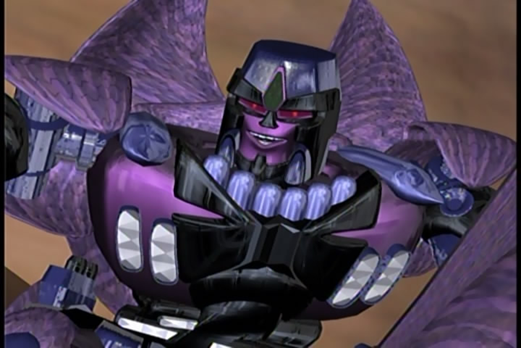
The Peculiar Olympians: Beast Wars Megatron


“The Peculiar Olympians” is a series of blog posts about my most favourite fictional characters. They are each here for some combination of sympathy, empathy, inspiration, humour, quality, staying power, and/or significance to my relationship with fandom. These are not all the characters that I like, but they are the ones that have stood out to me the most. The list is also alphabetical and nothing more.

A love for villains with no deeper motivation or backstory than greed and personal enjoyment has become a nostalgic artifact for me. I sometimes miss my larger appetite for such characters, but if a “simple” villain has enough flair, I can still love them. Beast Wars Megatron totally has that kind of style, and looking at him takes me right back to the time when I could better appreciate the undemanding kind of villain.

Beast Wars was my first fandom, the first series with which I sought out material beyond the television show and began to follow online discussions. It lead to a larger engagement with Transformers fandom as a whole (which I’ve since fallen out of), butBeast Wars is still my favourite Transformers series, and its Megatron my favourite of the many unrelated characters to have that name.

Three hundred years after the end of the Autobot/Decepticon war, the primary Transformers factions are now the Maximals and Predacons. A Maximal exploration crew pursues rogue Predacons who have stolen an artifact called the Golden Disk, and the two ships crash on an Earthlike planet. This world turns out to be riddled with stores of raw energon, Transformers’ primary fuel source, and robots must adopt alternate modes derived from local animals/fossils to protect themselves from the resulting radiation. The scale of this conflict first seems small, but further details will be revealed that will introduce the potential to change the course of Transformers history. (And while it sounds ridiculous on paper, and a lot of plot details were never resolved, Beast Wars is still a good show.)

Beast Wars Megatron only wants power. Here and there he makes a bit of noise about wanting to free the Predacons from Maximal rule back home, but it’s abundantly clear that even this tidbit is more about feeding his ego than anything else. Yet his smooth voice, delivered by one David Kaye, lends him an air of refinement, and his ability to play his enemies against each other, with a light but twisted sense of humour sets him a cut above the rest….

…which it makes it all the better when we see how monstrous and bestial he truly is, his sophistication a veneer. Furthermore, as Beast Wars progresses, Megatron grows ever more insane and power-hungry. He loses something in this transition, but retains enough panache that my faith in him only wavers, never disappears.

The same can’t be said for the Megatron’s re-introduction in the sequel series Beast Machines. The merits of this characterization have been debated, but after struggling to accept it for years, I fall squarely on the side that considers Beast Machines Megatron an inferior and implausible continuation. Yes, he conquered the whole of Cybertron as he had always dreamed of, but deliberately put the population in stasis to rule an empty world. In addition he had inexplicable obsessions with cold, mechanical order and the elimination of organics. He had his moments in this series, but they were fleeting, and ultimately he was an unsatisfying re-iteration. Still, the memories of Beast Wars Megatron remain fondly.

Tuesday, December 21, 2010

The Greatest Generation


If fandom is something involving interaction with like-minded people, the seeking out of additional information, and the construction of meta, fanart, and fanfiction, then my first fandom was Transformers. Beast Wars: Transformers was my entry into that, but the Transformers work with which I most expressed the most overt geekiness was the third season of the original Transformers cartoon. In doing so, I cemented a lot of personal tropes and desires that I would express in later fandoms.

I actually like Beast Wars better on both a critical and affectionate level, but one of my peculiar tendencies is to lavish more attention on works I consider engaging but critically inferior. Perhaps it is because a less well-constructed work leaves more room for imaginative analysis, or that I revere the better works so much it would feel almost blasphemous to try to create my own inferior homages to them.

I left Transformers fandom around 2002, but recently re-watched Transformers season 3, partly in tribute to the year 2010, with the Japanese dub of the season once billed as a sequel series, Transformers: 2010.  My feelings had changed and yet had not changed, and I felt a comforting boost of joy and nostalgia. For my pleasure (and maybe yours), I’ll share my new thoughts on an old favourite.

I was born in 1984, and thus was too young to catch the original Transformers boom. I never saw season 3 when it originally aired in 1986, but only in 1999, due to the fandom’s tape-trading circuit. While the early Transformers cartoon is somewhat remembered by the general public, the third season is considerably less so. It had an all-new cast of Transformers, and lost a lot of the iconic staples and imagery that fans remember from their childhoods—gone were the deserts and canyons and transforming Earth vehicles, though these were already beginning to be phased out.

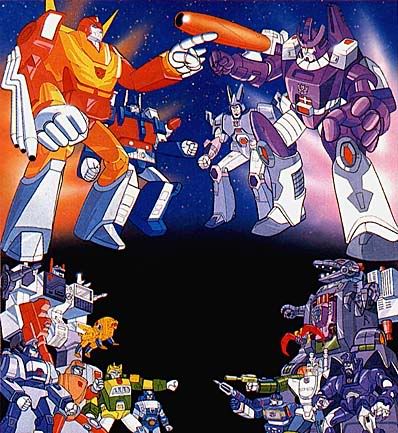
This was because of The Transformers: The Movie, which jumped the timeline forward from 1985 to the then-future 2005, killed off a lot of the original characters, and introduced new sci-fi settings into the mix. The third season followed from it, and some Transformers fans insist that the third season was a huge shark-jump, an enormous drop in quality with unlikeable characters and suddenly cracked-out storylines.
This opinion has become somewhat less popular throughout the years, with there being a notable number of fans who prefer the third season outright, or who are neutral towards it, or who see the entire original cartoon as a single body to be embraced or discarded as it will. The attitude that Transformers suffered in season 3 seems to be more the province of casual fans rather than fandom veterans, though as with everything else, there are exceptions.

When it is observed through adult eyes, however, it is hard to imagine the Transformers cartoon suffering any precipitous drop in quality. The series always suffers from poor animation, nonsensical plots, bad science, and tenuous continuity. And too, it always had some small spark of warmth and wit that makes it easier to understand why it is still so beloved.

I will admit that it was, on multiple levels, foolish of a series to shove an old cast out of the way for a new one, instead of gradually introducing them into the ensemble. However, any criticisms I make feel like lip service. I have utterly no interest in the original Transformers cast, and thus to have them bumped from primary character status is the best thing for me. It is only with this new cast of Transformers that the cartoon becomes engaging to me at all.

The third season of the Transformers cartoon left a deep mark on me and my relationship with fiction. I realized my taste for flawed characters who walked a little off the beaten path, who were snarky or standoffish or insecure. This was also the first time I began to more deeply consider why I chose to favour certain characters, and I still indulge in those thoughts for later characters. This was all in spite of the fact that many Transformers fans considered the newer characters more flawed and less competent than the characters who came before them.

Of course, when I speak in the generic, I’m really referring to the two new leaders, Galvatron and Rodimus Prime. Rodimus’ flaw was that he was insecure. A handful of episodes dealt with his insecurities over suddenly assuming leadership, either as one-off lines or major plot points. Galvatron’s flaw was that he was the TV version of insane: screaming, capricious, and violent.

However, since I now have a more cynical view of the cartoon’s quality, and realize that all of its faults were intrinsic to the whole, I don’t take too seriously any of the ethical issues raised by the characters or the storyline of season 3.As part of this new mindset, I am now uninterested in fretting over whether Rodimus Prime and Galvatron were “good” leaders or not. By adult standards, none of the Transformers leaders could command their way out of a wet paper bag, no matter how confident they were. The best thing you can hope for is that they entertain; no need to sweat if they might be leading their faction into a dark age, because Transformers didn’t really go into that.

My unconcern was also helped by realizing the series developed no real arc with either Rodimus or Galvatron. Their fans and haters alike will focus on certain episodes to define the characters’ infamous traits, but proportionally more of the episodes forgot these and treated them as normal cartoon leaders. In addition, with Galvatron the lines between “insanity” and just being a cheesy cartoon villain are sometimes pretty blurry.

As I’ve tried to grow and develop as a writer, I’ve realized that characters’ prominent traits usually need to serve a larger purpose, some relevance to the plot. Character flaws, for example, are things to purposely overcome or never overcome, depending on the tone of the story; they build towards a change, good or bad. Nothing of this sort happens in The Transformers. The flaws of Rodimus and Galvatron appear and disappear again and again, building towards nothing that isn’t resolved by the episode’s end. Much as the two characters fascinate me, I still see how poorly their story was told. Again, this is not an artifact of the series’ drop in quality in the third season, but part of the series’ general difficulties. The earlier seasons had no character arcs, either.

Yet because I love it, I am generous. I can see season 3 as a season that was trying to grasp at things that North American TV cartoons didn’t have a lot of at the time, especially through Rodimus’ existential angst. Sometimes it seems like it was trying to become something a little bigger than seasons prior. There are fleeting signs of a series that might care more about telling its own stories instead of appeasing the audience, which is a major step in writing a quality work.

I would have killed to be a fly on the wall when Hasbro and Marvel and whoever else decided to write Rodimus Prime and Galvatron in that way. Wanting to sell new leader toys is understandable enough, but why take this route wither their characterization?

Regardless of why they appeared, I liked them. I do have a stronger awareness that Rodimus should not have allowed his insecurity to get the better of him at all, but it’s still an interesting aspect on many levels. I also love how sarcastic and snippy Rodimus is at times, which his detractors fail to mention and is an amusing selling point. Galvatron is also amusing when he is angry, his rage is fun too, and there’s an additional dimension to his relationship with his much put-upon lieutenant, Cyclonus.

Cyclonus is another favourite of mine. He’s basically an evil robot Klingon who’s loyal to the bad guy despite living in a culture of backstabbers. At times, this loyalty looks doubly foolish, since he’s prone to getting a punch in the face from his leader when the writers remember Galvatron is supposed to be crazy.

I used to find an ethical dilemma here, constantly trying to prove that Galvatron did care for Cyclonus, but I just don’t worry anymore. Now my stance is that these characters are absolute villains in a children’s series, so it doesn’t really matter if one character I like will strike the other on the same side. In more serious or nuanced characters I might look twice, but for now I just let their relationship be. I still appreciate Cyclonus because he is imposing and arrogant rather than weak and sycophantic, giving some grandeur to his convictions, as foolish as they might look to an adult complexities. His genuine concern for Galvatron is also still strangely touching.

There is also Ultra Magnus, Rodimus Prime’s right-hand-man. With Rodimus, Galvatron, and Cyclonus, Magnus completes the quartet of beloved characters from season 3. While I like or tolerate the rest of the movie’s new Transformers, these are the ones that I truly declare myself a fan of. It makes for a neat package.

In Ultra Magnus’s case, he gets a bad rap from the fandom because of his “I can’t deal with that now!” line from the Transformers film, delivered when they’re under fire in space and it’s noted that their friends’ ship had gone down. Because of this, and the character’s humbleness, Magnus is seen as insecure and wimpish, though not met with such bile as Rodimus Prime is.

There have been many other versions of Ultra Magnus, met with more appreciation because they are more “badass” characters. Still, the 80s cartoon Ultra Magnus is my favourite. There’s something kindly and loveable about him, and he’s not really insecure outside of that meme--just modest and altruistic, always willing to step up to the plate when he’s needed. Magnus may come off as stolid, but I like stick-in-the-mud characters, sometimes.

My interest in the characters is what fuels my affection for the Transformers cartoon, creating an iron-clad shield against the series’ cheapness and ludicrousness. The earlier seasons don’t have that shield, which is why I cringe when I manage to catch a piece of them, and of most other 80s cartoons. Still, there are minor things that appeal to me outside of the four main characters.

First, while Rodimus, Magnus, Cyclonus, and Galvatron are the only characters I would declare myself a specific fan of, I have some affection for nearly every character associated with them--the original ones from the movie. Kup, Arcee, Blurr, and Springer on the Autobots’ side, and Scourge on the Decepticons’; I don’t include kid-robot Wheelie since he appeared later in the film, but I don't hate Wheelie as much as other people do. Arcee still bugs me somewhat, because she’s often just “the girl robot”, but I can’t totally hate her.

The idea that these six Autobots and three Decepticons should be “together” is indelible in my mind, and will taint any attempts to engage with other incarnations of them outside of the cartoon. Logically, I know that they (except for Arcee) were just toys that happened to be produced in the same year, and they could be mixed and matched however a Transformers writer pleases, which is what happened.

These characters had many other incarnations in the 1980s Marvel comics of the US and UK, in modern comics produced by Dreamwave and IDW, and even stories exclusive to the Transformers conventions. However, other portrayals of these characters never feel quite right, even if their stories were written better than the cartoon’s. Also, because better writing requires a less capricious status quo, “my” characters also ended up as secondary or tertiary cast members rather than the leads.

Further appeal can be found in some of the plots of season 3. While criticizing season 3 for being too outlandish is ridiculous in light of the many “wacky” episodes that aired before it, there were plenty of insane episodes in this season. In keeping with taking a less serious view of the cartoon now, I can laugh along with many of these insane plotlines, and find a cheerful joy in them due to my taste for the bizarre.

This bizarreness is also reflected in the art style of the series. Many episodes are populated with offbeat aliens and creatures, including the new antagonist Quintessons, and these monsters make the series even more engaging. The designs of the new Transformers are also more appealing, with a brighter range of colours, strange “futuristic” vehicle modes, and sleeker, more organic body designs.

And, even though it was established in a hasty and clumsy way, I still appreciate on principle the idea of the previously static Transformers universe undergoing some kind of change. Maybe not if I didn’t enjoy the result, but even so, for all its haphazardness, season 3 did try to establish a backstory and mythology for the Transformers, and did things like having the kid sidekick grow up and have a son of his own.

One of the ideas was that the Quintessons, random aliens from the Transformers movie, would turn out to be the creators of the Transformers, banished when their slaves rebelled. This is a very obvious retcon to an adult viewer, since nothing suggested this was the case when the Quintessons first appeared, and you can see painful attempts to shoehorn this in. Nonetheless, it was something. The comics, and many other continuities, instead proposed that Transformers were create by the robotic god Primus, for a grander purpose, but I’ve always had a soft spot for the Quintesson origin because the Transformers had to fight for their freedom.

As the Transformers brand has gone on to become a multimedia, multi-continuity franchise, nothing like season 3 was ever attempted again. While longer series had changes to the cast rosters, the leadership positions remained intact, with the main leaders always named Optimus and Megatron. Furthermore, while these series made several tweaks to it, nearly all incarnations of the Transformers replicated the premise from the original cartoon and comic.

My bias finds no problem when Beast Wars started this trend, especially since that series acknowledged the re-using of names in terms of historical gravitas, but after several more times it began to feel redundant. Since the franchise’s primary goal is to sell toys to the generations of toy-buyers that cycle ever more quickly, it’s no surprise that they would raid their own stores for the same thing over and over…very few would remember the previous iteration.

Still, I would like to see a greater variety of Transformers premises, which is another reason season 3 appeals to me. It was one of the rare times an “Optimus” and a “Megatron” were not in charge, and it was not just about fighting the enemy robots on Earth. I still enjoyed the newer material (I loved Transformers: Animated), but I craved difference, even when I was not the target audience.

Even though I have a slight preference for Rodimus Prime over Galvatron, I’d have to say the best episode of Transformers season 3 is “Webworld”, written by Len Wein and Diane Duane (yes, really), which focuses on Galvatron and Cyclonus instead. Threatened by the other Decepticons, Cyclonus tricks Galvatron to going to the planet Torkulon to be “cured” of his madness. It’s a world of webs, staffed by creepy simian aliens who put Galvatron through parodies of real-life psychological therapies. Galvatron ends up destroying the planet after he prevents the Torkulons from essentially trying to lobotomize him with giant insects (yes, really). It’s a strange episode full of purple and blue and orange with aliens everywhere, and nicely encapsulates both the stupidity and the small moments of earnest emotion that Transformers could have.

Not all the episodes of season 3 were great, however. Like most people, I disliked there being several episodes which focused on the new kid sidekick Daniel (offspring of the previous kid sidekick, though Daniel was much younger), and some were just a little too boring or absurd. However, my mellowed attitude means that even such episodes were easier to get through. There is also the alternate anime continuation “The Headmasters”, but as it’s a different continuity and has its own issues with characterization, I will ignore it for the purposes of this essay.

Still, the other shoe must drop, as they say, and by the end of season 3, I would have to contend with the same kind of hurried alterations that fans of the original seasons did. The two-part episode “The Return of Optimus Prime” aired after so many people complained about Optimus being gone. It depended primarily on continuity errors and contrivances, everything designed only to get Prime back on the table as quickly as possible. I can’t blame them, not when I embraced the same kind of immediate gratification for TF:TM, but obviously I didn’t like it, especially when later episodes acted like Rodimus Prime hadn’t existed at all.

Despite this revival of Optimus, the Transformers cartoon ended shortly afterwards. I’m glad that it did; there was something wrong about Optimus Prime living in the same world as Galvatron and Ultra Magnus and the rest--he was intrusive, a creature from an earlier aeon. Furthermore, if the show had continued, the 1986 characters would largely suffer the same fate as their predecessors: shuffled aside to make room for newer toys.

There were hints of that in the three-part “The Rebirth”which closed off the series. In this “season 4”, the new 1987 characters had the spotlight, and a whole bunch of them were introduced rapidly. There were even hints that Galvatron would be challenged in the future by one of the new villains, though the series ended on a cliffhanger.

In all this, it’s surprisingly easy for me to forget about the actual Transformers: The Movie. I had rewatched that more recently, and waited until the end of my rewatch to discuss it. As with season 3, I love this film dearly, though there is far less meat to it. Most of the character traits that I talked about weren’t present in the movie. Ultra Magnus is probably the character that gets the most play on those terms: Galvatron is there, but he is more of a standard “cool” character there, his insanity coming later, and Rodimus Prime mostly exists in his previous incarnation as the “teenage” robot Hot Rod. Just as with the television series, very little about the film makes any logical sense, but it’s still a treat, a blinding nostalgic rush of bright colours and laser blasts.

What more can I say? It’s one of those things that means a lot to you, but that you don’t feel comfortable recommending to anyone else, even other nerds. After getting older I can see the flaws more clearly, but the attachments to the characters are just as vivid. Here was where it all began for me, and it’s nice to go back once in a while.