Friday, March 25, 2011

The Peculiar Olympians: Khisanth


“The Peculiar Olympians” is a series of blog posts about my most favourite fictional characters. They are each here for some combination of sympathy, empathy, inspiration, humour, quality, staying power, and/or significance to my relationship with fandom. These are not all the characters that I like, but they are the ones that have stood out to me the most. The list is also alphabetical and nothing more.

I’ve loved dragons since before I can remember, but I can also be extremely picky about them. Usually I’m not interested in saintly magical companions or creatures of absolute evil, and keep hunting for something a little bit more interesting.

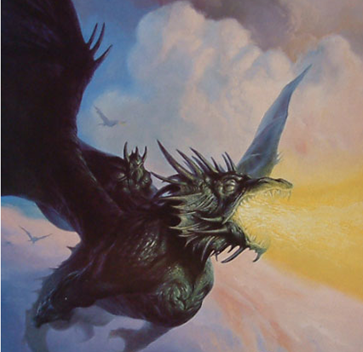
However, it’s surprisingly easy for me to pick just one dragon character as my favourite: Khisanth, from the novel The Black Wing by Mary Kirchoff. She’s from the Dragonlance series of books, which I know are mostly drivel, but Khisanth’s portrayal is that kind of happy cosmic accident that Peculiar Olympians are sometimes made of.

Khisanth is a black-scaled dragon, which in this setting means she is greedy and impulsive, breathes green acid, and prefers swampy, wet areas. She is the offspring of Takhisis, the Queen of Darkness, along with four other chromatic dragon breeds. Khisanth was at some point ordered to go underground and sleep after her Queen’s defeat in a war, waking up an adult, after which she wandered the world and had several adventures, before being exiled to an underground city to guard a magical artifact.

Khisanth, a.k.a. Onyx, is far better known as the minor antagonist that appeared in the first Dragonlance novel, Dragons of Autumn Twilight. In that book, she is an utterly generic villain, easily dispatched through the touch of a magical staff that turns her to ash, the same one she was to guard. The Black Wing is then a prequel, written by a different author, though it was years before I understood this, having completely avoided the founding Dragonlance books in favour of reading stories about dragons.

Normally these conditions would be several kisses of death to a book’s quality, but what emerges instead is a new take on a generic fantasy world, told through the viewpoint of an evil minion, one who is a tragic but also aggravatingly stupid anti-hero. Khisanth in the book has a personality that’s a combination of a spoiled child and a sadist carnivore, but manages to be sympathetic because she is capable of forming friendships, and does not directly serve evil until the final third of the book. Even then, because it’s from her viewpoint and before the latest war truly begins, it’s harder to see her as a mere villain.

Furthermore, Khisanth’s life is horrible. She regularly makes huge mistakes and never learns from them, and in the end fate throws her together with a human that she despises, one who murdered Khisanth’s friend and comrade because he felt Khisanth was a more worthy dragon. This is an assignment which she eventually breaks in the worst way, killing the man when she is sure that history is about to repeat itself. Yet Khisanth continually believes that she has a great destiny in store for herself. Readers who have read the original novel know exactly what is in store for Khisanth, and that tinges The Black Wing with a sense of clumsy tragedy.

Khisanth is my ideal dragon character because she operates between two extremes. She is like the “monstrous” dragon in terms of power, but instead of being a plot device, something saved for the climax, she is a protagonist. Unlike the saintly companion dragon, she actually has flaws, and in a subversive twist, refuses to have a rider until fate intervenes. Furthermore, with humans to contrast herself against, she retains some dragon grandeur, rather than being a talking animal as in some dragon-viewpoint books. Thus far, none of the professional and original dragon characters that I’ve read have managed to achieve this kind of potent mixture. Part of me does wish something  like Khisanth emerged in an original work, but I’m usually content to accept what it is.

Wednesday, March 9, 2011

The Peculiar Olympians: Sir Integral “Integra” Fairboork Wingates Hellsing


“The Peculiar Olympians” is a series of blog posts about my most favourite fictional characters. They are each here for some combination of sympathy, empathy, inspiration, humour, quality, staying power, and/or significance to my relationship with fandom. These are not all the characters that I like, but they are the ones that have stood out to me the most. The list is also alphabetical and nothing more.

It’s another conundrum: how do you stretch “She’s awesome” and “this is another cliché” into a full blog entry? Unlike many characters on this list, my interest in Sir Integral Hellsing was sharp and immediate, and there is little about my feelings towards Integral that really sticks out among her legions of fans.

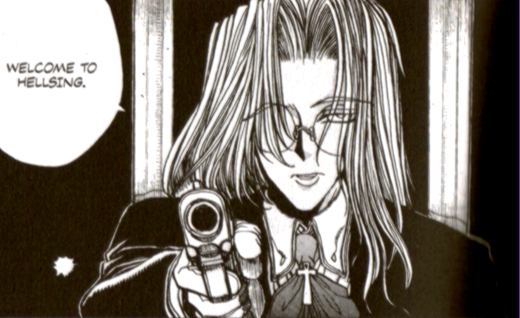
Descended from supernatural expert Abraham Van Helsing, Sir Integral Hellsing carries on the family tradition of heading the Hellsing Organisation, a group dedicated to the destruction of England's supernatural enemies. She inherited the mantle at age twelve, having to thwart an assassination attempt by her usurper uncle by finding underground the "fruits of the Hellsing family's labours", the vampire Alucard (spell the name backwards). Sir Integral Hellsing will stop at nothing to achieve her goals.

In Integra I could see the things I understood, such as female-centred androgyny (which means having a definite and matching physical and psychological gender but not bound by the old rules of how one of said gender should act), glasses, and deskwork. In addition, I saw what people universally covet in our heroes: emotional strength and control, steely nerves. There is something about a stoic female character, standing tall and serene, eternally ready, which I admire intensely.

Granted, Sir Integra is religious and patriotic while I am neither of these things, and as the manga progresses she engages in increasingly vicious behaviours in the name of her duties. Yet because Integra doesn't exist, there's no moral objection to admiring a character that isn't entirely clean or would likely disagree with me on certain matters. Besides, good heroes should have flaws, even if they are flaws that make the character actually "bad" on some levels instead of simply making them more approachable or giving them dilemmas to solve.

I first encountered Integra through the TV anime adaptation of Hellsing, which was one of those works that seems great until you review it more deeply and then make the inevitable comparisons with the original manga. My interest in the Gonzo-produced anime has been eroded down to a persistent nub, but this is still where I discovered Integra. She’s not that different in the manga but a secret part of me is still drawn to the Gonzo anime’s slightly more cool-headed and stoic characterization of Integra, at least in the early parts, before she is a cripple for the remainder of the show. And then there’s that snazzy green suit/blue ascot combo which is still striking to the eye. All of this lingers pleasantly in my memory even though I am a Hellsing manga die-hard.

Friday, March 4, 2011

Did You Catch the Fever? Flying Towards the Moon?


In addition to the Peculiar Olympians series, I have to make a confession that can’t wait: I’ve become one of those people who’s fallen for the multi-age, multi-demographic, bi-gendered appeal of the new My Little Pony cartoon, My Little Pony: Friendship is Magic. My interest is nowhere near as strong as the pony die-hards, and I’m still surprised at what has befallen the internet, but nonetheless, here I am.

It started with this thread on the forums for the Transformers fansite The Allspark. New converts literally hyped this show as Pixar-level and the best show of the new cartoon season, and soon an avalanche started. It was mostly of .gifs, screengrabs, and avatars, but with a lot of earnest episode and toy discussion, too.

Always in the market for a good cartoon, and having a love of bright, colourful objects and the increasing ability to appreciate traditional cuteness, I sampled Friendship is Magic several times, and for a while didn’t quite “get” it. I saw plenty of material for funny image macros, but the show itself seemed like a wafer-thin layer of eccentricity over a stereotypical girls’ cartoon.

But I returned to the show again and again, because it sounded so much like something I would like. Sometimes I felt like an investigator, trying to find out what had made these ponies so exciting to other nerds, and why it didn’t click with me despite my being open to it.

Slowly FiM started creeping up on me, even when I was beginning to feel like it wouldn’t. Before I knew it, it had a lock on me; I feel like I’ve been hypnotized. I started watching out of order, and am still trying to fill in some gaps in my viewing history. The one that really sold me was “The Ticket Master”, which is really odd, because it’s a very standard plot, but the way the characters act out the plot is hilarious.

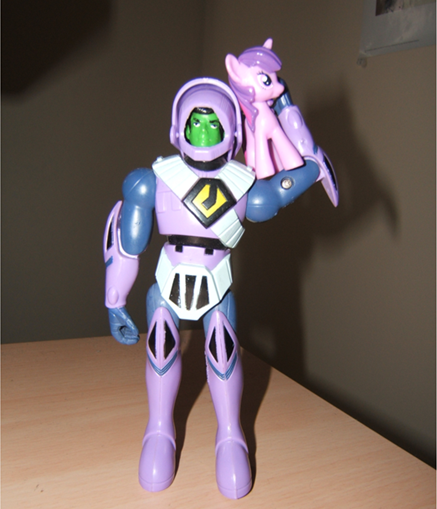
I now have two Pony figures on my desk; one tiny PVC, and one slightly larger one with hair. Both represent the same character, the very unfortunately-named Twilight Sparkle. She’s the nominal protagonist of Friendship is Magic, a bookish, serious unicorn pony. She was the obvious choice.

However, I don’t feel that Friendship is Magic quite lives up to the hype. I really want  to see this show as being on the level of the illustrious things it’s been compared to, and start of a renaissance for girls’ animation, but I just can’ t.

One reason is that no matter how quirky and fun it can be, this show still indulges in a lot of explicit moralizing. Twilight is often seen writing seen writing notes to
her mentor Princess Celestia about what she learned about friendship in the episode, and when she isn’t, the morals of the episode are pretty explicit anyway. There are no PSAs at the end, but there’s just about it.

The fact that it’s the girls’ cartoon that’s indulging in the transparent moralizing says a lot, and none of it good. Perhaps there is a feeling that girls are in more need of being taught virtues, or that animation targeted to girls remains stuck in a bygone era, while the rest of the cartoon world is now more apt to make fun of explicit moralizing.

I shouldn’t be surprised, given the series’ subtitle and that it’s a My Little Pony show, but explicit moralizing in stories is something I just don’t like. Most stories do indeed take moral stances, but such stances are made clear through the events of the story, without stopping to talk about it.

Secondly, the show is episodic. Episodic shows aren’t a bad thing in themselves, but when the series is held up as something groundbreaking, to see it episodic just reminds me that most girls’ shows are like that. There is a definite double standard involved when nerds of both genders much more easily accept boys’ properties to follow, but one aspect is that boys’ properties more often try for some kind of story arc and overreaching mythology (usually failing until recently), or are more likely to have a subversive sense of humour. Many cartoons that challenge the possibilities of American animation (in a certain way), while they may come up with great female characters, are also targeted to boys.

So the reason I feel a bit guilty about enjoying Friendship is Magic is that it seems in a weird way like supporting that dichotomy, that boy’s cartoons are not only more violent, but they’re also more developed. It’s the same reason I feel a bit odd for enjoying Monster High which is also subject to similar claims of mould-breaking that I don’t entirely agree with.

On the other side of things, I feel a little guilty about feeling guilty, since I may be trying to put too much on Friendship is Magic’s tiny shoulders, and Lauren Faust seems to have designed the show to address complaints about girls’ cartoons.

Yet this is the best set of explanations for why I find Friendship is Magic to be a guilty pleasure, even though I’m not the Internet Tough Guy who finds himself squeeing over ponies. (I’m not even male!)

If this is all true, than what does Friendship is Magic have? Well, you can’t underestimate the desire to give an A for effort. Friendship is Magic may not completely tear down the wall for girls’ cartoons, but it does do it, and in such a wasteland, effort should be rewarded. In the same vein, nor can you dismiss the fact that it’s much less treacly than you would expect from an MLP cartoon.

In fact, it’s not that treacly, period. Everything I’ve said about the moralizing is still true, but much of the rest of the cartoon feels very natural, very normal. The series is not trying too hard to present itself as sweet or nice. It certainly is, but in a very organic way that won’t make your teeth rot.

The animation is pretty to look at, with a lot of appealing character design and fluid movement, and I’m still fond of animation that uses simplistic character designs but gives them weight and depth. There’s also some hilarious slapstick and wonderful comic timing.

As others have mentioned, the main pony characters all have distinct personalities, and the characterization is pretty good. I’d hesitate to call them “multifaceted” as some are doing, but you could never mistake one pony for another.

My Little Pony: Friendship is Magic is also earnest. I do have a love of fourth-wall-breaking humour and snarky lampshade hanging, but it’s oversaturated, with only the greatest of the greatest shows being able to keeping pulling off this kind of mockery well. FiM doesn’t keep winking at the audience, or try to be hip and self-aware. It just presents itself as it is, which is very nice.

So yes, I like the ponies. I like the ponies. I like the ponies.

Saturday, February 26, 2011

The Peculiar Olympians: Exedore Formo


“The Peculiar Olympians” is a series of blog posts about my most favourite fictional characters. They are each here for some combination of sympathy, empathy, inspiration, humour, quality, staying power, and/or significance to my relationship with fandom. These are not all the characters that I like, but they are the ones that have stood out to me the most. The list is also alphabetical and nothing more.

Like many nerds, I’ve fallen prey to the appeal of the “nerd surrogate”: a character with nerdy traits who puts them to high-ranked and significant use in a speculative fiction setting. Unlike many, I one of mine in the character of Exedore Formo.

Exedore Formo (also written as “Exsedol Folmo” or “Exedol” or just “Exedore”) is a rare non-combatant member of the Zentradi, an artificially-engineered race of giants created for the sole purpose of waging their creators’ war. It is not a proper “warrior culture”, but one without ceremony, ethos, or reward.

Exedore serves underneath his fleet commander in a multi-faceted role that includes aspects of historian, archivist, and tactician. He has a prim, intelligent personality, but is hardly incapable of emotion. In some continuities, his odd appearance is attributed to deformity.

Though Zentradi were warned by their now-absent creators to avoid contact with the smaller humanoids, their contact with humanity lead to an unprecedented upheaval. Fuelled by some male grunts’ infatuation with the human culture they had stumbled upon, a cultural revolution began in which the Zentradi betrayed their fleet leader to side with humanity.

Partially this was an act of preservation, as they were scheduled to die by being “contaminated”, but it is clear that contact with humanity appealed to something fundamental in the Zentradi they had been denied. (Usually) reduced to human size, Exedore continues to play a key role in the human military following these events.

Exedore is a creature of multiple portrayals and continuities, appearing originally in the anime Super Dimensional Fortress Macross, and then in the continuity for Robotech, in which SDFM and two other anime were redubbed to be a three-part series in the same continuity. Both of these franchises spun off into their own material, with very different treatments of Exedore.

Regardless, the best versions of Exedore are ones that represent a character with moments of both poignancy and comic relief, serving the basic role of “geek on the bridge” but with more personality than expected. The ideal Exedore also develops an increasing emotional range as time goes on, as a smaller aspect of the Zentradi revolution.

This portrayal tapped into some fundamental desire of mine, to break free of my own constraints and fulfill my ambitions, not to mention my general love of stories in which characters cast off a repressive society. At the same time, I embrace Exedore’s comical aspects, finding him an endearing figure, an example of “ugly cute”, and liking his funny-looking character design. 

Unfortunately, if we were to be specific, no one portrayal of Exedore involves all this. The ones that truly represent what I like best about the character appear in the original Super Dimension Fortress Macross, and its dubbed counterpart Robotech: The Macross Saga. Only the novel and comic adaptations of the aborted sequel Robotech II: The Sentinels portray Exedore’s later character development in a satisfying way, despite these books being obscure works that are riddled with many other problems.

The most known portrayal of Exedore today is his Macross-franchise version that is completely retconned into a new form and characterization, with no real explanation in- or out-of-universe--the end result is that the character loses a lot of his quirkiness and personality, and doesn’t look as interesting. It’s a cringe-worthy thing to think about, and one that strongly tests my desire to respect the creators. I wrestle with the surprise that this would happen, and the knowledge that there are no real answers, but also that the writers have the freedom to do whatever they want with the characters. Still, I know what I prefer.

Saturday, February 19, 2011

The Peculiar Olympians: Dream


“The Peculiar Olympians” is a series of blog posts about my most favourite fictional characters. They are each here for some combination of sympathy, empathy, inspiration, humour, quality, staying power, and/or significance to my relationship with fandom. These are not all the characters that I like, but they are the ones that have stood out to me the most. The list is also alphabetical and nothing more.

In some cases, I pick a character for this list even when I find their series mediocre. In other cases, the choice is as much about the series as the character. Such is the case with the title character of Neil Gaiman’s. The Sandman. The Sandman is my favourite comic series (including manga, webcomics, and newspaper strips), because it resonates with me deeply as a writer and a storyteller. It is also what reminded me that western comics could be as great as manga.

Referred to as “conceptual entities” and “manifestations of primal truth”, the Endless are seven sibling beings who stand for various aspects of the living condition. Though technically not gods, they are sometimes worshipped as such, and may interact with mortals as well as with various supernatural entities.

Dream is the third oldest and part of the "Elder Three", with his older siblings being Destiny and Death, and his younger Destruction, Desire, Despair, and Delirium, all of whom are known by other names depending on the language or culture they are interacting with. Also called Morpheus, Onieros, Kai'ckul, Lord Shaper, and Prince of Stories, he stands for dreams, nightmares, the imagination, and the act of artistic creation. His realm is The Dreaming, an intricate and dangerous world populated by fanciful beings and presided over by Dream's castle.

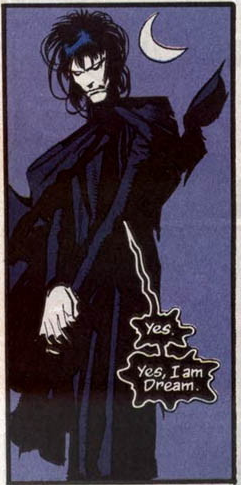
Though he can appear as virtually anything, the aspect of Dream seen most often in the series is a tall, gaunt man with chalk-white skin, a wild mane of black hair, and abstract black holes  for eyes (in which colour may flicker), who favours dark clothing of whatever era. This Dream initially appears as proud, stoic, and ruthless, though also devoted and thorough in his duties. He comes to learn more “humanity” slowly, even as he denies this change.

Dream might be less popular than his sister, Death, and not play a major role in every issue, but his is a felt presence, and without him I wouldn’t love the series as much. He is fascinating: what drove this callous but stoic character to orchestrate an elaborate suicide, if that was indeed what happened? Is it true that supernatural beings, unlike men, cannot change, and so must be made into new stories instead?

Naturally I mean the character of the “black” Dream. The “white” Dream, Daniel, is a character that I still like, but he is seen so briefly and more exists to prove a point (perhaps answering the questions I asked above), than to be a character in his own right.

On a final quirky note, since Dream's realm is populated by creatures from myth and legend, it might be fair to infer that Dream rules over fictional characters as well, making him king and father of all the characters on this list. Furthermore, as a symbol of storytellers, of course I feel some natural affinity towards the character. I want to be a writer, and even if I’m not one yet, I’m engaged with writing and literature.

Saturday, February 12, 2011

The Peculiar Olympians: Daria Morgendorffer


“The Peculiar Olympians” is a series of blog posts about my most favourite fictional characters. They are each here for some combination of sympathy, empathy, inspiration, humour, quality, staying power, and/or significance to my relationship with fandom. These are not all the characters that I like, but they are the ones that have stood out to me the most. The list is also alphabetical and nothing more.

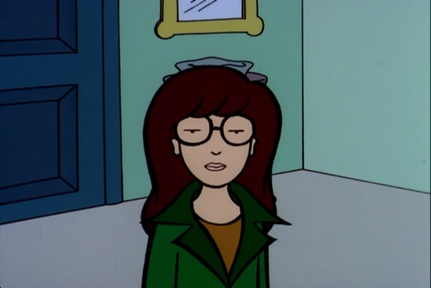
Putting Daria on this list is a total cliché. Yes, I’m a brainy female social outcast who wears glasses, says sarcastic things, and is often frustrated with mainstream culture, there you go. Daria is still a combination of the person I was in high school, and the person I wish I was in high school. And long past that period, when America’s obsession with high school remains baffling, Daria is still an icon of mine.

 It’s not entirely accurate to call her a source of inspiration, since she has a lot of flaws. Yet that is part of Daria’s charm; viewing the series as a grown woman introduces that new layer of appeal, namely that she is and has always been a well-crafted character that any kind of writer can appreciate.

Daria lives in the America you know, only dumber. Originally a foil to Beavis and Butt-head (made to provide an intelligent and poised female student in contrast to the two male dumbasses), her family moved to Lawndale, as she moved into her own spinoff.

In between dealing with the stupidity of life, Daria enjoys books, the perpetually-airing TV show Sick Sad World, and the company of her best friend Jane Lane, who had similar sensibilities but is the artistic instead of literary type.

As college grows nearer, Daria finds her preconceptions and habits challenged through the introduction of Jane's boyfriend Tom Sloane, who would also become Daria's boyfriend after a mess. Tom led Daria to challenge her attitudes and explore the negative aspects of them, but she mostly remained the same character.

The series finally saw a DVD re-release in 2010, due to years of licensing hell over the many pop songs used as incidental music. In the end, this music was almost entirely removed. Like most, I would rather it kept the original music, but the series was so important to me that I was not going to resort to bootlegs for the rest of my life.

During the intial wave of reviews following the DVD release, there were a few people coming out of the woodwork to indulge in trite moralizing against Daria-the-character. They seemed to miss the point, however: Daria was never an invincible character or mere wish fulfillment for those who hated the mainstream culture of the 1990s. Instead, she was a multi-faceted, multi-layered character who could be wrong, or could be hurtful, but also not to the extent of condemning female nonconformity and independence. This is true of the early seasons, and in fact I think the later seasons sometimes try too hard to put Daria in the wrong.

No matter what else, there is still a value, a rightness to Daria. Characters should not be vehicles to teach lessons, of course, but it’s still wonderful to see a smart female character as a lead, especially when she isn’t put on a pedestal. In a culture where women are encouraged to downplay their brains and avoid speaking their minds, it’s nice to have an alternative.

Friday, February 4, 2011

The Peculiar Olympians: Andromeda Shun


 “The Peculiar Olympians” is a series of blog posts about my most favourite fictional characters. They are each here for some combination of sympathy, empathy, inspiration, humour, quality, staying power, and/or significance to my relationship with fandom. These are not all the characters that I like, but they are the ones that have stood out to me the most. The list is also alphabetical and nothing more.

For a long time now, I’ve been fond of the anime character design known as the bishounen (“beautiful boy”). There is no overall bishounen character type to go along with this appearance, but at best, perhaps by accident, certain bishounen characters show that male characters can be strong without being traditionally “manly”. It’s one of the few things I’ll still admit that anime and manga has over western works.

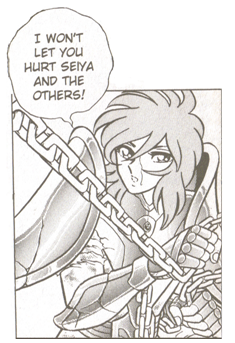
If my list of favourite fictional characters is meant to represent aspects of my fandom experience, then a bishounen character was a must for it. I decided easily on Andromeda Shun, from the manga Saint Seiya (know in various countries as Knights of the Zodiac). The character and premise goes a little something like this:

Since the days of myth the Greek goddess Athena has been surrounded by warriors who defended her and upheld the cause of justice in her name. Called "Saints”, they all wear Cloths, supernatural suits of armour that form a figure representing a constellation when at rest. There is a Saint for each constellation, and they are ranked Bronze, Silver, or Gold, as well as other side variants depending on whether it’s the manga or anime.

The continuing incarnation of Athena in mortal flesh ensures that Saints exist clandestinely in the modern day. The Bronze Saint Andromeda Shun is one of these modern Saints, an orphan who trained at the Grande Foundation with ninety-nine other potential Saints who would be sent off to remote locations for further instruction from a new teacher.

Shun's destination was Andromeda Island, a place of extreme temperatures off the coast of Ethiopia. Shun was trained by Silver Saint Cepheus Didaros. Shun's older brother became Bronze Saint Phoenix Ikki.
I didn’t choose Shun to represent my interest in bishounen characters primarily for his looks, as in the manga he’s drawn flatly, and in the anime his initial colour scheme is a clashing mess of green and pink--though in both cases he’s not exactly hard on the eyes. But it’s more because Shun represents the apex of “not manly, but strong”.

In my opinion, the most inspiring heroes are those who have to overcome something within themselves, in addition to their external foes. It’s a tricky thing to make a character’s pain convincing but not grating enough, so that the audience will not be inclined to wait for his rebirth, but Shun achieves it. For those not wiling to dismiss him, he proves to be very heroic. Even though he does not like to fight, he will stand and survive and make sure that others do the same.

However, the idea that Shun always needs Ikki to save him has become a meme of sorts in the series’ tiny English-speaking fandom. In reading the manga myself, I have not seen Shun save Ikki enough times for it to be approach meme status. I don’t know if my reading the manga instead of watching the anime makes a difference, but I just want to be clear that it’s manga-Shun that I base my study on, and that in that case, he very much holds his own.