Showing posts with label television. Show all posts

Friday, January 11, 2013

Shoulda Stayed Lost: Season Five of the 4Kids TMNT and Other Stuff


I could make an overblown speech about making the world burn with the sheer force of my nerd and not-nerd rage. I'm not gonna, but that's the state of mind I was in towards most of season five, the "lost season" of the 4Kids TMNT series. And after thinking it over…my complaints were totally legitimate.

No, nothing was ever bad enough to destroy the goodwill of previous episodes, but it was one hell of a firewalk. It started out mildly annoying, then went straight on to making me angry. Thank God it was half the length of a regular season.

I know this might sound odd coming from someone who loved Splinter so much, but I've never been all that excited when full-blown Martial Arts stuff comes into play in a Turtles universe, when it's all fantasy ninja stuff, all the time. So then, the Ninja Tribunal parts bored me to tears. Even the appearance of nicely-designed dragons couldn't help.

Apparently there is now this huge backstory involving the Ninja Tribunal and the Foot Mystics--and while it doesn't come out of nowhere, the support for it still feels weak. Furthermore, you push all these new characters on viewers, along with the Turtles' fighting companions, and expect us to care about them in such a short timeframe, and it doesn't work. What they tried to sell, I wasn't buying.

To make it worse, there are such blatant toy advertisements here, character redesigns and new characters that scream, "action figure variant!". The Turtles with their mystical patterns, Karai with her "Proton Pack", Bishop with his red circuitry suit, and so many of their enemies—it just looks silly.

I hated the idea of Tengu Shredder from the start. First off, his introduction starts as a cheesy McGuffin chase, and it results in a villain that has no panache, no style. He's just a roaring megalomaniac, without the cool air of Ch'rell. Even though Ch'rell eventually goes nuts, there's the principle to consider. 

Furthermore, while there's precedent for Shredder being a mantle, it still feels a little silly to hype up this powerful new villain, only to have him be one who looks and sounds like the former main villain. Calling him the "True Shredder" makes it feel even more fanfic-y, and I say this as somebody who's indulged.

And then there is Karai...the point at which my nerd rage tipped over into something stronger. It seemed that no one involved understood how terrible it looked to have the series' only female villain be completely at the mercy of the new Big Bad, especially when she had had barely any time to shine on her own.

This is shown without question, accepted without hesitation: a naked contempt for Karai's skills as a warrior and her strength as a villain. Every character accepts it, every character tries to tell her how futile it is, making Karai look ever more stupid for trying.

It's not about her being defeated by Tengu Shredder, really, but how she gets so little a chance to stand up to him, and after so short a career as the Shredder. She is frozen in mid-attack, fleeing in terror from a giant serpent, calling on her minion for help—and Tengu Shredder pins her to the wall and causes her armour to fall off and talks about making her his "slave".  Yeah, she's wearing a black body stocking underneath, but does that really make a difference? There is just no way to see this but that Karai being the damsel in distress. And it is absolutely awful. 

I've had my issues with this franchise's treatment of female characters before, but this takes home the prize. None of the blows that Karai manages to deal in the aftermath of the Tengu's attack  on her, nor the Turtles treating her as a threat, can do anything to change this.

The final twist of the knife is that Dr. Chaplin's attachment to Karai is valourized, treated with gravitas, is a romance in all but explicit name. This, from his introduction as a creepy Nice Guy who made robots in her likeness but never could be honest about what it meant, and who never had any positive traits at all.  

In short, Chaplin is living every creepy nerd-boy's fantasy of being given a hot chick without doing anything. There is enough of that disgusting shit in media made for adults; we don't need it here.

(Next time I see someone compare Dr. Chaplin to Fred Wolf Baxter, I'm probably going to twitch a little.)

The goofy style of the earlier episodes never quite disappears, and in the end, it all seems like it's cribbing from children's anime in the worst way, with all the silly glowing doodads and garish, over-designed costumes. And you know what? I love dragons, but we still don't need 'em here.

Also, when did Hun become so stupid? He's acting like the meathead lazy writers would have already made him into.

It therefore is no surprise that I felt no sense of suspense, no sense of tension, when all of this came to a head and there was a huge battle between Tengu Shredder and basically the entire cast. I just watched, fuming in silence. The arrival of Hamato Yoshi's spirit was pure deus ex machina, made worse that it happened multiple times.

There were only a few things to cool the fire. A story with Splinter and the younger Turtles is always a treat, and the design of the Bone Demon was really cool (hey, Playmates, where was the action figure of that?). I'm also always happy to see Baxter, even if he's never happy anymore—at least his robot body has "put on some pants". The Baxtertank was sure unexpected, and I'm glad he didn't get eaten by a dragon.

Urgh.

Ancillary Turtles Stuff

Naturally, with such a short period of time, there isn't much of a chance to build up things. But, I have to talk about something else, so let's get this circus rolling.

Hearing that the IDW comics series has dark and edgy Neutrinos made me laugh so hard that I've come the closest ever to going to pick the series up, though I still haven't.

I am still taking it slow going through the Fred Wolf series, watching more of the third season. I guess I sometimes need to prep myself before watching this series, which I still feel weirded out by. Where the heck are my nostalgia goggles? I remember many of these episodes from when I was a child, but I'm looking at them like I would a show airing today, with a sharp adult cynicism.

Some of them are still too annoying to finish, and I give myself leeway to stop any time and not finish every episode.

I let myself do that, because out of the almost two hundred episodes, there are none I actually need to see. With the 4Kids series I want to be a completist, because I still respect it, and there's continuity and things.

However, there was one goddamn episode I hated but forced myself to...watch parts of, because I needed something in it for something. That was "Raphael Knocks 'Em Dead", which didn't have the prime Fred wolf villains, but, it was basically the "giggle ray" episode. It centers around the characters telling jokes, and I don't have to paint a picture of how horrid an episode like that for this series is. Stick to sass, Raphael.

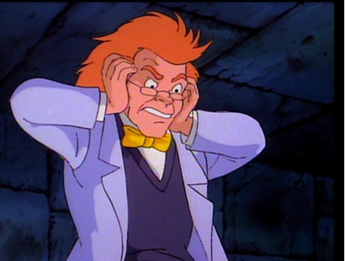
And somebody got the brilliant idea to recycle human Baxter Stockman's model sheet, give him orange hair, and say he was "Barney Stockman" still voiced by Pat Fraley, and make him the mad scientist of that particular day.

Naturally, Baxter Stockman is irreplaceable, but I found the execution really funny, because Barney acts like Baxter on crack, constantly yelling and screaming and always showing his malicious side. He also seems to be more confident and competent a mad scientist, and treated like an equal by the gangsters who hired him. Despite his making the usual jokes you'd expect, hating to be mistaken for his brother and pitching a fit when it happens again and again, these are still hilarious contrasts, and I wish Barney was in an episode I could sit through.

I don't know how much of Barney's different personality was supposed to be different, and not just something the writers came up with at random, but it works. Hell, it even unintentionally suggests a reason for Baxter becoming insane and evil—it just runs in the family. Baxter might've wanted to go legit, but the little guy was a powder keg.

Depressing, ain't it? Heh, heh, heh.


Saturday, January 5, 2013

Scary Monsters, Super Creeps: Season Four of the 4Kids TMNT series and Other Stuff


Sorry for the long time this has taken: I did finish watching season four a while ago, but fell off the blogging wagon, as I tend to do.

After feeling each season was a "mixed bag", season four was the most consistently entertaining:  few hiccups, but overall an enjoyable run, with the filler being much more exciting than usual, so much that I didn't mind the lack of a main plot. Who would have thought?

While many would call the removal of a series' major villain a shark-jumping moment, TMNT thankfully has much more to draw on, so that it doesn't miss a beat between when Ch'rell is gone. Even Karai isn't in this season that much, proving that the TMNT universe doesn't have to be about the Shredder—but there creates another problem.

While I'm still not sure how Bishop's rogue clone gained the ability to control rats, 4Kids's version of the Rat King in "I, Monster" was wonderfully horrific. The Rat King has always been creepy, even in the Fred Wolf series, and even to a rat-lover like me—not because he can control Splinter, but because he's just so unsettling. In addition, ravenous hordes of almost anything can be scary, and rats are still creatures of pestilence. So "I, Monster" was a perfect atmosphere in which to show off the 4Kids Rat King.

(Incidentally, the term "rat king" also refers to a group of rats fused together at the tails and moving together. Some purported specimens have come down through the ages, but the veracity is doubted)

The path that Karai has chosen as avenger/replacement Shredder is exciting. Various media have made me skittish about female villains and side-changing, because it suggests female villains have to be more "moral". Thus, it's refreshing to have Karai not change sides. And it makes sense for her to do so.

I just wish she was in this season more often, since she seemed to be forgotten for most of it, and then the Foot Mystics played her like a harp. That part was disappointing, and I hope Karai will get back on that horse at some point, and not end her story defeated by talking garbage cans (who turn out to be aliens).

(Also, thank God they didn't give her armour boob cups)

Baxter Stockman isn't seen much in this season, but when he is, it's a hell of a thing. But before that, Baxter's poor attempts at ass-covering in "Outbreak" still don't phase me. I do still view 4Kids Baxter as respectable, but without failure and hubris, he'd be boring. I still think that when he does screw up, it's still within the parameters of this being a serious show, and of Baxter being a character who is more than comic relief.

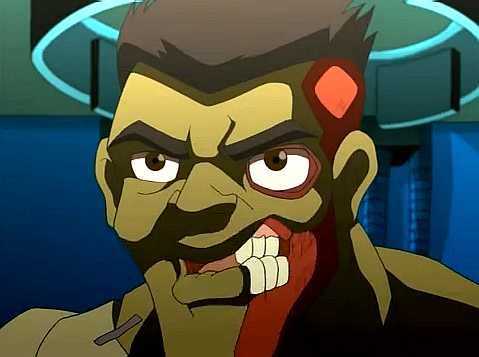
Hubris is at the core of "Insane in the Membrane", as Baxter is so eager to get a human body he ignores the possibilities of failure and pays a horrible price. It's an intense, scary episode, the first time since childhood that a kid's cartoon has actually shocked me.

I've spoken before about how showing a character's human side doesn't exonerate their actions, and "Insane in the Membrane" is a perfect example. It is not trying to tell us Baxter is innocent, but rather to display, neutrally, the visceral reaction that any person would have when faced with knowledge of their own failure, their own lost potential.

This adding of a sudden dimension to a long-standing character can be tricky, but here it's excellent. Regret is an aspect to Baxter we've never seen before, but it fits him perfectly. For all his ego and confidence, objectively Baxter's story has been a string of failures. To be reminded of the faith his mother had in him, and the many ways it all went wrong, helped to push Baxter over the edge quicker. He sees that his confidence doesn't measure up to the truth.

The gorier parts of the episode are also necessary to up that emotional intensity—it wasn't until the second viewing I realized the metal "stitching" on Baxter suggested he had been trying to staple himself together, the way we know he had been using nails for the same purpose. (Eeeeggghhhhh)

I don't believe kids should be shielded from conflict or terror, and it is an absolute shame that this episode was never aired in the U.S. Although, I do ask why nobody intervened when Baxter was degenerating. Maybe Bishop wanted to teach Baxter a lesson….

And then, goddamn, he's back, in that weird cyber-organic construct that looks to be made of muscle fibre wrapped around a metal skeleton; just another day in paradise for the guy named after a type of paper. With this, Baxter's fate goes from amusing and disturbing to just disturbing. He swiftly reasserts his arrogance, but now it seems defensive.

Poor guy. I find Baxter's failures amusing, but I like him, so it's no surprise that eventually my more standardized instincts take over. It's not like, say Dr. Venture, whom I also find entertaining, but I don't like—I wouldn't care if Rusty were hit by an eighteen-wheeler, but watching Baxter can be heartbreaking.

While you can do anything with a character in different universes, I guess I now have a solid investment in the image of Baxter Stockman as an evil but pitiful failure, and I liked the 4Kids version making this subtext of failure text.

The Mirage Baxter, at least in his first appearance, is merely defeated, but is not a failure, if that makes sense, though he is obviously the roots for the 4Kids version. Fred Wolf Baxter, as I've pointed out, has more in common with 4Kids Baxter than you might think, which is a topic I hope to get to once my 4Kids viewing is done.

The only problem with all of this is that the reveal of Baxter's past in "Insane in the Membrane" doesn't have any impact on his portrayal outside of that episode, at least so far. Baxter is back in his rut, being treated as he usually is, acting as he usually is. But I'm still so impressed that I can't fault the series that much.

"All Hallow's Thieves" was another good episode, since I'm a big fan of Halloween and this was a well-done episode. The thought of Splinter taking the little Turtles trick-or-treating was just so adorable I could die. However, I kept expecting the thief-demons to have an ulterior purpose, or to turn on the man who controlled them. Oh well.

I'm glad, for reasons of principle rather than affection, that Casey Jones isn't so big a doofus in this season. Mikey, on the other hand, is starting to get excessively goofy. Maybe I'm late to the party in noticing, but it's only just now started to bother me.

Not all of the episodes were that great. "A Wing and a Prayer" was boring, and I disliked the cliché of the technological Avian being the villain. And who didn't assume that the flatulent midget would be the Ancient One and teach Leonardo a trite lesson about failure? I like that Leo's anger wasn't resolved in a single episode, but the payoff wasn't that great.

The animated version of "Sons of the Silent Age" was also a disappointment—I really doubt Stephen Murphy intended the threat of genetic bottleneck to replace the immediate hopelessness of his original ending.

I don't like the conclusion others draw, that female mutants of any sort shouldn't be allowed because it would dilute the unspoken tragedy of the Turtles being the first and last of their new species, but a story stating that truth still strikes an effective blow, and it's a shame the TV version lost that.

However, I did like the 4Kids conceit of tying both the angels and the fish-men into the Atlantis legend. It doesn't feel forced at all.

"Samurai Tourist" was a lot of fun, especially since I've read some Usagi Yojimbo. I question the rhinoceros Gen eating the hot dog, but it does fit with Sakai's habit of avoiding most species-specific traits for his animal characters, apparently to minimize the amount of questions raised. There are exceptions, but mostly Sakai likes to write his characters as people who happen to look like animals, without the distinctive traits of their respective species.

I also did a mental spit-take at Gen dressing like Rocksteady. I thought there was no way Peter Laird would have let a joke like that slip through. Maybe he got downvoted.

"Adventures in Turtle-Sitting" was pretty fun, barring Baxter's sorry state. I'm glad Donatello's mutation wasn't solved at the end of the first "Good Genes" episode, which makes the story stronger.

"Ninja Tribunal" was a dud to end this season on, I'm afraid. I've got that sinking feeling that we're going to head into more boring tournament fights. But I'm going to soldier on

Ancillary Turtles Stuff

Mark over at TMNT Entity reviewed an issue of the Mirage comics that had a special place in my heart: "Twilight of the Ring", issue #37, one of the many guest issues from the first volume of the comics.

I was six years old in June of 1991 when I read this issue, a comic that looked like a strange thing but was still labelled "Teenage Mutant Ninja Turtles" and so my parents bought it for me. I can't pretend I came out of the womb with all my tastes and facilities intact: this issue was incomprehensible, disturbing, and frightening, unlike anything I had seen before, used as I was to the old cartoon. It disappeared somewhere in my old house and I never missed it.

(I still wonder sometimes how Mirage TMNT comics made their way to the grocery store comic racks, which was where I got the issue from.)

Today, "Twilight of the Ring" is the opposite: an exciting story that is beyond even the dimensions of the original comic. It takes the modern fable of dinosaurian obsolescence into fantastical, surreal territory, and is just plain fun to watch unfold. The way the forest changes around them as the story goes on, and the suspense as each Turtle begins to disappear while Donatello grows more unhinged...what used to be terrifying is now right up my alley.

It proves one of the strengths of TMNT, that I can get a story like this, then go back to giggling over the 80s cartoon and still accept that I'm inside the same media franchise. Anything goes, as long as the separate universes don't contradict their own tone.

Sure, there are Unfortunate Implications arising from a story about a spiritual reptile/mammal conflict when the Turtles count three mammals as family, but that just gives the story a little spice. The reality is that Leo is only returning the world to its natural cycle, and that giant rat/possum that they fight is not Splinter. (Though that might have been part of what scared me at the time.)

However, being a dinosaur fan of small scientific knowledge, I couldn't accept the suggestion that the tiny mammals of the Mesozoic could form hordes enough to challenge dinosaurs. The declaration of "They ate my eggs!" is particularly bad, since I've actually seen it proposed in old children's books that mammals eating dinosaur eggs was one possible cause of extinction—which really gives the tiny prehistoric mammals too much credit, like it's put in there for humans to feel good about ourselves.

"It Came from the Depths" was the last Nicktoons Turtles that aired before the holiday hiatus, and I still found it more enjoyable than what had come before. Maybe I'm finally settling into a groove with this series, and it's finally found its land legs. However, I still don't take back any of my complaints about the previous episodes.

This is basically the same origin for Leatherhead that Mirage and 4Kids did; I like some parts of that origin and not others. I like the idea that Leatherhead's creators cared for him, which the Nick show changes, and that he can be intelligent and erudite, which the Nick show keeps. The "Hulk Out" aspect of Leatherhead was tedious from the start, and here it still is. Nothing new, nothing gained.

In short, I'm waiting to form an opinion of Leatherhead here. What I do know, however, is that his head looks more like a crocodile's than an alligator's, and that's going to be bugging me every time I see him.

What I did like about this episode was Michelangelo being useful. It's so perfect to cast him as the "heart" of the Turtles, but the Nick show has been missing out on this opportunity in favour of making him a pure joke. I'm glad to see they tried to treat him as a worthwhile character, an idealist who might keep the Turtles from getting too dark. Keep it up, okay?

Splinter also steps up to the plate, showing more sides to his personality than that of the stern taskmaster he was in every episode I've seen (note: I still haven't gone back and watched the pilot), making funny comments that seem to have some gentle humour beside them, and getting involved in physical combat.

That was pretty cool, though I didn't enjoy it as much as I would seeing a nostalgic Splinter fight. Once again, it seems an interest in Splinter is almost entirely dependent on nostalgia and is difficult to call up outside of that. I shouldn't see it as damming, really—I'll talk more about this when we get to Turtles Forever, and I promise I'll have something new to say.

(I honestly don't mind a tall Splinter, though, since a character's height usually has nothing to do with the emotional investment you have in them, and Archie Comics' Splinter eventually came to be tall anyway)

Because of this, I can't decide if it's more effective to have Splinter only fight when circumstances get the most intense, or if he should casually enter the battle when the writers feel like it, the way the Splinter of my childhood did.

I've also noticed that veteran male TMNT fans like to speculate that Donatello's crush on April in this series will draw in more female fans, which lead to a chain reaction of awful opinions about women expressed by the fandom.

It's narrow to think that romantic stories (if you can call Donny's manic but silent crush on April "romantic") are the only kind women would be interested in. The worst example is referring to Donatello as being like the "Edward Cullen" to female fans, as if the only comparison they can make is to use the most alien example of mainstream female culture that they still know.

I don't doubt there are differences between the ways men and women "do" fandom, but that doesn't mean casting female fans as strange creatures is right. It's no chore to treat any new female fans as people. To not think of them as simply creepy weirdos, or be only able to view female interest in Turtles through the lens of mainstream female culture.

Yeah, I personally find attraction to any Turtles character who isn't a young, fit human to be a little disturbing (I'm not into guys who are older than me, crazier than me, or who might carry the Plague, in other words), but that's my cross to bear. There's a definite double standard in calling out female fans on their weird sexual obsessions while continuing to drool over April O'Neil.

Anyway, after thinking it over further, I would prefer if the Nicktoons series does something distinct with Baxter Stockman, even though I'm interested in him because he's heading towards that "mad scientist failure" quasi-archetype. He can still be that, but still be unique, too. At the moment, I don't believe he'll actually transform into anything.

Oh, and I feel sorry for those fans who keep insisting that calling the alien species "The Kraang" doesn't mean the appearance of a Krang character is impossible, and keep combing through the series for evidence that there is a Krang proper.

I'm reading the Archie comics again, which are a forgotten gem once you get past the terribly-drawn, terribly-written TV adaptations that start off the run. It's hard for me to be objective about them, but they seem better than the old cartoon, with the early issues having a spirit of cheerful childishness but never leading to the feeling like my brain is being crushed like a paper cup. It builds up continuity with care, and becomes stronger as time goes on.

The environmentalism is still grating, but less than I think it would be without the nostalgia filter. I can't say I actually like any character that I used to, except for my nostalgia-powered Splinter obsession. That's not surprising, when my reason for liking most characters was at the time, "turns into an animal I like". Characters like most of the Mutanimals have personalities, but just not ones I get into.

I did receive the Turtle Van box set for Christmas, and I intended to watch more Fred Wolf Turtles, but I kept getting sidetracked. I think I just need to prep myself any OT episode viewing that doesn't feature my favourite characters, Splinter in the spotlight, and Baxter simply being there. What the heck is wrong with me?

Till next time.

Sunday, November 18, 2012

Lola Bunny and "The Looney Tunes Show"


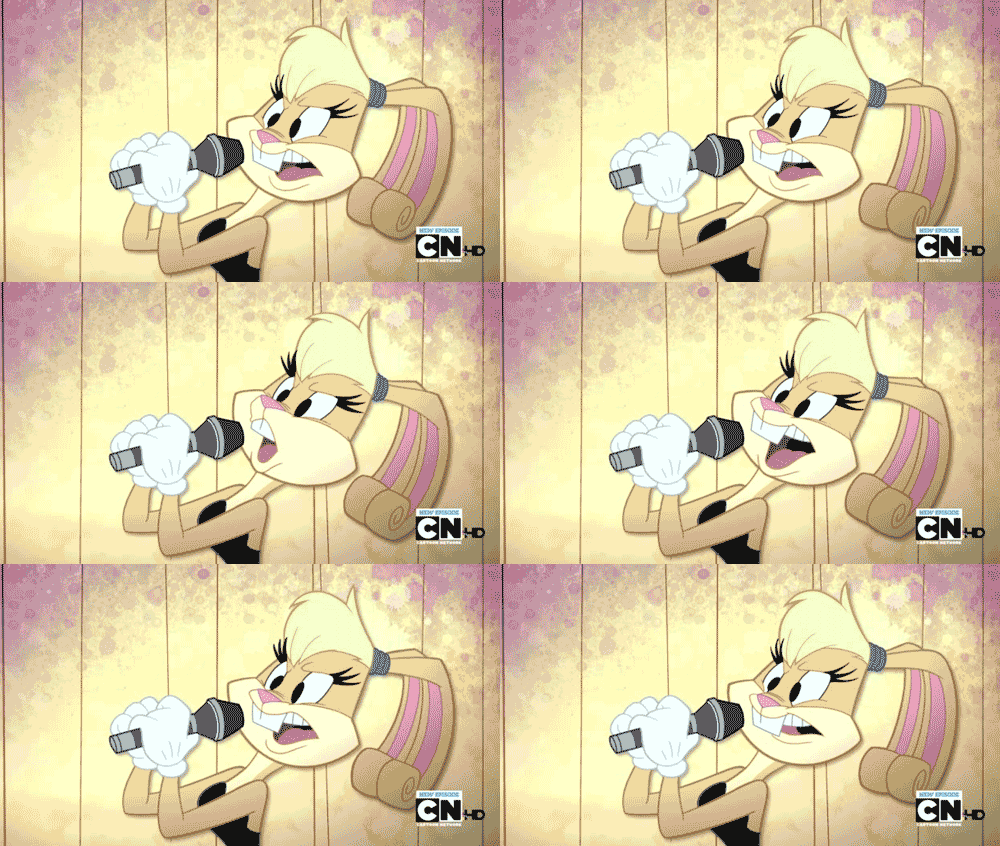
Image from Toony Time

I have a dog in this fight, but it's more like a Chihuahua. Still, there's an opinion I have to share: Lola Bunny is the best thing about The Looney Tunes Show, and a character who is a million times better than her initial appearance in Space Jam. Not that being better than Space Jam Lola is hard, but I appreciate the principle.

I don't have a problem with adding new Looney Tunes characters, male or female. If you are trying to bring back fondly-remembered characters, you're already going to have to rewrite them, so adding a new character to suit the changing times also shouldn't be out of the question.

The trouble with Lola Bunny (voiced by Kath Soucie) was only that she was a shallow character, and one that had no comedic aspects whatsoever, no one involved in her creation who pretended they were making a new addition to a comedic cast. In Space Jam she took herself entirely seriously, and the narrative let her. She was saved from slapstick instead of participating it. All of that sounds like nothing a Looney Tunes character, however removed from their original roots, would be. And there's that creepy sexualisation….

And dammit, Lola felt so calculated. Tokenism isn't adding a minority character itself, but adding them superficially, not as characters, but as points to score with advertisers and executives. The way that Lola Bunny was so distant from anything recognizably Looney Tunes shows how little effort was put into making her.

Lola from The Looney Tunes Show (voiced by Kristen Wiig), on the other hand, starts out as an insane stalker with the attention span of a very stupid insect. Canada is behind on episodes of the series, but from where I sit, Lola is now, actually a funny, cartoony, loony character. She's exactly what a comedic female character should be: subject to the same pitfalls and pratfalls as the male cast, instead of getting stuck being the moral centre, the "straight" one who is there to roll her eyes at the men's antics.

Some have taken offence to Lola's insanity, saying that it pushes the idea of women in love as desperate and crazy. But craziness should be allowed in cartoons, and Lola isn't defined by her relationship to Bugs: she's got a weird personality that shines through everything she does, and that is what defines her, rather than the attraction to Bugs (unlike Space Jam, where "love interest" comes above "sexy basketball star"), and furthermore, her possessiveness of Bugs is just plain fun. Lola is simply a complete and total nutbar, and it's not because she's female—it's because she's a funny cartoon character. In addition, she does things without Bugs, such as the President's Day song.

Lola still might not be to everyone's taste, because the writers do a very good job of making her sound and act exactly like the type of flighty, rambling person that you might encounter in real life and have grate on your nerves. There's a certain realism to Wiig's line delivery that you don't get from a lot of cartoon characters, including everyone else in the cast. But for all of that, Lola is likable, so that you can enjoy her enough to appreciate that quality.

However, while I like Lola, I don't find The Looney Tunes Show to be that interesting. I'll watch it when it's on, but it doesn't grab me. It's not that I'm a big fan of the original Looney Tunes shorts and don't like to see them changed: I like those old cartoons, but they don't loom large in my mind. It's just that something feels unnatural about The Looney Tunes Show, the sheer weirdness of trying to place characters from the 30s-50s into a modern style of humour and pacing.

My inner schoolmarm likes to wag her finger and remind me there's nothing that can't be done well, but even so, you've got to establish these personal standards, so you can get a better idea of what you want from entertainment. You are free to make exceptions to these standards at any point, but you have to make note of them.

In this case, I'm usually not comfortable with the idea of "eternal" fictional characters, being remade for every era and taste, long after the creator is gone. I see this as based on the conceit that a character is just an image, and not a personality that depends on their era. I believe the opposite….a character can't just be ported from one era to another, but we do it because of the longer and broader reach of mass media today, where because we can touch the past so easily, we can bring it back in a new form just as easily.

Lola Bunny is a good example of this. She's a fun character, but she's so obviously the product of a modern style of humour, it shows that Looney Tunes have to be totally rewritten to conform to modern standards, and I fundamentally don't understand why writers need to go through that trouble, instead of creating original characters. It's because I'm a nerd, I guess, who doesn't emotionally understand the value of name recognition or why going with a recognized brand is still "safe" even if you have to rewrite it.

That stays true, even if I think Lola is damn great. We need more cartoony female characters, and if something like Lola can be turned to the side of good, then we can hope for more cartoony female characters to show up in unexpected places.

Thursday, October 11, 2012

Shows for Grownups: Weeds


I actually watch a lot more live-action TV than I let on, it's just that the cartoons are much more fun to write about. A friend recommended Showtime's Weeds to me, and I was hooked through all eight seasons, taking them in through rentals and downloads.

Weeds is the story of Nancy Botwin, a rich suburban housewife who takes up pot dealing to support her lifestyle and family after her husband's sudden death. As the series progresses, she constantly gets in deep shit but manages to keep coming back, as you do.

What excited me most about this series was that Nancy was an anti-hero, but also a woman and a mother. That's so rare, even though it shouldn't be. Apparently Nancy gets a lot of shit for being all these things, more shit than perhaps a father in her situation would get. I know why this happens, but it's no excuse: if you really want to see a show for adults, you should move past the immature beliefs in female moral superiority, or that motherhood is the only sacrosanct profession.

Being an anti-hero and not a strict villain, there are moments when Nancy loses it, moments where she sheds tears or is in a vulnerable situation. Yet that doesn't change the fact that it's her fault, and that at times you see that Nancy enjoys this. She will grin and puts her feet up on the dash, ready for a new adventure. Eventually she does grow tired of that life, but it takes coming the closest she's ever been to death to start her on that path, and even then her life never truly returns to normal.

This demonstrates something about characterization that should've been obvious to me, but took a long time for me to put into words: that while we all should ask for characters who aren't purely good or purely evil, it's still easy to judge characters for the acts they commit, and know that circumstances don't excuse actions taken.

In this case, we might feel sympathy for Nancy at times, which makes the series effective, but she's still a criminal who wrecked her life and that of her immediate family. She could have had a back-up plan as a housewife, or she could have done anything else legal or taken a cut in her lifestyle. If she had, there would then have been no story, but even so, Nancy is not a good person. Toxic, even.

Weeds is also not a series that rests on the laurels of its setting and cast. After the first few seasons, the Botwin family leaves the setting the series began in, and then later Nancy goes through with a third pregnancy, while they keep changing locations. These constant changes are one of the many reasons I'm thankful for cable TV: I tend to prefer stories that change as they proceed, moving from setting to setting, and television often has problems with this process.

Suspense is also one Weeds' best qualities. The best moments have you certain that there is no way the characters are going to escape without their brains blown out, and yet somehow they do…until the next time, when the cycle starts all over again. Weeds is also a very, very funny show, too. It has you laughing almost as much as it tenses you up, sometimes laughing at jokes you thought you never would, or at least not in public company. This is another thing I'm thankful to cable TV for.

The series ends with a return back to where it began, which is appropriate, I think. Nancy had exhausted her world and as she was trying to change, and stopping her cycle (as well as she could), going back to the beginning was both surprising and makes sense. One hell of a ride from there and back again, certainly.

Thursday, May 17, 2012

Princess Jellyfish: Ambiguity and Fashionable Geekdom


I love this series because it is sweet and entertaining, but it's also got depth, refusing to offer simple scenarios or simple answers. Also because it hits a little too close to home in both a good and bad way, and far more directly than any other anime that I can make that claim about.

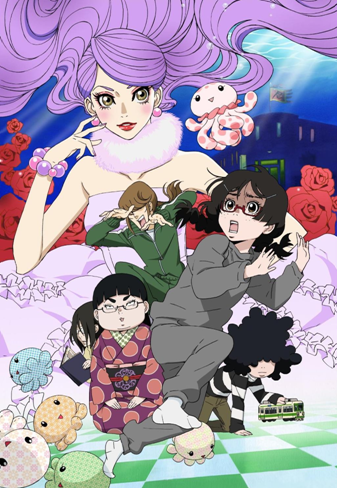
Tsukimi Kurashita is an eighteen-year-old girl who moved to Tokyo to become an illustrator. However, she has not gone anywhere yet, and is living in a small apartment block with "The Sisterhood": four slightly older women, and one female manga artist who is never seen and communicates with notes under the door. All visible members are "otaku", characterized by obsessive focus on a single thing, and with the typical social awkwardness and unfashionable dressing this suggests.

For Tsukimi, her "thing" is jellyfish, which are also connected to nostalgic memories of her deceased mother. When she makes the regular trip to the pet shop to talk to her jellyfish friend, "Clara" (a play on "Kura", as in "Kurage", the Japanese word for jellyfish), she sees Clara's tank now has another jelly species whose secretions are poisonous to her/it. Tsukimi tries to muster up the courage to talk to the hip clerk in the closed shop, but can't succeed…before a glamorous girl shows up and demands Clara for Tsukimi. Shocked at the kindness of one of "The Stylish", Tsukimi takes Clara home with the girl in tow.

This girl is actually a boy: Kuranosuke Koibuchi, the illegitimate son of a powerful political family. Kuranosuke regardless lives with his father, and cross-dresses to come off as too crazy for politics, and to reconnect with the glamorous mother who was pressured into giving him up. Kuranosuke genuinely likes living with the Sisterhood, keeping up with a disguise that only Tsukimi knows is false, which is good, because the apartment is a "nunnery", with no male tenants allowed.

Kuranosuke also wants to be the one to get them dressing better and acting better, especially because their apartment block is threatened by redevelopment, and they need to become respectable to protest it. Furthermore, they are going to try to raise money to buy the building. They start out with the flea market, and end up trying to create a line of jellyfish-themed dresses for sale. Oh, and in the middle is a very awkward love triangle between Tsukimi, Kuranosuke, and Kuranosuke's older ("legitimate") brother, Shu.

Shu catches sight of the first made-over Tsukimi and is immediately smitten, despite their being over a decade of age difference (Shu is thirty). It takes a long time for Shu to realize who Tsukimi is, seeing her several times in her regular sweats, and assuming the made-over Tsukimi is a different girl. The age difference is, I guess, supposed to be overwritten by different cultural standards, and the fact that Shu is a virgin who's never been kissed or been on a date, putting him on a "young" level and equivalent to Tsukimi's inexperience, but it's still a little creepy.

There's a fourth person who has the potential to get with nobody but Shu: Shoko Inari, a woman involved with the area development. She slips Shu a mickey and tries to convince him they had sex, in order to blackmail him into supporting the project to Shu's father. There are some genuinely poignant moments at first, when Shu comes staggering home with his clothes rumpled, and then goes to Tsukimi's just to hold her hand, but the rest of the story is played mostly for comedy.

Inari fancies herself a femme fatale and expert manipulator, but is prone to explosive, cartoony rages and behaving like a child. When Inari starts following Shu around to get her blackmail, it's played as comedic rather than disturbing. To make it worse, it eventually looks like Inari might be falling for Shu genuinely. Neither the anime nor the manga has anything happen between them, but the direction creates further discomfort. It's not entirely okay for Shu to be in love with Tsukimi, but this isn't the best alternative.

A series about female geeks, in large number and without male counterparts (though one could argue that Kuranosuke is a "fashion geek", and his family has a chauffeur named Hanamori who is quite obsessed with his Benzes), is something unusual. That it's unusual is not surprising, given certain perceptions of gender, but it's good to have something different, anything that demonstrates that female characters can be flawed in that very real way, without pulling back. Though Tsukimi has the most development, you would know people like every "Nun" if you hang in geeky communities. The only exception might be Mayaya, obsessed with the Three Kingdoms, who becomes a "cartoon" by yelling her sentences and making vaguely martial-arts poses and hand movements.

Of course, few pieces of popular fiction remain static as their story progresses, and these characters must change from what they were. The use of makeovers does mean the story is simply about the female characters learning to be "normal", however. There are many layers to the presentation, so that the audience is not left with a simple understanding of what Tsukimi "ought" to be.

Sometimes there is the sense that Tsukimi should break free of her otaku bubble, with her friends being potential dead weight because they have weaker characterization and less ambition. The major exception is Chieko, invested in traditional Japanese dolls and clothing. Her mother owns the building and she functions as the "den mother" and is also a wizard at sewing, meaning she has some skills and practical intelligence to offer. Chieko helps to make sure Tsukimi's friends aren't just obstacles to her becoming "normal".

Yet at the same time, Chieko is not as complex as Tsukimi, and the rest of them (Bamba, Mayaya, Jiji), are far less competent. They are eternally reluctant to help out and easily distracted, by their obsessions, their laziness, some good food, or by their fears and persecution complexes in regards to the fashionable elite. So the picture is not rosy either.

Tsukimi also keeps switching back and forth in her appearance, and Kuranosuke in fact surprises himself by being happy the first time he has seen Tsukimi changed back. Tsukimi's musings also include questioning of whether women truly do need to become "princesses" to be happy.

Kuranosuke also starts to perform his technique on all the other "outside" girls except for Chieko (whose signature kimono can blend in with the fashionable), and they continue to be unchanged in other ways. When Kuranosuke takes them all out to a cafe, Bamba is watching for trains and Jiji is watching for old men, their respective obsessions. Furthermore, Tsukimi's love of jellyfish, the main characteristic of her geekdom, becomes fuel for artistic creativity, meaning that not everything about her needs to be changed. The popular presumption that a makeover will make a character automatically more poised is therefore challenged, but it could go other ways than just to make it so that fashionable dressing is no big deal.

Before this, it is also made clear that the Sisterhood has a persecution complex/fear of "The Stylish" that at first seems ridiculous once we meet the friendly and glamorous Kuranosuke, whom everyone but Tsukimi are unjustifiably abrasive towards when they first meet him. Yet Inari and others also confirm their implied fears, that "The Stylish" are not only different from they are, but predatory and nasty.

This is what I mean by Princess Jellyfish offering no easy answers, and audience reaction to it is bound to be equally complex. While a story isn't obligated to be politically correct, it's always harder to get viewers on your side if a story has the already-looked down on groups of society do as they are already encouraged to do in real life. And where is the line between taking care of yourself and arbitrary standards of beauty? It is convincing when Kuranosuke tells the Sisterhood that to be taken seriously in protest against the development, they must dress respectfully, i.e. fashionably, but Kuranosuke, as a disguised boy, can also reject the trappings of femininity anytime he wants, while the Sisterhood, as women, are asked to consider them obligatory rather than a personal preference. One's interpretation of what this series is doing may depend largely on their personal experiences.

One could argue that Princess Jellyfish involves pandering to its audience, with what is technically a story about a plain girl (potentially) getting a beautiful boy. Yet pandering is fine if it's not obvious, and the quality of the main characterizations, and the constant shifting the series undergoes makes Princess Jellyfish at least look objective. The makeover plots have made so that Princess Jellyfish can't be a total reversal of the "plain guy gets beautiful girl" plot already, either.

However pandering, romantic, or comedic Princess Jellyfish might become, though, Tsukimi's awkwardness and fears feel extremely real for anyone who has ever undergone something similar. ANNCast even made note that Princess Jellyfish is a series that is about a fundamentally female experience, or at least, a contemporary, urban "female experience" rather than a universal one. It maybe Japanese, but I, as a North American viewer, still "got it". It's not about Princess Jellyfish being a "chick show", but something more about the day-to-day living as a young woman whose life didn't follow the script, both by accident and design. Yet anime fandom was raving about this series, so it must speak to male viewers as well.

Princess Jellyfish is not perfect. As I suggested, the focus is on Tsukimi, and while the other members of the Sisterhood  have character, they don't change or develop as the plot progresses, and often serve as just comic relief or sewing machines. While the makeover plots mostly do a good job of justifying themselves, Kuranosuke's desire to get rid of Tsukimi's glasses or saddle the girls with high heels brings slight physical crippling into the mix and is harder to accept.

I also have a slight preference for the original manga version. The anime isn't bad, but in the name of finishing off a series while the manga is still ongoing, the characters' outward problem is solved too quickly, as Chieko's mother shows up and tells them she isn't selling the building after all, and the love story is still left open. It's better than if the series went on longer and added more of its own off-the-cuff material, but it means the series is not as fulfilling as it could have been. The manga version takes more time to flesh out the story of characters trying to solve their money woes, and probably will finish off the romantic aspect in some way. Unfortunately, only the anime is officially available in English, while the manga is confined to scanlations.

Aesthetically the series is also successful, though the realistic setting dictates everything be low-key. The dubbing is good, so is the original Japanese acting, and the score is okay. The animation in the TV series is decent, and the artwork is great. Every character looks distinct, which is especially good for the female cast, because female animation designs rarely have that same sense of character that male designs are allowed. All of the Sisterhood looks different, and though tiny, afro'ed Bamba and lanky, square-jawed Mayaya might seem too unfeminine for some viewers, it's refreshing to have this difference.

The opening is cute, with the characters acting out western pop culture references, but the song is the singer's plea to live a gentle life without frustration, and one wonders if it is meant to be critical of the main cast. The closing series has child versions of the Sisterhood and Kuranosuke playing in a park, depicted with a lack of outlines and a slow camera pan, and it's cute in a different way.

This review is so long because Princess Jellyfish is just that great. In some ways it's a different kind of series, and the progression isn't obvious or easy for anyone involved. Tsukimi is easy to relate to, but the writers aren't afraid to let her change..yet without removing what makes her interesting. A lot of things remain anyone's guess, and if the elements described have intrigued anyone, the series is worth your time.