Watch this space.

Showing posts with label RoM. Show all posts
Showing posts with label RoM. Show all posts
Saturday, November 26, 2011

Wednesday, November 10, 2010
Reflections on Macrophilia Part 8: Conclusion
To recap: I love the Zentradi because I found that their original story resonated with me in a peculiar way, unintentionally touching on some of my personal ideals and desires. This was filtered through some appealing characters with their own stories to tell and their own initiative to take. Above all else, I grew attached to the human-friendly male Zentradi from the SDF-1 era (Exedore, Breetai, and the spy trio), with Exedore being at the forefront, because they were the characters who most strongly embodied the themes and ideals of the Zentradi. Exedore was the one I liked with the most, because I empathized with him the most obviously, and continued to like him even when he was re-imagined as a new character. Anything else related to Macross or Robotech was a distant interest at best.
It might be argued that being primarily a Zentradi fan makes me a Macross fan by default, and I’d agree: I am a Macross fan. However, it doesn’t logically follow that I must be a Macross purist, too. It’s easy to say that Robotech offers nothing once one discovers the three separate original series, and I’d argue that is true for most when you strip away the nostalgia for Robotech. Yet it’s not that simple for me. Certain small things that Robotech once did with my favourite Zentradi are essential to my personal fandom, and I can’t give those things up, regardless of the crude, fake nature of their material.
Furthermore, when I’m involved with Robotech there is this sense of assurance that I can act on my automatic impulses and desires, be myself, spread my wings, have fun, rather than rework and twist my perceptions to try to fit the radical alterations made by Macross. I understand that the quality of the Macross stuff is better, and overall more supports the themes that drew me to the Zentradi, but those are not the only issues. The mishandling of my favourite Macross characters will always be a black mark.
Because of this comfort, early on I mistook myself for more of a Robotech fan, before reconsidering the complex issues surrounding this assertion. However, because I still allow Robotech to come into competition with Macross and in some ways win, such as in preferring Sentinels Exedore to Neo-Exsedol (strictly on a level of personal fondness rather than artistic legitimacy) , I can’t be a simple Macross fan.
Yet Macross is what originated the Zentradi. The first series is even better in its original presentation, and there are good things about Macross’ handling of the race. If I had the option of tweaking one universe or the other to contain my “ideal” Zentradi treatment, it would be a hell of a lot easier to remake Macross to my own standards.
Since the reality is what it is, I have to adapt. When neither the Macross nor the Robotech franchise alone can give me the basic whole of authenticity, quality, perpetuation, and pleasing treatment of my favourite characters, I have to choose both in the end. Despite the difficulty this causes, I do truly enjoy what I did get out of the experience.
It might be argued that being primarily a Zentradi fan makes me a Macross fan by default, and I’d agree: I am a Macross fan. However, it doesn’t logically follow that I must be a Macross purist, too. It’s easy to say that Robotech offers nothing once one discovers the three separate original series, and I’d argue that is true for most when you strip away the nostalgia for Robotech. Yet it’s not that simple for me. Certain small things that Robotech once did with my favourite Zentradi are essential to my personal fandom, and I can’t give those things up, regardless of the crude, fake nature of their material.
Furthermore, when I’m involved with Robotech there is this sense of assurance that I can act on my automatic impulses and desires, be myself, spread my wings, have fun, rather than rework and twist my perceptions to try to fit the radical alterations made by Macross. I understand that the quality of the Macross stuff is better, and overall more supports the themes that drew me to the Zentradi, but those are not the only issues. The mishandling of my favourite Macross characters will always be a black mark.
Because of this comfort, early on I mistook myself for more of a Robotech fan, before reconsidering the complex issues surrounding this assertion. However, because I still allow Robotech to come into competition with Macross and in some ways win, such as in preferring Sentinels Exedore to Neo-Exsedol (strictly on a level of personal fondness rather than artistic legitimacy) , I can’t be a simple Macross fan.
Yet Macross is what originated the Zentradi. The first series is even better in its original presentation, and there are good things about Macross’ handling of the race. If I had the option of tweaking one universe or the other to contain my “ideal” Zentradi treatment, it would be a hell of a lot easier to remake Macross to my own standards.
Since the reality is what it is, I have to adapt. When neither the Macross nor the Robotech franchise alone can give me the basic whole of authenticity, quality, perpetuation, and pleasing treatment of my favourite characters, I have to choose both in the end. Despite the difficulty this causes, I do truly enjoy what I did get out of the experience.
Reflections on Macrophilia Part 7: General Portrayal of Post-SDFM Zentradi
When considered beyond the annoying treatment of my favourite characters, the status of the Zentradi in the post-1982 Macross productions looks like a gift: they live human lives, with human bonds, and none of Robotech’s messiness. Yet despite the race’s general happiness, I just don’t find much that is compelling about later Zentradi characters, and there are a few additional difficulties I have with it. In this discussion I include hybrid characters, though some of those characters of course are portrayed as more “Zentradi” than others.
At this point in the timeline, the thematic appeal of the Zentradi passes on to other characters and antagonists. It up only to the characters’ individual appeal to create an interest in them, which they can’t seem to do. Instead, Zentradi introduced after 1984 trigger a variety of responses in me: they are mildly objectionable, or good for a few laughs, or fulfill my personal ideals for Zentradi-dom but without much characterization. I don’t want to take up a great deal space in this essay discussing them; I do genuinely like a few of the newer Zentradi characters, but not as deeply as I did the original ones, not enough to have any strong emotional investment in their respective anime.
Human characters remain the primary driving force of all new Macross narratives, with full-blood Zentradi as secondary, tertiary, and background characters who may or may not be treated poorly by the plot. Sometimes part-Zentradi characters receive major roles, but they also never turn out to be very gripping, and their heritage has superficial or negative relevance.
That’s not to say I’m not cheered by Macross 7 and Macross Frontier depicting crowds of Zentradi (now distinguished by their retconned pointed ears) dressing and acting just like modern humans, because that represents their freedom in the most obvious, immediate way. However, there are more complex possibilities than choosing between an image like that and a monotonous life of war.
Another bugbear is that strong double standard of characterization when it came to the Zentradi genders, going right back to the original series and then extending it. Male and female Zentradi are treated very differently by the narrative, and seem to both fit into separate but dubious moulds.
Male Zentradi characters are usually depicted in either a purely military or a purely pleasure-seeking/civilian context, and are side characters without much development. When they are full-blood male Zentradi, there is also a tendency to recycle or riff on their predecessors’ obsession with female pop stars, as if being a pop star fanboy was part of the Y chromosome.
Minmay was important to Zentradi, yes, but it’s strange to think that her image still dominates their lives to that uniform a degree. For one thing, it seems to suggest that male Zentradi characters are underdeveloped and unchanged, instead of being the product of generations of societal change. That they'll always look at her the same way.
It further suggests these characters are not to be taken seriously, as the writers reference the older “Minmay cult” but take away the heart in it, leaving just the comedic aspects. The original Minmay fanboys balanced being goofy fanboys with some characterization, and the high command had different reactions to her. The newer characters do not possess this range, and seem to be acting like fanboys because the writers want a homage, never mind how little sense it makes. There were reasons why male Zentradi loved Minmay, but they just don't apply anymore, and shoudn't transfer to any pop star.
One of the worst examples is probably the episode Fastest Delivery of Macross Frontier, which reduces the Zentradi characters appearing in it to grim threats or ineffectual “good guys”, almost all of whom are total fanboys anyway, and swiftly killed even after they avert a crisis situation. It looks like they're not "real" characters and don't matter.
In the same series there was also Richard Bilra, whom, despite his name, was a full Zentradi and a powerful mogul in his own right. He also had a dream to create a galaxy-wide communication network, showing just the kind of ambition, intelligence, and initiative that I wanted to see out of the latter-day Zentradi characters.
However, the end of the series shows that Bilra may have wanted this only as a method to find Minmay, who in the Macross continuity was literally lost in space. It is never made clear if this really was Bilra’s only reason for wanting what he did, and I’d really like to believe it wasn’t, because it makes him defined solely by Minmay, and not as a character himself.
Whenever there is danger from rogue Zentradi, it is usually from males. And it is Guld Goa Bowman, a male part-Zentradi character, whose heritage is shown to make him tragically dangerous; viewers are obviously meant to sympathize with Guld, but judging him as a character rather than being under the “fault” of anything, I disliked him intensely. Later male hybrids such as Michel Blanc or Brera Sterne at least mitigate this by having some Zentradi blood but being heroic and likeable, but their heritage gets less of a mention at all.
It often seems like male Zentradi characters can be slotted into a few character types, with difficult implications throughout, and are usually not given as much prominence as characters. Yet for all this, the series also depicts them in a wider variety of occupations and character types than female Zentradi.
In contrast, female Zentradi characters are often part of the main cast, and have lives with both military and domestic aspects. Nonetheless, most female characters that have Zentradi blood are either “perfect” hotshot warriors, happy, bouncy cute girls, or some fusion of the two types. Exceptions are rare: Milia certainly fit this mould in her youth, but her older self is a different sort of character. Stoic, muscular Veffidas Feaze of Macross 7 is a more notable exemption, but she is a character who rarely speaks and is not well-developed.
Danger from female Zentradi is also rare; when they display wrath, it is usually righteous. Most part-Zentradi characters are female, but they are all tractable as well. “Fleet of the Strongest Women” provides some exceptions to this trope, but it’s not enough.
Both of these portrayals have their bad points. On the male side, I wish that the Zentradi gender populated by what is in some ways a more varied range of characters would get more prominence, and that there would be some challenge to certain memes about male Zentradi. On the female Zentradi side, while “strong female characters” are a good thing, here such portrayals seem driven by a desire to idealize women instead, and you get a sense of dull standardization rather than something worth cheering. Female Zentradi characters are not interchangeable, but they often seem very close in looks, personality, and roles, which makes them uninteresting.
Ultimately, the best thing would be for a range of Zentradi characters of either gender. There would be some room for aggressive male hybrids, shameless Minmay fanboys, sexy female pilots, and adorable hybrid girls. But I just wish that they did not dominate Zentradi portrayal. They are restrictive images, and some of them were expressed better in the original series.
The issue of internal danger from seemingly assimilated Zentradi was also a difficult thing in itself. I do not want the Zentradi to be portrayed as saintly, but I want characters to be responsible for their actions, instead of making them out just poor things that can’t help it. If the Zentradi are always dangerous, never able to overcome their warlike urges, why tell a story of their escape? It’s just as bad when Macross implies it as when Robotech states it.
I interpreted Super Dimension Fortress Macross’ depiction of some Zentradi turning on humans to be attributable to the Zentradi’s personal failures to adjust to a new world, something that humans would have experienced in similar situations of radical transformation. However, later Macross works seem to spin it into a “natural” Zentradi predisposition towards aggression that makes them dangerous. An uncomfortable subtext, it undermines the optimistic themes of the TV series, not to mention the complexity when Exsedol once implied that humans and Zentradi may be more alike than they thought. This phenomenon’s virtual restriction to male characters also damages its credibility.
I could tolerate these things much better if I had strong emotional investment in later Macross productions. I simply don’t enjoy anything as much as I did Super Dimension Fortress Macross. Yet the strongest reactions I have to anything post-SDFM, positive or negative, frequently end up tied to my pet interests from the original series, with my being largely superficial or spiteful towards anything else.
Some might attribute it to hurt feelings over how the franchise handled my favourite characters, and that is part of it. Yet it is not the only reason I feel detached from the Macross franchise as a whole. To detail more would go beyond the Zentradi parameters of this essay, but there are many issues related to individual series that all accumulate together and make me “less” of a Macross geek than I should be. I just gotta think that it's not me, it's them.
However, in more recent years, I at least found some interest in the Macross Frontier films, which were more enjoyable than the TV series. Not for the Zentradi characters, but for presenting the storyline out in a more palatable way, with some amazing concert visuals and triggering a liking for Sheryl Nome, who is now my favourite human character in the franchise. It wasn't a matter of being open to liking different things, but for something just coming out that I happened to like. None of my opinions have actually changed.
And, though I didn't get to see it, Macross: the Musicalture, an original Macross story represented as a stage musical, sounded like it offered up some of the diversity for Zentradi characterization that I was looking for. It makes me hope that more interesting and different things will come out in the Macross franchise in the future.
At this point in the timeline, the thematic appeal of the Zentradi passes on to other characters and antagonists. It up only to the characters’ individual appeal to create an interest in them, which they can’t seem to do. Instead, Zentradi introduced after 1984 trigger a variety of responses in me: they are mildly objectionable, or good for a few laughs, or fulfill my personal ideals for Zentradi-dom but without much characterization. I don’t want to take up a great deal space in this essay discussing them; I do genuinely like a few of the newer Zentradi characters, but not as deeply as I did the original ones, not enough to have any strong emotional investment in their respective anime.
Human characters remain the primary driving force of all new Macross narratives, with full-blood Zentradi as secondary, tertiary, and background characters who may or may not be treated poorly by the plot. Sometimes part-Zentradi characters receive major roles, but they also never turn out to be very gripping, and their heritage has superficial or negative relevance.
That’s not to say I’m not cheered by Macross 7 and Macross Frontier depicting crowds of Zentradi (now distinguished by their retconned pointed ears) dressing and acting just like modern humans, because that represents their freedom in the most obvious, immediate way. However, there are more complex possibilities than choosing between an image like that and a monotonous life of war.
Another bugbear is that strong double standard of characterization when it came to the Zentradi genders, going right back to the original series and then extending it. Male and female Zentradi are treated very differently by the narrative, and seem to both fit into separate but dubious moulds.
Male Zentradi characters are usually depicted in either a purely military or a purely pleasure-seeking/civilian context, and are side characters without much development. When they are full-blood male Zentradi, there is also a tendency to recycle or riff on their predecessors’ obsession with female pop stars, as if being a pop star fanboy was part of the Y chromosome.
Minmay was important to Zentradi, yes, but it’s strange to think that her image still dominates their lives to that uniform a degree. For one thing, it seems to suggest that male Zentradi characters are underdeveloped and unchanged, instead of being the product of generations of societal change. That they'll always look at her the same way.
It further suggests these characters are not to be taken seriously, as the writers reference the older “Minmay cult” but take away the heart in it, leaving just the comedic aspects. The original Minmay fanboys balanced being goofy fanboys with some characterization, and the high command had different reactions to her. The newer characters do not possess this range, and seem to be acting like fanboys because the writers want a homage, never mind how little sense it makes. There were reasons why male Zentradi loved Minmay, but they just don't apply anymore, and shoudn't transfer to any pop star.
One of the worst examples is probably the episode Fastest Delivery of Macross Frontier, which reduces the Zentradi characters appearing in it to grim threats or ineffectual “good guys”, almost all of whom are total fanboys anyway, and swiftly killed even after they avert a crisis situation. It looks like they're not "real" characters and don't matter.
In the same series there was also Richard Bilra, whom, despite his name, was a full Zentradi and a powerful mogul in his own right. He also had a dream to create a galaxy-wide communication network, showing just the kind of ambition, intelligence, and initiative that I wanted to see out of the latter-day Zentradi characters.
However, the end of the series shows that Bilra may have wanted this only as a method to find Minmay, who in the Macross continuity was literally lost in space. It is never made clear if this really was Bilra’s only reason for wanting what he did, and I’d really like to believe it wasn’t, because it makes him defined solely by Minmay, and not as a character himself.
Whenever there is danger from rogue Zentradi, it is usually from males. And it is Guld Goa Bowman, a male part-Zentradi character, whose heritage is shown to make him tragically dangerous; viewers are obviously meant to sympathize with Guld, but judging him as a character rather than being under the “fault” of anything, I disliked him intensely. Later male hybrids such as Michel Blanc or Brera Sterne at least mitigate this by having some Zentradi blood but being heroic and likeable, but their heritage gets less of a mention at all.
It often seems like male Zentradi characters can be slotted into a few character types, with difficult implications throughout, and are usually not given as much prominence as characters. Yet for all this, the series also depicts them in a wider variety of occupations and character types than female Zentradi.
In contrast, female Zentradi characters are often part of the main cast, and have lives with both military and domestic aspects. Nonetheless, most female characters that have Zentradi blood are either “perfect” hotshot warriors, happy, bouncy cute girls, or some fusion of the two types. Exceptions are rare: Milia certainly fit this mould in her youth, but her older self is a different sort of character. Stoic, muscular Veffidas Feaze of Macross 7 is a more notable exemption, but she is a character who rarely speaks and is not well-developed.
Danger from female Zentradi is also rare; when they display wrath, it is usually righteous. Most part-Zentradi characters are female, but they are all tractable as well. “Fleet of the Strongest Women” provides some exceptions to this trope, but it’s not enough.
Both of these portrayals have their bad points. On the male side, I wish that the Zentradi gender populated by what is in some ways a more varied range of characters would get more prominence, and that there would be some challenge to certain memes about male Zentradi. On the female Zentradi side, while “strong female characters” are a good thing, here such portrayals seem driven by a desire to idealize women instead, and you get a sense of dull standardization rather than something worth cheering. Female Zentradi characters are not interchangeable, but they often seem very close in looks, personality, and roles, which makes them uninteresting.
Ultimately, the best thing would be for a range of Zentradi characters of either gender. There would be some room for aggressive male hybrids, shameless Minmay fanboys, sexy female pilots, and adorable hybrid girls. But I just wish that they did not dominate Zentradi portrayal. They are restrictive images, and some of them were expressed better in the original series.
The issue of internal danger from seemingly assimilated Zentradi was also a difficult thing in itself. I do not want the Zentradi to be portrayed as saintly, but I want characters to be responsible for their actions, instead of making them out just poor things that can’t help it. If the Zentradi are always dangerous, never able to overcome their warlike urges, why tell a story of their escape? It’s just as bad when Macross implies it as when Robotech states it.
I interpreted Super Dimension Fortress Macross’ depiction of some Zentradi turning on humans to be attributable to the Zentradi’s personal failures to adjust to a new world, something that humans would have experienced in similar situations of radical transformation. However, later Macross works seem to spin it into a “natural” Zentradi predisposition towards aggression that makes them dangerous. An uncomfortable subtext, it undermines the optimistic themes of the TV series, not to mention the complexity when Exsedol once implied that humans and Zentradi may be more alike than they thought. This phenomenon’s virtual restriction to male characters also damages its credibility.
I could tolerate these things much better if I had strong emotional investment in later Macross productions. I simply don’t enjoy anything as much as I did Super Dimension Fortress Macross. Yet the strongest reactions I have to anything post-SDFM, positive or negative, frequently end up tied to my pet interests from the original series, with my being largely superficial or spiteful towards anything else.
Some might attribute it to hurt feelings over how the franchise handled my favourite characters, and that is part of it. Yet it is not the only reason I feel detached from the Macross franchise as a whole. To detail more would go beyond the Zentradi parameters of this essay, but there are many issues related to individual series that all accumulate together and make me “less” of a Macross geek than I should be. I just gotta think that it's not me, it's them.
However, in more recent years, I at least found some interest in the Macross Frontier films, which were more enjoyable than the TV series. Not for the Zentradi characters, but for presenting the storyline out in a more palatable way, with some amazing concert visuals and triggering a liking for Sheryl Nome, who is now my favourite human character in the franchise. It wasn't a matter of being open to liking different things, but for something just coming out that I happened to like. None of my opinions have actually changed.
And, though I didn't get to see it, Macross: the Musicalture, an original Macross story represented as a stage musical, sounded like it offered up some of the diversity for Zentradi characterization that I was looking for. It makes me hope that more interesting and different things will come out in the Macross franchise in the future.
Reflections on Macrophilia Part 6: Regarding Neo-Exsedol
Yet the biggest shock when venturing further into the Macross universe was the apparent retconning of Exsedol Folmo into a completely new personality and design, which in the process removed many of the qualities that had captured my interest and seemed to terminate his character arc, transforming him into little more than a device.
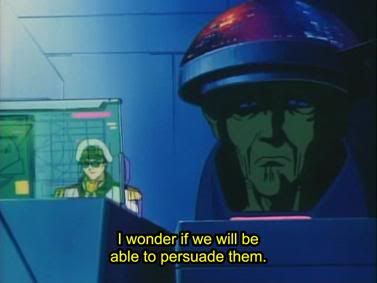
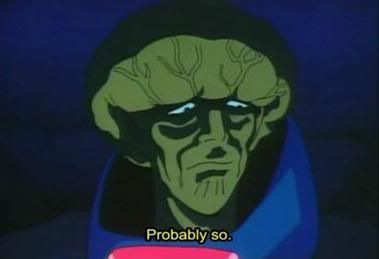
Neo-Exsedol appears as a minor character in the sequel to the original TV series, Macross 7; physically, he is essentially his DYRL design, though with some minor colour differences. At full Zentradi size, he sits (?) underneath the bridge of a ship, his giant (in more ways than one) head sticking up Whac-A-Mole style through the floor to be beside the captain’s chair, a captain who just happens to be Max Jenius from the original series. Later episodes show Exsedol leaving the ship and moving around, but he remains in that certain position until more than halfway through the series, and even then usually does not go anywhere much.
This depiction confused some anime fans in 1994, with them demanding to know how he had gotten that way. These days, most Macross fans seem to accept Neo-Exsedol as a matter of course, with the confusion being instead over why he is still an issue. However, Neo-Exsedol is a major snag for me, a major reason why I can't view Macross as a "complete", ordinary media franchise, but always look at it with some twitchiness.
I’ve already made my preference for Classic Exsedol’s physical appearance clear, and that’s certainly one of my issues with Neo-Exsedol. But Neo-Exsedol also has a new, less appealing personality, with a reduced emotional range, limited mobility, and just a different texture. On top of that, there’s no explanation as to why he is virtually a new character.
In addition to barely moving, his bearing is flat and deadpan, and he sports a nearly perpetual frown. Sometimes this is broken by sudden comical fits of terror, but overall Exsedol remains at this one level setting. When the fleet is in crisis, he also has a tendency to fall into bleak pessimism. Though still voiced by Japanese actor Ryunosuke Obayashi, in Macross 7 Exsedol even has a different voice: deeper, slower, more resonant, and, contradictorily, younger-sounding.
Neo-Exsedol also often seems more like a device than a full-fledged cast member. He is too big and too stationary to have much of in the way of meaningful interaction with the other characters. Even when he is showing some kind of friendliness towards them, there is a sense of distance because he is merely a Big Talking Thing in the Background.
The promotional art for Macross 7 also suggests this remoteness, because Exsedol is usually absent from these images, even in shots that are otherwise crammed with rest of the cast. Though his size would prevent appearance in some of the more standard group shots, some acknowledgement of his existence would be welcome.
(An “extra” episode of Macross 7, "Fleet of the Strongest Women does show a slightly more involved Exsedol. He isn’t that large a departure from the way he is in the rest of the series, but slightly more appealing nonetheless.)
Now, none of his traits would be objectionable on a completely original character, but they are a tremendous departure from the reasons I was drawn to Classic Exsedol. Neo-Exsedol may have that same basic role of “geek on the bridge”, but that is only a small part of what endeared the character to me. The design and personality of Neo-Exsedol are much less fascinating than the original, and all we see is that he is static.
His physical inertness is partially out of necessity, because of he is a giant character in a place built for humans, but there’s no explanation as to why he remains in that state, and his emotional inertness remains. I’m also put off by his blanket pessimism, since crises in the fleet always prompt him to lament that none of them are going to succeed, in contrast to his quick response to the looming threat in SDFM.
Nevertheless, one of my major interests in Exsedol was his potential character development. In Super Dimensional Fortress Macross, there were brief hints dropped about Exsedol’s interest in Earth culture, and these fuelled my interest in his character growth. On hearing the spy trio’s first testimony of human life, Exsedol expresses an interest in going to Earth. He finds the drinks served at the peace talks to be surprisingly delicious, and seems to adjust well to being at human size for the remainder of the series.
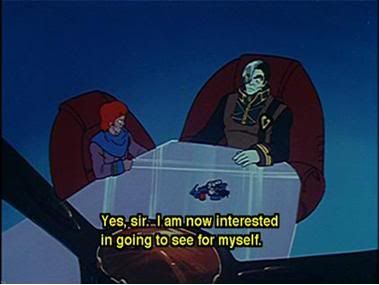
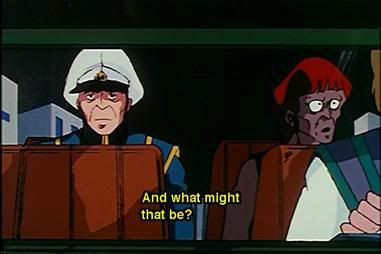
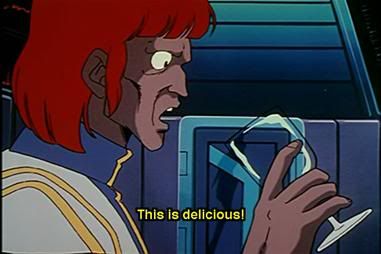
At that time, I could picture Classic Exsedol becoming part of the human world to a degree on par with Milia and the spies, an image that was essential to giving him that complete arc. As I’ve admitted, the writers did not need to show this completeness, but it was a potential possibility.
With Neo-Exsedol, however, I have no room to play, since he is the absolute antithesis of his original portrayal. Though Macross 7 took place thirty-three years after the original series, my instinctive response was that Neo-Exsedol does not seem to follow logically from the TV series even if I looked at his characterization and not his body…unless you wanted to be really dark and think that the events of “Satan’s Dolls” drove Exsedol into that static, distant position, and I’m not willing to go that far.
Now, I’ve relented slightly on this position, at least when I’m in the mood to. One could say that Neo-Exsedol’s characterization is the product of a more realistic aging process than consumers of popular entertainment are used to. While most series try to keep aged characters familiar, in real life people can change radically over their lifetimes. So Exsedol, though he showed some interest in human culture in 2012, might have by 2045 been more comfortable just sitting somewhere, especially since he refers to himself as an “old man”. Theoretically, this leaves thirty-three years of a “blank” period in which I could have my own fun.
However, I can’t do this, for several reasons That Exsedol is a fictional character makes all the difference; I cannot shed that expectation of consistent depiction across a character’s lifespan, making it hard to try to make the most of what I’ve been given in replacement. A fan grows attached to what a character is as they first see them, and is less willing to
follow along with radical change than they would be with a real person.
Neo-Exsedol is too different, and whatever happens to him, he would arrive at that position where he had been drained of almost everything interesting. Besides, Macross, as a universe, did not set up any expectation of realistic treatment of anything else, so was might have been a realistic attempt at aging characters comes off as jarring.
An additional problem is that the past events of the new Macross canon can never be truly known, and hence neither can Classic Exsedol’s existence. Later Macross anime make references both to the TV series events and to the events of Do You Remember Love? by turns, with DYRL being an in-universe movie on top of that. There has never been any outline published of what exactly is canon and what is not.
This created a specific dilemma for me. While with most other characters, they could have their same events with their retconned designs, with Exsedol it left some huge questions open. Have the appearance and traits of Classic Exsedol been lost with time or had they never even been present? Did he have the personality of Classic Exsedol, or of Neo-Exsedol? Any of these prospects would radically change the way Exsedol worked in SDFM. You cannot simply replace Classic Exsedol’s scenes with Neo- Exsedol and have them come off the same, and therefore more specific details are required.
Furthermore, because Macross and Exsedol are someone else’s creations, my own imaginings can never substitute for an official word from on high. I don’t expect one anymore, but it is the ideal circumstance; being left to figure out things on my own is disorienting, not because I’m stupid, but because I usually try to respect the boundaries and authority of creators. I might be able to make up theories about Neo-Exsedol, but will never actually know if that was the intent. I may complain about Neo-Exsedol, but I could never just dismiss his existence because I didn’t like it; he’s canon, and I must engage with his portrayal rather than pretending he never happened.
Neo-Exsedol’s body is even harder to explain away. I did not like the way he looked in comparison to the original form, but things were worse because I then had to contend with several red herrings regarding his current state. Early on, I was willing to assume that there was some in-story explanation involved, that Classic Exsedol had somehow become Neo-Exsedol. It looks absurd to be now, but I was operating on expectations formed by the majority of popular entertainment, where radical changes were explained in-story. I still prefer their methods over Macross’ ambiguity.\
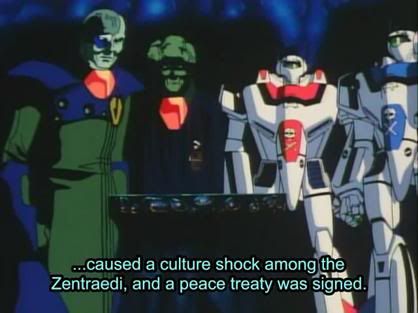
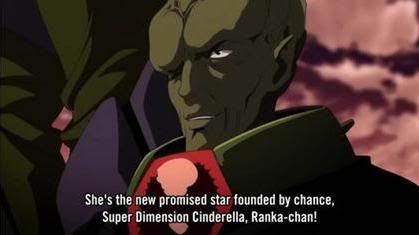
One possible explanation for Neo-Exsedol involved a quote from the Macross 7 DVD liner notes: “Although he [Exsedol] was Micloned at one time, he purportedly returned to his former Zentradi size and realtered his body makeup for fear of losing his cerebral capacity and memories.” While my automatic response (and those of other fans years before), was to interpret this as meaning that Exsedol had been modified in-story from the TV series design, maybe due to some dreadful illness, I slowly realized that this didn’t work as an explanation for several reasons.
First, nothing else was ever said to supplement or clarify this lonely liner note, either published or inside the stories. Exsedol also appears with the DYRL design in flashbacks in Macross 7, and is part of a larger display of DYRL aesthetic in later Macross anime. Because of these last two things, it is impossible to believe that there was anything “special” about Neo-Exsedol’s physical appearance. And in the next TV series, Macross Frontier, an apparent clone of Neo-Exsedol’s Zentradi type was seen, finally killing the modification theory that was already gasping for breath.
In the face of all this, I decided to assume that Classic Exsedol never existed in the current Macross continuity, and that Neo-Exsedol in Macross 7 is consistent with whatever came before him, having never acted or looked like Classic Exsedol in the past. Of course, this didn’t go down easy: on top of essentially erasing that character and necessitating new and likely less-compelling versions of his primary scenes, it was still an informal, unofficial explanation.
Sometimes I wish instead that Do You Remember Love? was established as the official background for all new Macross anime, since it would have neatly solved the Exsedol Question. The result would not have been pleasing but it would have been clear, for the Macross 7 version of Neo-Exsedol works much better as a continuation of his DYRL self than of Classic Exsedol, and not only on physical terms. DYRL Neo-Exsedol has nothing that creates the expectation that he’ll do anything else beyond transferring his current role to the human army, and the Macross 7 version seems like a much more pleasant individual in comparison to him, making for adequate character development when the character wasn’t all that fleshed out to start with.
Another, more recent theory, was that Neo-Exsedol somehow takes the shape of Classic Exsedol when micloned, which would allow his scenes from the original series to remain intact at least in terms of physical action. From here, we could go back to the infamous liner note and assume that Exsedol chooses the impractical condition of remaining at his natural size because he has some physiological difficulties with being micloned. The theory of a more realistic aging process would then be employed to explain his new personality. His “new” voice may even be what he sounds like when at his natural size, and so on and so forth.
But it is still not good enough. This is just the imagination of fans, which is not the same as something official. I resigned myself to never being able to get anything more, just before finding out that Shoji Kawamori, one of the men involved with Macross, went on record as saying that since all Macross works were fictional, they could be treated as altering takes on a non-existent “real” event, similar to how all WW II movies were different from the real war. Hence, perhaps, Neo-Exsedol and Classic Exsedol were to be perceived as two different actors playing the same role in different versions of a war drama. Or, more simply put, there was no need to worry about stability when it was all fictitious anyway. There was no “real” Zentradi war, so why stress consistency?
Yet it is not too much to expect stability and clarity from fiction, instead of going off and doing anything because it’s “just fiction”. Even if very few viewers were as invested in the portrayal of Exsedol as I was, they were still left confused and for no good reason, so I failed to have much sympathy for Kawamori. This “official” response also had me thinking that Neo-Exsedol was a writer’s whim and not “meant” to be thought about in the same manner that fans did.
Writers can have their whims, of course, but it all bothers me anyway. Exsedol was my favourite character in the series, and virtually replacing one character with a new one is an unpleasant thing, no matter how minor he is. Some clarification on how much of his original SDFM appearance and portrayal were still canon to the mainstream Macross would have eased my difficulties, but I realize that that is not going to happen. Ultimately, Neo-Exsedol cannot be explained in terms of anything but fan theories: he simply is.
This extreme case of retroactive continuity and its related lack of “growth” is especially conspicuous when weighed against the portrayal of Mila Fallyna Jenius in Macross 7. I did find Milia a problematic character in that series because she often comes off as a petty, petulant harpy who is comic relief because she is an older woman who is sexual and outspoken. But it is also clear that Milia has lead a rich, full life, taking a variety of jobs and moving about freely in the human world.
She also looks almost the same as she originally did, apparently ageless, with only cosmetic differences in dress, hairstyle, and modernized art design. While Exsedol and Milia were obviously different in how prominent they are in the story, it still stings a bit. It is not that Milia’s life is more directly explored (that is to be expected), but that she has one, while Exsedol is written in a way that cuts off the possibility of being anything more than a big talking head, when both embodied the changes in the Zentradi.
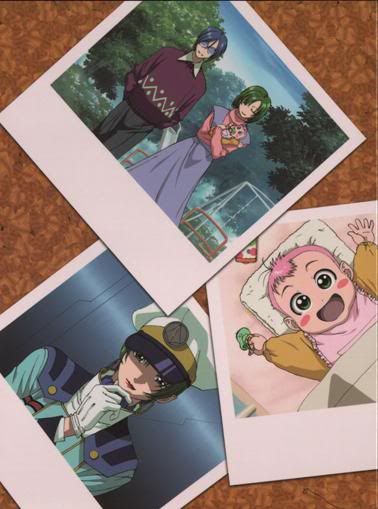
Besides being so different from what I enjoyed, Neo-Exsedol also seems to be a largely useless character in Macross 7, to the point where I find it hard to imagine why he is part of the cast of at all. Allegedly, his purpose is to inform the characters about the enemies in the series, called the Protodevlin: energy vampires in the bodies of humans and genetic constructs, who are ancient enemies of the Zentradi. Exsedol, being a veteran Zentradi, lends the enemies’ existence some gravitas, for he can tell you just how badass they are, though largely through his own terror.
Exsedol’s vast knowledge appears to be largely useless. He has a few scenes of translation and analysis, but they seem like things that other educated scientists and personnel could have done by themselves (though perhaps accessing databanks filled with knowledge he gave them), and Exsedol and the other scientists are usually one step behind the truth, too.
Exsedol is also terrified of the Protodevlin, an apparently reflexive fear that drives him to retreat into his floor opening for several episodes, crying “Protodevlin!” The image of Exsedol sinking away, only his shivering braincase visible, doesn’t feel right either. The character has never been macho, but the Protodevlin turn out to be such ridiculous villains in their goofy appearance, cheesy personalities, and method of defeat (being repelled and then pacified through rock music) that his paroxysms seem unjustified.

The way that Exsedol expresses fear makes him look even more comedic, without the integrity and the vivacity that Classic Exsedol had to balance out his humorous moments. Furthermore, because there are other reasons to fear the Protodevlin besides Exsedol’s own terror, his looking ridiculous is unnecessary to drum up fear of those enemies, either.
Otherwise, Neo-Exsedol’s role in Macross 7 consists largely of needless exposition or pointless dialogue. It would be easy to “stitch up” the scenes where he is supposedly needed and then to cut him from the series. There would still be enough offhand references outside of Macross 7 to suggest that Neo-Exsedol had been retconned, but it would be better if he was not put through the rigmarole of Macross 7. Why make him a cast member, and re-create him as a new character, if you are going to do nothing with him?
Yet I suppose I ought to be clean about it and say that, despite all this, I do have a certain love for the Macross 7 version of Neo-Exsedol. I find him to be rather likeable, and take more of an interest in him than anything else in the series. He’s also a nice contrast to just about every other giant-brained character in fiction, looking like a B-movie monster but actually a nice guy, if rather deadpan. It is only the knowledge that he is “replacing” a much better character, with little interest in explaining how or why, that agitates me. At best, Neo-Exsedol is a guilty pleasure, and at worst, he is the main reason why I cannot become a pure Macross fan. What is a minor quibble for most viewers is a deal-breaker for me. Not only was his design changed, but his entire personality and manner, too.
This handling of Exsedol, Warera, Rori, Konda, and Britai was a real kick in the ovaries, especially when it was reasonable to expect that the Macross universe would be nothing but superior to Robotech when it came to handling the characters who originally came from it. Unlike many other fans, I do not feel the urge to “protect” my favourite Macross characters from representation in Robotech, because Macross has already done a fair job of screwing up these characters on its own.
I’m aware that these five are secondary characters, but it doesn’t follow that I should expect them to change at the drop of a hat, and never grow attached to any aspect of them since it may all disappear.
The question about my favourite Zentradi that always lingers in my head is, “What about afterward?” It is essential to be able to picture those characters experiencing the fruits of human culture, finding broader experiences, greater emotions, and new successes. Unfortunately, this is not what happened.
When such things are only restricted to Milia, I get the nagging feeling that the human-friendly male Zentradi from the original TV series end up forgotten by the Macross universe: written poorly, drastically altered, and never allowed to develop fully. Set against this, the happy fate of the majority of Zentradi becomes a little more of a distant interest, though I have some problems with that portrayal as well.
Reflections on Macrophilia Part 5: Bad Endings
Exploring what I believe to be the Macross universe’s ill treatment of my favourite characters would be heavily skewed towards the handling of Exsedol Folmo, so I will begin by talking about the others first, ones whose fates don’t require as extensive an explanation.
The original names for Bron, Rico, and Konda were respectively Warera, Rori, and Konda, which, when arranged and divided just so, translate to “We have a Lolita Complex ” in Japanese, and a Lolita Complex, sometimes shortened to “lolicon” or “rorikon”, refers to an attraction to young girls, sometimes very young, though in this case, it's likely referring to their attraction to the teenage Minmay, since they never do anything unseemly.
Macross fandom likes to assert that this naming joke makes the spy characters themselves pedophiles, but when watching SDFM I didn’t read those characters that way. There’s only that infatuation Minmay, and a joke about Shammy seeing Rori with the Minmay toy and asking if he is a “lolicon”. In fact, though the characters are obviously awakening sexually, I was in fact impressed with their lack of sleaziness.
I believed in their relative innocence even before I grew to like the characters, and therefore knowing their true names wasn’t a point of anger. The flippant attitude most fans take towards the implication does make me boil a little, because I won’t separate my real-life attitudes about such issues from everything else. To think of beloved characters as pedophiles involves mortal panic rather than giggling acceptance, and therefore I do not endorse it, especially when there is no evidence in that favour.
However, Warera, Rori, and Konda were also said, in obscure supplemental Macross material, to have ended up as bitter, burned-out alcoholics cursing human culture, with Rori leeching off his wife (who also happened to be Vanessa from the original series, Warera’s former girlfriend) by not working.
This made me utterly flip my shit when I first heard about it, and I’ll never understand the mentality behind it. It is true that the very last episodes of Super Dimension Fortress Macross depict Warera, Rori, and Konda trying and failing at various jobs and hence, if the issue were considered neutrally, such a fate would be a legitimate possibility for them. Furthermore, they could also be considered “just fanboys” whose destiny is an expected reflection of how some varieties of hardcore nerds can’t hold down jobs in real life.
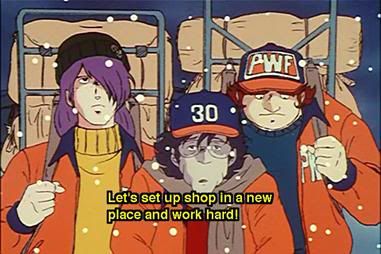
However, since Macross never came off as a pessimistic, ironic, mocking or vicious series, it seems extremely uncharacteristic for it to do this to the comic relief. In real life, we might not deserve to be rewarded for our good deeds or likeable personalities, but in fiction, we tend to expect it for characters, unless a work is being blackly subversive. I ask the same question I ask of the Robotech novels’ near- extinction of the Zentradi: what is the point of telling the story of their involvement in a great peace, only to have them end up crushed?
Would I rather have them respected and dead, like in the Robotech novels, or alive and complete failures, as in the Macross universe? Neither. Both are awful. Yet the Macross version bothers me a lot more because of the overt degeneration rather than a sympathetic treatment, making me so very close to preferring the Robotech novels version, though in the end I always step back to criticize them both.
As for Britai, he never appears in any other works. I infer his design retcon because all later references to him use the DYRL design. This aside, he actually got off lightly, in that his new design, while still objectionable, is at least familiar, and in supplemental material, he is said to become commander of the Earth forces later on, which actually is pretty awesome.
However, I’m a poor loser, because the fact of him being Neo-Britai kills all interest I might have in speculating about his future and providing him with that sense of development I craved. When, for example, the Macross video game Macross 2036 says that Neo-Britai has a friendship with Milia and an avuncular relationship with Milia’s daughter, it is a tremendous shock, because it goes against my view of the new Britai as a cold and distant figure. Yet while it is exactly what I wanted, I still don’t have the urge to follow up on it, because it's just a story in a game. Britai’s fate is undoubtedly the best fate of the bunch, however.
And then there is Exsedol. Poor, poor Exsedol. I feel like I should say more, but we have a lot to go through with him, so we will wait.
The original names for Bron, Rico, and Konda were respectively Warera, Rori, and Konda, which, when arranged and divided just so, translate to “We have a Lolita Complex ” in Japanese, and a Lolita Complex, sometimes shortened to “lolicon” or “rorikon”, refers to an attraction to young girls, sometimes very young, though in this case, it's likely referring to their attraction to the teenage Minmay, since they never do anything unseemly.
Macross fandom likes to assert that this naming joke makes the spy characters themselves pedophiles, but when watching SDFM I didn’t read those characters that way. There’s only that infatuation Minmay, and a joke about Shammy seeing Rori with the Minmay toy and asking if he is a “lolicon”. In fact, though the characters are obviously awakening sexually, I was in fact impressed with their lack of sleaziness.
I believed in their relative innocence even before I grew to like the characters, and therefore knowing their true names wasn’t a point of anger. The flippant attitude most fans take towards the implication does make me boil a little, because I won’t separate my real-life attitudes about such issues from everything else. To think of beloved characters as pedophiles involves mortal panic rather than giggling acceptance, and therefore I do not endorse it, especially when there is no evidence in that favour.
However, Warera, Rori, and Konda were also said, in obscure supplemental Macross material, to have ended up as bitter, burned-out alcoholics cursing human culture, with Rori leeching off his wife (who also happened to be Vanessa from the original series, Warera’s former girlfriend) by not working.
This made me utterly flip my shit when I first heard about it, and I’ll never understand the mentality behind it. It is true that the very last episodes of Super Dimension Fortress Macross depict Warera, Rori, and Konda trying and failing at various jobs and hence, if the issue were considered neutrally, such a fate would be a legitimate possibility for them. Furthermore, they could also be considered “just fanboys” whose destiny is an expected reflection of how some varieties of hardcore nerds can’t hold down jobs in real life.
However, since Macross never came off as a pessimistic, ironic, mocking or vicious series, it seems extremely uncharacteristic for it to do this to the comic relief. In real life, we might not deserve to be rewarded for our good deeds or likeable personalities, but in fiction, we tend to expect it for characters, unless a work is being blackly subversive. I ask the same question I ask of the Robotech novels’ near- extinction of the Zentradi: what is the point of telling the story of their involvement in a great peace, only to have them end up crushed?
Would I rather have them respected and dead, like in the Robotech novels, or alive and complete failures, as in the Macross universe? Neither. Both are awful. Yet the Macross version bothers me a lot more because of the overt degeneration rather than a sympathetic treatment, making me so very close to preferring the Robotech novels version, though in the end I always step back to criticize them both.
As for Britai, he never appears in any other works. I infer his design retcon because all later references to him use the DYRL design. This aside, he actually got off lightly, in that his new design, while still objectionable, is at least familiar, and in supplemental material, he is said to become commander of the Earth forces later on, which actually is pretty awesome.
However, I’m a poor loser, because the fact of him being Neo-Britai kills all interest I might have in speculating about his future and providing him with that sense of development I craved. When, for example, the Macross video game Macross 2036 says that Neo-Britai has a friendship with Milia and an avuncular relationship with Milia’s daughter, it is a tremendous shock, because it goes against my view of the new Britai as a cold and distant figure. Yet while it is exactly what I wanted, I still don’t have the urge to follow up on it, because it's just a story in a game. Britai’s fate is undoubtedly the best fate of the bunch, however.
And then there is Exsedol. Poor, poor Exsedol. I feel like I should say more, but we have a lot to go through with him, so we will wait.
Reflections on Macrophilia Part 4: Introducing Macross and the Cinematic Heartbreaker
Even when it seems logical to become a Macross-only fan, I cannot fully love the Macross franchise and reject Robotech, as a good anime geek should. My attachments to certain expanded multiverse portrayals are the obvious cause, but I feel slightly estranged from the Macross universe for other reasons.
The Macross continuity has certain aspects to it that made me feel squeamish or disappointed. I will concentrate only on the Zentradi material, and as far as that goes, while things are better for the race as a whole in the Macross continuity, its handling of specific Zentradi characters is a large problem for me, one that cannot be overshadowed by the appealing elements found in later projects.
In the future Macross series we get depictions of the Zentradi’s happy future, unencumbered by future battles with humanity or with the non-existent Invid and they number in the millions. Unlike with Robotech, these appealing images appear in works of high quality and of artistic authenticity, a fact that certainly has its draw.
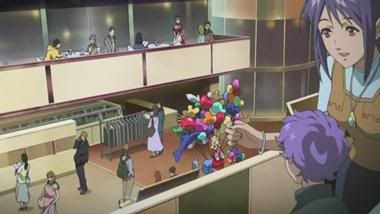
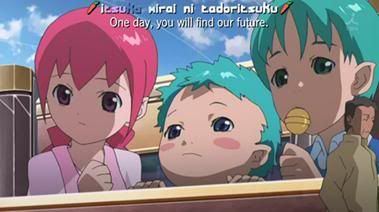
Let me also say again that I think the original subtitled Super Dimensional Fortress Macross is better than its Robotech dub, including in the thematic aspects that captured my attention.
However, the Macross universe also ran roughshod over my most favourite characters from the original series, dampening my enthusiasm for any future depictions of the Zentradi, no matter the quality.
This began with the animated film adaptation of the original Macross TV series, released in 1984 and known as Super Dimensional Fortress Macross: Do You Remember Love?, one of the rare compressed remakes that is lauded by its fandom. And DYRL is visually impressive, especially in comparison to the sometimes clunky animation of the TV series.
However, the film, the first authentic Macross work that I viewed, became the foundation of my ambivalent feelings towards its universe. I find the film be cold and lifeless despite its surface slickness, and dependent on memories of the TV series to gain most of its depth. However, the core of my dislike concerns the film’s re-interpretation of the Zentradi.
It was a dislike that was immediate. Though the basic themes of SDF Macross are still on display in Do You Remember Love?, its version of the Zentradi spoiled any other potential enjoyment I could have gotten out of the film. This new vision undermines the personality of the Zentradi characters, and introduces several obnoxious tropes related to gender and design. While I would have less of a problem with this if the film had been just a movie, DYRL ended up creating a lot of design retcons and plot ambiguities in the mainstream Macross universe.
Before we begin, I’d like to note that some of the Zentradi characters have different names altogether in Macross, while others merely have different renderings of the Japanese characters that make up their names than what the Robotech dub chose. In the interest of division, I’ll be using the “Macross” names when I discuss those characters in a pure Macross context. Here are the following versions that I use, and their Robotech equivalents:
Britai = Breetai
Exsedol = Exedore
Rori = Rico
Warera = Bron
Konda = Konda
Kamjin = Khyron
Milia Jenius = Miriya Sterling
Max Jenius = Max Sterling
Miclone/Micloned = Micronian/Micronized
Shammy = Sammy
Minmay = Minmei
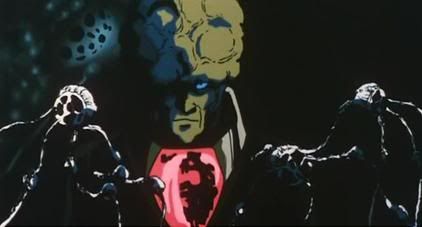
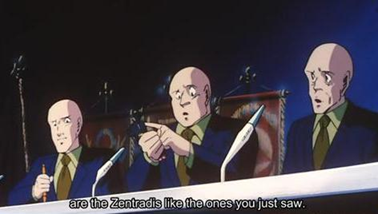
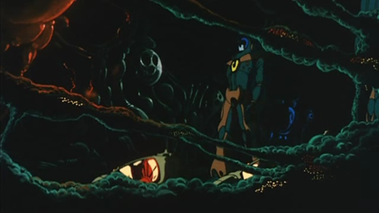
Though Do You Remember Love? kept the basic body designs of its human characters the same under their new uniforms, it redesigned the male Zentradi extensively. Britai is bald, scowling, and virtually monochrome, coloured almost entirely in different shades of green. Exsedol is a giant-brained green creature in a long black cloak with tendrils for arms, virtually unrecognizable. Kamjin, Warera, Rori, and Konda are bald, with some of Rori and Kamjin’s distinctive features removed. Britai and Exsedol also seem flatter, grimmer, and stiffer in personality than their TV series selves were; even when they show a little character in the film, the form it takes seems more like an tedious cliché than an appealing one. Their ship interiors receive a twisted aspect with a bio-technological look, now shrouded in literal darkness.
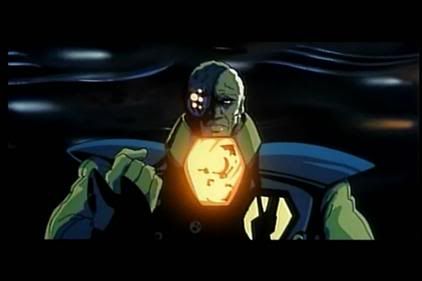
At the same time, the film made the Zentradi females more stereotypically feminine in dress, replacing their purple pilot suits and dark green mecha with candy-cane outfits and cherry red or lavender machines. The soldiers themselves are kept generically beautiful and with distinct hairstyles, in contrast to the now-depilated males. With their own technology that was shiny, pastel-coloured, and brightly lit, these females formed a stingingly sharp contrast to the male characters.
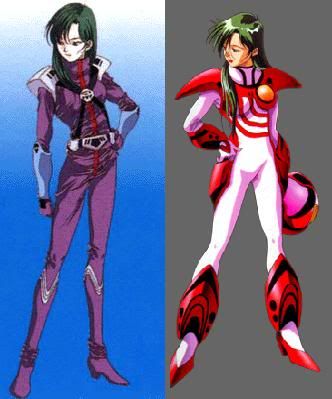
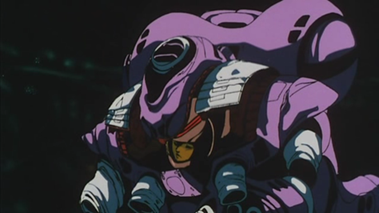
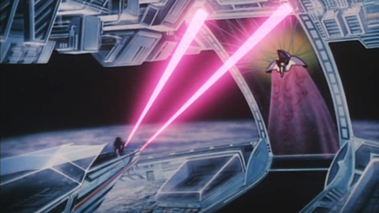
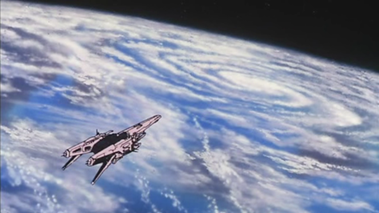
Yes, I’m one of those people who flips out at the thought of female characters wearing “pink”, and more strongly, I don’t care for double standards of beauty applied by gender. One could argue that the Zentradi are similarly divided by gender/beauty in the TV series, too, but I don’t believe the meme that female Zentradi are always beautiful and male Zentradi are always ugly.
Originally, it was more like the character designs fell into the old trap of giving males a wide variety of appearances, including a few good-looking specimens, while the females “had” to be only gorgeous. Not a good thing, but better than the DYRL version, where the contrast between male and female Zentradi is so much harder to ignore due to its extreme nature, and the male characters being outright creepy.
Of course, a justification for this contrast might be that in the film, the female Zentradi become “Meltrandi”, fighting against the male “Zentradi” in a literal battle of the sexes, continuing the one that their creators started when men and women developed the ability to reproduce without each other. Yet there was no reason given for the contrast between the armies to fall along such stereotypical lines.
In any case, I loathe Gender War plots. They are predicated on anti-egalitarianism and uniform behaviour within the genders, and therefore conflict strongly with my own personal values. It would take an exceptional writing team to make such a portrayal palatable, and the version presented in Do You Remember Love? does not qualify, as the reasons for this war are quickly handwaved. The gender war also made the prospect of further internal Zentradi growth seem more difficult and conflicted after the war was over, an unnecessary complication.
Though the (male) Zentradi faked a peace effort with humans early in the film, true peace was only achieved when Minmay sang an ancient love song salvaged and translated from the two factions’ creator civilization, and this transformed a portion of the Zentradi and Meltrandi into allies by awakening their latent racial emotions.
Though it is Britai’s ultimate decision to call on the other Zentradi/Meltrandi to fight with him on the side of humanity, the movie loses much of the sense that the Zentradi were taking initiative. They seem more to be merely “charmed” by music without having to take their own actions in addition to that.
A lot of this admittedly comes from having to excise the arcs of the secondary characters to make the plot fit the running time of a film. However, that does not mean that the truncation could not have been more appealing than this. Instead of being a distillation of the themes of the Zentradi, DYRL took only the basic cliché of the Zentradi and discarded even the small details that had made them stand out in the first place. The Zentradi in DYRL now serve more as symbols than characters.
I imagine a defence of the DYRL male designs going like this: by being drawn the way they are, the DYRL male Zentradi are more credible as a threatening and stifling military machine, and menace must be established before the power of altering it can truly have an impact. SDFM’s original message is enhanced when the male Zentradi are darker, edgier, and more frightening. However, those TV series designs, where the male Zentradi looked like “just guys”, helped in making them seem like characters first, and scary invaders second, stressing the notion that their story was slightly different from the usual sci-fi tales of aliens discovering humanity.
The classic Zentradi designs also better opened the way for considering the all-important “afterward”: Because of the way they looked, it was so much easier to imagine the TV series Zentradi males changing and expanding their roles and lives, instead of moving into a similar military position on the human side without additional development.
If the TV series Zentradi seem altogether too emotional and too physically individualized for cloned beings living a dreary life of war, their portrayal does make sense in a symbolic way, but also in a logical one. Because visually they are very close to normal humans already, and have a range of emotions, the “softer” Zentradi portrayals make their fast transformation into human allies easier to accept. The choked nature of Zentradi life is also very clear even before DYRL’s brooding darkness. Finally, it does make more sense for the Zentradi to act “natural” in their environment rather than cold and sinister, since the military lifestyle is their natural life, and they would believe themselves comfortable within it until they saw something better firsthand.
I also find, as best shown in my very strong preference for TV-series Exsedol, a certain colourful charm in many of the original Zentradi designs, something perhaps akin to what anime fans who prefer Super Robots or vintage toys feel. TV series Britai and Exsedol’s designs were also particularly appealing in that they were a little bit subversive. Britai more resembled a handsome hero, or at least the rugged commander who would chew out said hero, than a terrifying alien, and Exsedol was the rare intellectual extraterrestrial who initially didn’t go for the Elephant Man head. Their designs also contrasted with each other’s more than DYRL’s black-and-green pair, which ties into that “just guys” image that I have of them.
None of this means the Zentradi are merely “cute”, or any less powerful in terms of their arc and arsenal, but the visuals of the 1982 Zentradi better serve the notions I have about them, and what they “inspired” in me.
I can see how the DYRL male Zentradi could be used to portray that admirable old saw that looks don’t matter. But how a character looks does matter: it’s part of what that character is to the viewer, and in some cases, like this one, the characters’ designs are part of the appeal. Furthermore, the redesigns of Exsedol and Britai always come with a change in their personalities, so I cannot say how I would react to these characters if they were only altered visually but were otherwise unchanged.
Besides, when any of the justifications for the DYRL look can’t be said to apply to the female Zentradi, the potential justifications for the Zentradi re-imagining lose their relevance. When this sense of increased military standardization/menace and potential for a “Don’t judge a book by its cover” message is not equally applicable to the “Meltrandi”, it all seems like an attempt to be darker and edgier but without putting off the fanboys in the audience with grotesque female characters. This is another reason why I can’t take the redesigns seriously on the level of either trying to make the Zentradi look more “badass” or sending a message about inner beauty.
(And given its association with DYRL’s double standards of beauty and its Gender War, I don’t use the term “Meltrandi” to refer to female Zentradi except in a DYRL context)
If DYRL had been just a movie, I would have had less of a problem with this re-conception instead of making it into a bête noir. But the new Zentradi designs also, to an extent, retroactively replaced the originals in the main Macross continuity, though with the genders never having been at war, and the later generations of Zentradi all looking like normal, attractive humans regardless of sex.
Furthermore, Exsedol and Britai have been confirmed to be retconned into their DYRL designs, and many other such retcons have been displayed, though many other things remain ambiguous. Kamjin, oddly enough, now is implied to have kept his TV series design, despite some initial use of Neo-Kamjin in earlier Macross games. These retcons only intensify my complaints with the new designs, and in turn my dislike of the film.
Because of these radical differences, I ended up using “Classic” and “Neo” to separate the original TV series designs from the DYRL/retconned Zentradi designs, such as Neo-Britai, Classic Kamjin, etc. I later found out that some upgraded Zentradi ship models gained the prefix “Neo-” in the Macross universe, which was a nice coincidence, though in the case of the Zentradi themselves, these depictions were far from an upgrade.
When it comes to the redesigns of Exsedol and Britai I can still enjoy them to an extent, but the more comfortable I grow in my own skin, the closer I get to absolutely rejecting these depictions. It wasn’t long ago that I could still perk up at the sight of Neo-Britai and Neo-Exsedol, but while those feelings still linger, but there’s also a stronger sense of being repulsed by those same designs. I sometimes wonder if I tried to accommodate myself to these redesigns more for the purposes of proving that I adequately respected Macross as the continuity that created the Zentradi.
My issues, however, extend beyond Do You Remember Love?. My favourite Zentradi characters were all handled poorly in the major Macross continuity, which soured me towards anything else within it.
The Macross continuity has certain aspects to it that made me feel squeamish or disappointed. I will concentrate only on the Zentradi material, and as far as that goes, while things are better for the race as a whole in the Macross continuity, its handling of specific Zentradi characters is a large problem for me, one that cannot be overshadowed by the appealing elements found in later projects.
In the future Macross series we get depictions of the Zentradi’s happy future, unencumbered by future battles with humanity or with the non-existent Invid and they number in the millions. Unlike with Robotech, these appealing images appear in works of high quality and of artistic authenticity, a fact that certainly has its draw.
Let me also say again that I think the original subtitled Super Dimensional Fortress Macross is better than its Robotech dub, including in the thematic aspects that captured my attention.
However, the Macross universe also ran roughshod over my most favourite characters from the original series, dampening my enthusiasm for any future depictions of the Zentradi, no matter the quality.
This began with the animated film adaptation of the original Macross TV series, released in 1984 and known as Super Dimensional Fortress Macross: Do You Remember Love?, one of the rare compressed remakes that is lauded by its fandom. And DYRL is visually impressive, especially in comparison to the sometimes clunky animation of the TV series.
However, the film, the first authentic Macross work that I viewed, became the foundation of my ambivalent feelings towards its universe. I find the film be cold and lifeless despite its surface slickness, and dependent on memories of the TV series to gain most of its depth. However, the core of my dislike concerns the film’s re-interpretation of the Zentradi.
It was a dislike that was immediate. Though the basic themes of SDF Macross are still on display in Do You Remember Love?, its version of the Zentradi spoiled any other potential enjoyment I could have gotten out of the film. This new vision undermines the personality of the Zentradi characters, and introduces several obnoxious tropes related to gender and design. While I would have less of a problem with this if the film had been just a movie, DYRL ended up creating a lot of design retcons and plot ambiguities in the mainstream Macross universe.
Before we begin, I’d like to note that some of the Zentradi characters have different names altogether in Macross, while others merely have different renderings of the Japanese characters that make up their names than what the Robotech dub chose. In the interest of division, I’ll be using the “Macross” names when I discuss those characters in a pure Macross context. Here are the following versions that I use, and their Robotech equivalents:
Britai = Breetai
Exsedol = Exedore
Rori = Rico
Warera = Bron
Konda = Konda
Kamjin = Khyron
Milia Jenius = Miriya Sterling
Max Jenius = Max Sterling
Miclone/Micloned = Micronian/Micronized
Shammy = Sammy
Minmay = Minmei
Though Do You Remember Love? kept the basic body designs of its human characters the same under their new uniforms, it redesigned the male Zentradi extensively. Britai is bald, scowling, and virtually monochrome, coloured almost entirely in different shades of green. Exsedol is a giant-brained green creature in a long black cloak with tendrils for arms, virtually unrecognizable. Kamjin, Warera, Rori, and Konda are bald, with some of Rori and Kamjin’s distinctive features removed. Britai and Exsedol also seem flatter, grimmer, and stiffer in personality than their TV series selves were; even when they show a little character in the film, the form it takes seems more like an tedious cliché than an appealing one. Their ship interiors receive a twisted aspect with a bio-technological look, now shrouded in literal darkness.
At the same time, the film made the Zentradi females more stereotypically feminine in dress, replacing their purple pilot suits and dark green mecha with candy-cane outfits and cherry red or lavender machines. The soldiers themselves are kept generically beautiful and with distinct hairstyles, in contrast to the now-depilated males. With their own technology that was shiny, pastel-coloured, and brightly lit, these females formed a stingingly sharp contrast to the male characters.
Yes, I’m one of those people who flips out at the thought of female characters wearing “pink”, and more strongly, I don’t care for double standards of beauty applied by gender. One could argue that the Zentradi are similarly divided by gender/beauty in the TV series, too, but I don’t believe the meme that female Zentradi are always beautiful and male Zentradi are always ugly.
Originally, it was more like the character designs fell into the old trap of giving males a wide variety of appearances, including a few good-looking specimens, while the females “had” to be only gorgeous. Not a good thing, but better than the DYRL version, where the contrast between male and female Zentradi is so much harder to ignore due to its extreme nature, and the male characters being outright creepy.
Of course, a justification for this contrast might be that in the film, the female Zentradi become “Meltrandi”, fighting against the male “Zentradi” in a literal battle of the sexes, continuing the one that their creators started when men and women developed the ability to reproduce without each other. Yet there was no reason given for the contrast between the armies to fall along such stereotypical lines.
In any case, I loathe Gender War plots. They are predicated on anti-egalitarianism and uniform behaviour within the genders, and therefore conflict strongly with my own personal values. It would take an exceptional writing team to make such a portrayal palatable, and the version presented in Do You Remember Love? does not qualify, as the reasons for this war are quickly handwaved. The gender war also made the prospect of further internal Zentradi growth seem more difficult and conflicted after the war was over, an unnecessary complication.
Though the (male) Zentradi faked a peace effort with humans early in the film, true peace was only achieved when Minmay sang an ancient love song salvaged and translated from the two factions’ creator civilization, and this transformed a portion of the Zentradi and Meltrandi into allies by awakening their latent racial emotions.
Though it is Britai’s ultimate decision to call on the other Zentradi/Meltrandi to fight with him on the side of humanity, the movie loses much of the sense that the Zentradi were taking initiative. They seem more to be merely “charmed” by music without having to take their own actions in addition to that.
A lot of this admittedly comes from having to excise the arcs of the secondary characters to make the plot fit the running time of a film. However, that does not mean that the truncation could not have been more appealing than this. Instead of being a distillation of the themes of the Zentradi, DYRL took only the basic cliché of the Zentradi and discarded even the small details that had made them stand out in the first place. The Zentradi in DYRL now serve more as symbols than characters.
I imagine a defence of the DYRL male designs going like this: by being drawn the way they are, the DYRL male Zentradi are more credible as a threatening and stifling military machine, and menace must be established before the power of altering it can truly have an impact. SDFM’s original message is enhanced when the male Zentradi are darker, edgier, and more frightening. However, those TV series designs, where the male Zentradi looked like “just guys”, helped in making them seem like characters first, and scary invaders second, stressing the notion that their story was slightly different from the usual sci-fi tales of aliens discovering humanity.
The classic Zentradi designs also better opened the way for considering the all-important “afterward”: Because of the way they looked, it was so much easier to imagine the TV series Zentradi males changing and expanding their roles and lives, instead of moving into a similar military position on the human side without additional development.
If the TV series Zentradi seem altogether too emotional and too physically individualized for cloned beings living a dreary life of war, their portrayal does make sense in a symbolic way, but also in a logical one. Because visually they are very close to normal humans already, and have a range of emotions, the “softer” Zentradi portrayals make their fast transformation into human allies easier to accept. The choked nature of Zentradi life is also very clear even before DYRL’s brooding darkness. Finally, it does make more sense for the Zentradi to act “natural” in their environment rather than cold and sinister, since the military lifestyle is their natural life, and they would believe themselves comfortable within it until they saw something better firsthand.
I also find, as best shown in my very strong preference for TV-series Exsedol, a certain colourful charm in many of the original Zentradi designs, something perhaps akin to what anime fans who prefer Super Robots or vintage toys feel. TV series Britai and Exsedol’s designs were also particularly appealing in that they were a little bit subversive. Britai more resembled a handsome hero, or at least the rugged commander who would chew out said hero, than a terrifying alien, and Exsedol was the rare intellectual extraterrestrial who initially didn’t go for the Elephant Man head. Their designs also contrasted with each other’s more than DYRL’s black-and-green pair, which ties into that “just guys” image that I have of them.
None of this means the Zentradi are merely “cute”, or any less powerful in terms of their arc and arsenal, but the visuals of the 1982 Zentradi better serve the notions I have about them, and what they “inspired” in me.
I can see how the DYRL male Zentradi could be used to portray that admirable old saw that looks don’t matter. But how a character looks does matter: it’s part of what that character is to the viewer, and in some cases, like this one, the characters’ designs are part of the appeal. Furthermore, the redesigns of Exsedol and Britai always come with a change in their personalities, so I cannot say how I would react to these characters if they were only altered visually but were otherwise unchanged.
Besides, when any of the justifications for the DYRL look can’t be said to apply to the female Zentradi, the potential justifications for the Zentradi re-imagining lose their relevance. When this sense of increased military standardization/menace and potential for a “Don’t judge a book by its cover” message is not equally applicable to the “Meltrandi”, it all seems like an attempt to be darker and edgier but without putting off the fanboys in the audience with grotesque female characters. This is another reason why I can’t take the redesigns seriously on the level of either trying to make the Zentradi look more “badass” or sending a message about inner beauty.
(And given its association with DYRL’s double standards of beauty and its Gender War, I don’t use the term “Meltrandi” to refer to female Zentradi except in a DYRL context)
If DYRL had been just a movie, I would have had less of a problem with this re-conception instead of making it into a bête noir. But the new Zentradi designs also, to an extent, retroactively replaced the originals in the main Macross continuity, though with the genders never having been at war, and the later generations of Zentradi all looking like normal, attractive humans regardless of sex.
Furthermore, Exsedol and Britai have been confirmed to be retconned into their DYRL designs, and many other such retcons have been displayed, though many other things remain ambiguous. Kamjin, oddly enough, now is implied to have kept his TV series design, despite some initial use of Neo-Kamjin in earlier Macross games. These retcons only intensify my complaints with the new designs, and in turn my dislike of the film.
Because of these radical differences, I ended up using “Classic” and “Neo” to separate the original TV series designs from the DYRL/retconned Zentradi designs, such as Neo-Britai, Classic Kamjin, etc. I later found out that some upgraded Zentradi ship models gained the prefix “Neo-” in the Macross universe, which was a nice coincidence, though in the case of the Zentradi themselves, these depictions were far from an upgrade.
When it comes to the redesigns of Exsedol and Britai I can still enjoy them to an extent, but the more comfortable I grow in my own skin, the closer I get to absolutely rejecting these depictions. It wasn’t long ago that I could still perk up at the sight of Neo-Britai and Neo-Exsedol, but while those feelings still linger, but there’s also a stronger sense of being repulsed by those same designs. I sometimes wonder if I tried to accommodate myself to these redesigns more for the purposes of proving that I adequately respected Macross as the continuity that created the Zentradi.
My issues, however, extend beyond Do You Remember Love?. My favourite Zentradi characters were all handled poorly in the major Macross continuity, which soured me towards anything else within it.
Reflections on Macrophilia Part 3: Ambivalence and the Robotech EM
You would think, if my focus were primarily on a Macross element, I would have nothing to do with Robotech after my initial probing. Instead, many strange things happened, and matters instead branched off into two basic forks: the Robotech expanded multiverse (most of it currently deemed unofficial) and the mainstream Macross continuity.
I experienced both sides more or less simultaneously, and in the end, I couldn't discard either of them for the sake of my interest in Zentradi. Macross is good for the Zentradi as a whole group, but the specific approach to certain characters leaves something to be desired, and in Robotech (at least, the old novels and comics) is good for some certain Zentradi, but the general handling of the race is godawful.
By the time I came on the scene, there had already been scads of Robotech comics and a novel series published, and all long out of print and recently declared “not canon”. Yet since the material still existed, and contained some Zentradi stories, I wanted to take a crack at it.
Initially I devoured almost everything in the Robotech EM without thought to quality or consequence, initially distracted by the shine of works that actually thought about my favourite characters and offered them further growth. I soon realized that everything was largely a garbage pile that few sane fans would bother with, but even after realizing that, I still stuck with the Robotech EM because of those very small things related to the Zentradi.
The big beast of the Robotech apocrypha was a1986 project called Robotech II: The Sentinels. It was originally going to be an animated television “sequel” to Robotech, actually a side story about the Macross characters and their journey to Tirol, the homeworld of the Robotech Masters (characters from the second segment). This Robotech Expeditionary Force ended up working with a group of local alien rebels (the titular Sentinels) to free their nearby planets from the mutual threat of The Invid (whose other faction formed the villain of the third Robotech segment), as well as dealing with a coup attempt within their ranks.

The Sentinels project rapidly fizzled, though it briefly survived in a an animated “pilot” using some of the footage that had been produced, separate comic and novel adaptations, some other released plans and scripts, and scattered references in the eventual rebooted continuity.
If judged by the standards of the other popular American cartoons of the 1980s, the Sentinels outlines seen about on par. But when compared to anything else, even the original Robotech dub, The Sentinels was bad or at least looked like it could have been.
It didn’t add any new or compelling facets to most of the returning cast, made a muck of continuity, and the new characters were largely ciphers, with some truly awful character designs and a flimsy backstory. The novel version introduces some interesting ideas that challenged Robotech’s previous boundaries, but overall, it is difficult to find much to praise Robotech II: the Sentinels for in terms of its concepts.
Because they already received a sense of completeness within the Macross series the return of the main Macross characters in The Sentinels feels particularly forced and artificial, all of the sequel stories seem to struggle with what to do with them. As a result, the returning Rick, Lisa, Max, and Miriya feel empty and generic, or are simply mucked with.
But what draws me to The Sentinels is some aspects of the portrayal of Exedore and Breetai. With these characters, there was some potential character development left to work with, which is why they get more out of that story, however brief their scenes are. This is the reason that I cannot stay mad at the thing, no matter how savage a critique I build up inside my head.
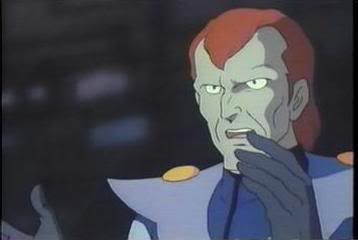
It goes against all the laws of the universe for the Robotech novels to do anything compelling or interesting with a Macross character; even I’m not sure how it happened. Yet however it did, Sentinels Exedore, primarily as portrayed in the novels, was what helped define, shape, and elevate my interest in the character as a whole, and was a very welcome change from what the more visible continuities did with him.
While Exedore was a minor character in the Sentinels novels, the books still furthered his character growth, having Exedore become more emotional and more expressive, while remaining recognizable. Exedore plays an important role in figuring out several key things in the novels, and is present for climactic events. His kinder personality implies that he has overcome the blues he had at the end of the TV series, now twenty years in the past. Readers’ mileage may vary, finding him too “soft”, but he preserves a core of stoicism and clarity.
All of this gives me a sense that Exedore has finally gained that complete character arc, and now has become a richer being, opening the door for the fuller life and deeper explorations that I would conduct at my own fannish leisure.
Sentinels Exedore is not a seamless re-creation. On some levels he simply can’t be, since he was not the product of the original creators; in a more concrete sense, he has a few minor out-of-character moments and personal errors. The novels also do not make it clear where Exedore actually ends up when the storyline finishes, though he does survive. Overall, however, I was very happy with this angle. It aligned perfectly with what I wanted out of Exedore, and felt “right” to me. I accepted it. Because his existence offered a completed character arc, Sentinels Exedore was the reason that I became as big a fan of the character as I did.

In the case of Breetai and the Robotech expanded multiverse, of course the first thing everyone remembers is that, due to being unable to use the original character design, The Sentinels depicted a human-sized Breetai with a ridiculous bucket-helmet on, and this was how he would have looked in the animated series had it been completed. Fortunately, the comics and the novels had the freedom to use the original design for Breetai, and both versions had Classic Breetai back by the second volume (though through a set of contrived circumstances).
Breetai was also planned to be killed off, and the first death scene that made it into print was dreadful. In a extremely out-of-character moment, Breetai has the revelation that he and the Invid Regent must kill each other to complete the cycle of battle between Zentradi and Invid. Thus, Breetai turns his battle with the Invid Regent into a suicidal conflict, pinning the Regent so that he cannot escape, and the two of them destroy each other.
I’m not happy with either Breetai’s buckethead design or his death scene (though I’m probably less angry about Buckethead Breetai than I should be). But placed between them was some character development for Breetai in the novels, too.
This character development included a Zentradi love interest named Kazianna Hesh. Though she was likely only created to prove Breetai’s virility (the last remaining part of his otherwise complete macho awesomeness), Kazianna was more likeable and more “alive” than she had any right to be. In fact, she was the second character after Exedore that I named myself a fan of as an individual being, and to this day the only female Zentradi I like unreservedly. Kazianna was strong, focused, and playful, knew what she wanted and went for it, and unlike the other female Zentradi of her era, appeared to have control of her situation rather than swept along by fate.
Moreover, there was the sense that Breetai was himself a late bloomer who was still detached from human culture until Kazianna came along, while his troops were growing into it far faster. This acknowledgement helped humanize Breetai even more, but never took away from his power. For as long as he lasted, Breetai also became the leader of the new Zentradi civilization.
Despite what could be nitpicked, seeing Exedore and Breetai fully “grow up” and add new aspects to their lives was tremendously appealing. The imagery got a lock on my fandom consciousness, so that any depiction of Breetai and Exedore that did not suggest they had expanded or altered their own roles and selves following the SDF-1 era felt incomplete.
While intellectually I understood that an exploration of Exedore and Breetai beyond the TV series was non-essential and a good story should know when to end and leave the viewers wanting more, I’m entitled to a little bit of greed now and then. Besides, I always did feel that the writers left a loose end when not making it clear if Exedore had overcome his brief bit of angst near the end of the series.
The Sentinels-era Zentradi also end up claiming a planet of their own to build their civilization on, which I thought was pretty cool for the independence it suggested, though I had several issues with that premise and matters related to it, which will be discussed below.
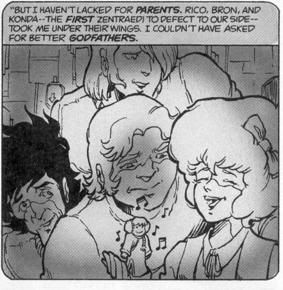
Rico, Bron, and Konda never appeared in the Sentinels novels, as they had sadly been killed off behind the scenes in the TV series novels, due to factors that were conflictingly explained. This is a sore point, especially since the authors had also made the effort to connect them to the main cast by making them the caretakers of Max and Miriya’s daughter Dana before their deaths.
They seem to die only to give Dana an excuse to angst, when she already has plenty. As if the stagnation caused by death wasn’t enough, the trio are depicted pining away over their first girlfriends, female members of the bridge crew who were written as killed in the Robotech dub. They had no apparent interested in dating again, not that they had much of a chance afterwards.
I thought it the most natural thing in the world that Rico, Bron, and Konda, should be able to live and make something of themselves, continuing the theme of Zentradi “adulthood”. Given their level of intelligence, I didn’t expect them to amount to much, but I pictured them as the sort of people who live comfortably in the same low-end job for the rest of their lives.
However, the novels handled the revelation of their deaths with some attempt at warmth and sensitivity, and this may have had a role in making me understand that I did like these characters after all.
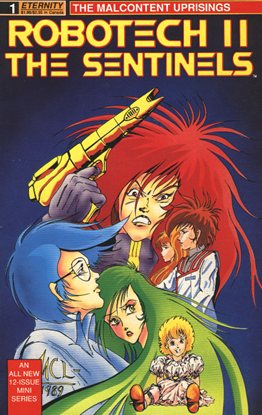
Robotech apocrypha also offered the Malcontent Uprisings/The Zentradi Rebellion, a comic miniseries and its extended novel version which chronicled a Zentradi backlash against the humans following the Macross portion of the original TV series, alongside Miriya’s conflict with a friend from her days in the Zentradi army. The concept fascinates me in several ways, primarily in the appeal of fighting for a happy conclusion, but the actual story was interesting only in small ways. Ultimately, both versions of this story were more about the affects of this rebellion on humanity than on the Zentradi characters, which was a wasted opportunity.
Zentradi-wise, the Uprisings stories made Miriya into a more complex character by giving her internal conflicts, acknowledging that she had a life outside of Max, and making humanity’s reaction to her more suspicious and varied. However, the miniseries only briefly dwelt on the other major Zentradi characters. The comics only have a one-issue story where Breetai tries to infiltrate the Zentradi weapons-dealing underground, during which he has no strong interaction with the established characters, and a cameo by a disgruntled-looking Exedore in the final issue. The novel also seriously short-changed the male Zentradi characters, turning Exedore and Breetai into little more than Voices of Doom and Rico, Bron, and Konda into completely oblivious airheads, which they not entirely were in the TV series...just close to it.
The Uprisings also tried very hard to push the notion of “The Zentradi Imperative” an ingrained combat urge that was driving their remaining population all over the world to kill and destroy. That was a huge narrative cop-out, removing the responsibility, and thus the potential for change, from the Zentradi and corrupting the themes of the Macross story. In addition, even with a military as simplistic as the Zentradi’s, the mere urge to kill is not enough to form a workable military force, and so a universal inclination towards aggression makes little sense.
I did enjoy that the Uprisings presented female Zentradi as equally culpable in causing trouble and equally susceptible to the Imperative. Such a condition only makes sense, but other writers seem to be reluctant to show female Zentradi as a genuine danger to humans following the first war.
The Imperative also existed beside this weird attempt to make the Zentradi into more typical “warrior aliens”, mostly due to the work of Robotech comics writer Bill Spangler. Through him, the Zentradi received a harsh and grating native language that included concepts like “kara-brek” (honourable death) and “kara-thun” (a ‘death dance’ where condemned prisoners are allowed one last chance to fight their executioners), as well as a greater interest in values of honour and fidelity to Zentradi-dom.
This really didn’t work for me, as it contradicts one of the smaller appeals of the original Zentradi. Arguably, a main point of the Zentradi’s story is that there is no glory or honour in their lives: even if some individuals may take pride in their work, Zentradi they are simply doing what they are told to do, rather than it being a true “warrior culture”. Other warrior aliens have chosen to be what they were, and have at least a bit more to their lives than fighting, but the Zentradi do not have that luxury. They are much more pathetic than their counterparts in other SF series, in the truest sense of invoking pity.
The old comics also contained a few other small Zentradi stories besides these, but mostly they were forgettable. I retained a soft spot for some, like Bill Spangler’s utterly trashy Zentradi prequel comics, or Bruce Lewis’ Hohsq’s Story, which wrapped the intriguing idea of an independent Zentradi settlement into a lot of empty clichés and truly awful artwork.
No matter how much I criticize the Robotech expanded universe, certain tidbits are indispensible, enough to sustain an interest in Robotech for a good while. That later realization of the material’s fundamental lack of quality didn’t seem to change that; I don't quite understand it either.
It is especially confusing since there are some notable problems with the Zentradi treatment in the Robotech EM, problems that are most obvious in the novels. I cannot deny these issues, and they don’t exist comfortably alongside what I do enjoy.
One of those problems is the reveal (only part of Robotech) that the Zentradi were created originally as high-gravity-resistant miners for the planet Fantoma before their creators’ imperial ambitions lead to their being reconditioned as warriors. Before that, Zentradi had even formed a crude civilization on Fantoma, whose ruins exist for Breetai to find in the second Sentinels novel, as he recalls his past life as a workaholic miner.
This return of memories is explained only vaguely, but more important, the entire Fantoma story distorts the themes of the original series. Their story is far less poignant if the Zentradi already knew something of civilization before human contact, even if it was a crude version. Furthermore, though the Zentradi begin to form a new independent civilization on Fantoma, the bleak rocky world seems like no place for living.
Sure, the original Macross contained a storyline about Earth’s remaining population living and thriving on a scorched planet with all modern conveniences, but the conditions of Fantoma are much harsher. The only logical reason Zentradi might settle on Fantoma is out of an attachment to their original “home”, but I could not accept Fantoma as an adequate “home” for the Zentradi when that storyline was such a misfire, and the novel writers never tried to explain the Zentradi’s reasoning, anyway.
Things also get worse for the Zentradi. The novels also sport an unrealistic understanding of how long it should have taken Zentradi to start interbreeding with humans and themselves. First, human/Zentradi hybrids, despite the two races’ established genetic compatibility being an important plot point previously, are in the books somehow so difficult to conceive that only two exist, and one is killed. The other, Dana Sterling, is also viewed as a rare and powerful genetic anomaly in spite of the genetic similarities between the two races.
Also, it is strongly implied that Zentradi did not produce their own children until Breetai and Kazianna’s son Drannin was conceived, almost twenty years after the peace. The reasons for either condition are never explained and do not gel with the Zentradi’s speedy adaptation of other aspects of human culture, nor the optimistic nature of their original storyline.
Finally, Zentradi numbers are reduced by scores. There are only a handful of Zentradi left alive by the end of the Sentinels war, being practically an endangered species. Actual extinction is not in the cards, since the Zentradi are rebuilding their numbers the old-fashioned way by the end, but except for Exedore and Miriya, they are all now operating on Fantoma.
The original REF mission had only a small contingent of Zentradi warriors to begin with, though, and the real problem is the way that the rest of the Zentradi population is handled. Before the second part of Robotech, they have virtually lost interest in integration with humans. Except for the doomed spy trio, they confine themselves to the orbiting Factory Satellite. The reasons unexplored until the novel Before the Invid Storm, and in that book, human persecution leading up to and following the Malcontent Uprisings are responsible for that exodus.
Not only have the Earth Zentradi exiled themselves en masse, but they revert to their original sexually-segregated conditions and the males all die off after apparently losing the will to live. The females, though more active, eventually follow in their own time, refusing an explicit offer of freedom and independence. While some complexity among Zentradi reactions and adjustments makes for a more realistic story, this screaming racial fatalism is utterly confusing. How does it fit with the previous storylines? What does it add to the plot? The answer is absolutely nothing at all. There is no reason for the Zentradi to almost die out, especially not through their own will by applying some kind of insane prideful fatalism.
The writers certainly didn’t seem like sadists, but the Zentradi’s actions are so contradictory to what the Macross part established, and so inexplicable, that on some levels it’s even hard for me to take it all seriously. Yet however it is interpreted, this is what I mean when I say that the Robotech EM is worse for the Zentradi in the more general sense. I could see the Fantoma/Sentinels treatment as the product of clunky writing, and there were some pleasant aspects to that Zentreadi story, but the handling of them in Before the Invid Storm seems outright cruel.
As to the single characters, things are still a little muddy, despite my larger happiness with them. I’ve explained by my issues with the deaths of Breetai and the trio, and some of Breetai’s best interaction with Kazianna is tainted a bit because it is part of a visit to Fantoma and Breetai’s recollections of the past life. Kazianna herself, despite how much personality shines through her stereotypical role, still is underdeveloped.
The story also makes a big deal out of Exedore having to remain permanently Micronized, when the only Zentradi sizing chamber breaks down and he has to face that bravely. This scene hooked me early and reinforced the possibility that Exedore might not only be a creature of appeal but of integrity, which “The Messenger” also demonstrated. However, thinking it over again, that premise for that scene seems highly unrealistic. Where did all the other sizing chambers go to begin with?
The friendship between the Sterling family and Rico, Bron, and Konda is also never deeply explored or even clearly defined. With the material that’s provided, a reader might get the impression that while they took care of Dana, Miriya never talked with her own daughter about Zentradi heritage, and never had much interaction with the trio, either. That feels more like writer’s oversight than a deliberate statement that Max and Miriya only used them as free babysitters and didn’t really care about them, but it’s a portrayal I would rather do without.

Miriya herself is a problematic character in the Sentinels novels, and without the compensation that the male Zentradi characters have. She is largely just another body to fill a cockpit and speak some generic lines…until she becomes pregnant, and her child turns out to be a mini-messiah who is for some reason named “Aurora”.
Throughout Aurora’s gestation, Miriya becomes a woozy, fainting damsel in distress, and after her daughter is born, both she and Max inexplicably retire from the military to tend to their supernatural daughter, whom they accept unreservedly. The end of the novel series briefly mentions that Max and Miriya, former fighter jocks, become Earth’s ambassadors to Tirol/Fantoma...for some reason.
The novels and comics are not considered canon to Robotech anymore, but there is so much stuff to at least talk about, and to build my personal fandom on, that I’m not going to care if it is apocryphal. It is probably a testament to the many problems with Robotech that I elected to take this route, since I haven’t wanted to subvert canon for any other fandom.
The newly canonical Robotech continuations don’t have much for this, good or bad. When creator group Harmony Gold decided to reboot the expanded Robotech continuity in the aughts, Prelude to the Shadow Chronicles was published, a five-issue comic miniseries meant to display the final stages of an ambiguous rebooted Sentinels storyline and serve as the lead-in to a new series of animated Robotech features. The only film produced was Robotech: the Shadow Chronicles, part of a new era for Robotech that doesn’t seem to have gone anywhere since. I just stopped caring after a while.

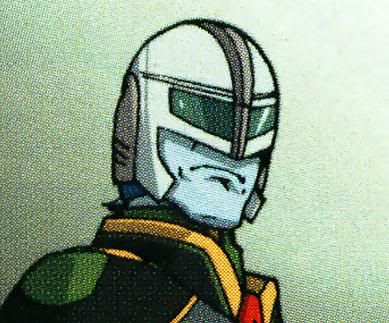
In Prelude, Breetai and Exedore are redesigned yet again. Breetai is back in his Buckethead mode, though not quite as goofy-looking, while Exedore is reworked almost to the point of being unrecognizable, looking more like Benjamin Franklin with bug eyes. Both are then quickly and unceremoniously killed off: Breetai in being destroyed by the corrupt general T.R. Edwards while occupied with battling the Invid Regent, Exedore in an incoherently-staged military testing accident. The exact fate of Miriya is never given, as she never even appears.
Zentradi are also otherwise never seen or referred to outside of those same comics which killed Exedore and Breetai, which has lead some readers to conclude that Zentradi have become extinct in Robotech. The behind-the-scenes reason is that, moreso than in the era of the Robotech EM, the producers of Robotech are worried about legal interference with the Macross franchise, which means that the Zentradi are to be avoided by any means.
However, this is only an imagining, a question that will never be answered because of the legal issues, and so it does not concern me. The deaths of Exedore and Breetai in Prelude to the Shadow Chronicles do not affect me because they are such quick, insipid moments, with no build-up or context or characterization to them. They could have been any other guys, for all the comic tells us about who they are and what they’ve done before they die. I cannot even truly acknowledge them as the same beloved characters, which might have been the fate of Sentinels Exedore and Sentinels Breetai if they had failed to live up to expectations.
Having the novels and older comics to fall back on further reduces the impact of Shadows Exedore and Shadows Breetai. The quality of these is no better than the modern Robotech continuations, but the older works do feel more vibrant. The Sentinels novels and comics feel more “real” to me than those works deemed official. In a vague way, I chose that as my personal ending to the story of Robotech, even though the adaptations are incompatible with the TV series and there are many things I would change.
There’s really not much at the end of it but just taking the good pieces out of the Robotech EM and putting them to my own use, while regretting a bunch of other things. The fact is, without the additional development the novels offered for my favourite characters, I wouldn’t have grown to like them as much as I do now, and so whatever the other issues, I am not letting go of Robotech.
I experienced both sides more or less simultaneously, and in the end, I couldn't discard either of them for the sake of my interest in Zentradi. Macross is good for the Zentradi as a whole group, but the specific approach to certain characters leaves something to be desired, and in Robotech (at least, the old novels and comics) is good for some certain Zentradi, but the general handling of the race is godawful.
By the time I came on the scene, there had already been scads of Robotech comics and a novel series published, and all long out of print and recently declared “not canon”. Yet since the material still existed, and contained some Zentradi stories, I wanted to take a crack at it.
Initially I devoured almost everything in the Robotech EM without thought to quality or consequence, initially distracted by the shine of works that actually thought about my favourite characters and offered them further growth. I soon realized that everything was largely a garbage pile that few sane fans would bother with, but even after realizing that, I still stuck with the Robotech EM because of those very small things related to the Zentradi.
The big beast of the Robotech apocrypha was a1986 project called Robotech II: The Sentinels. It was originally going to be an animated television “sequel” to Robotech, actually a side story about the Macross characters and their journey to Tirol, the homeworld of the Robotech Masters (characters from the second segment). This Robotech Expeditionary Force ended up working with a group of local alien rebels (the titular Sentinels) to free their nearby planets from the mutual threat of The Invid (whose other faction formed the villain of the third Robotech segment), as well as dealing with a coup attempt within their ranks.
The Sentinels project rapidly fizzled, though it briefly survived in a an animated “pilot” using some of the footage that had been produced, separate comic and novel adaptations, some other released plans and scripts, and scattered references in the eventual rebooted continuity.
If judged by the standards of the other popular American cartoons of the 1980s, the Sentinels outlines seen about on par. But when compared to anything else, even the original Robotech dub, The Sentinels was bad or at least looked like it could have been.
It didn’t add any new or compelling facets to most of the returning cast, made a muck of continuity, and the new characters were largely ciphers, with some truly awful character designs and a flimsy backstory. The novel version introduces some interesting ideas that challenged Robotech’s previous boundaries, but overall, it is difficult to find much to praise Robotech II: the Sentinels for in terms of its concepts.
Because they already received a sense of completeness within the Macross series the return of the main Macross characters in The Sentinels feels particularly forced and artificial, all of the sequel stories seem to struggle with what to do with them. As a result, the returning Rick, Lisa, Max, and Miriya feel empty and generic, or are simply mucked with.
But what draws me to The Sentinels is some aspects of the portrayal of Exedore and Breetai. With these characters, there was some potential character development left to work with, which is why they get more out of that story, however brief their scenes are. This is the reason that I cannot stay mad at the thing, no matter how savage a critique I build up inside my head.
It goes against all the laws of the universe for the Robotech novels to do anything compelling or interesting with a Macross character; even I’m not sure how it happened. Yet however it did, Sentinels Exedore, primarily as portrayed in the novels, was what helped define, shape, and elevate my interest in the character as a whole, and was a very welcome change from what the more visible continuities did with him.
While Exedore was a minor character in the Sentinels novels, the books still furthered his character growth, having Exedore become more emotional and more expressive, while remaining recognizable. Exedore plays an important role in figuring out several key things in the novels, and is present for climactic events. His kinder personality implies that he has overcome the blues he had at the end of the TV series, now twenty years in the past. Readers’ mileage may vary, finding him too “soft”, but he preserves a core of stoicism and clarity.
All of this gives me a sense that Exedore has finally gained that complete character arc, and now has become a richer being, opening the door for the fuller life and deeper explorations that I would conduct at my own fannish leisure.
Sentinels Exedore is not a seamless re-creation. On some levels he simply can’t be, since he was not the product of the original creators; in a more concrete sense, he has a few minor out-of-character moments and personal errors. The novels also do not make it clear where Exedore actually ends up when the storyline finishes, though he does survive. Overall, however, I was very happy with this angle. It aligned perfectly with what I wanted out of Exedore, and felt “right” to me. I accepted it. Because his existence offered a completed character arc, Sentinels Exedore was the reason that I became as big a fan of the character as I did.
In the case of Breetai and the Robotech expanded multiverse, of course the first thing everyone remembers is that, due to being unable to use the original character design, The Sentinels depicted a human-sized Breetai with a ridiculous bucket-helmet on, and this was how he would have looked in the animated series had it been completed. Fortunately, the comics and the novels had the freedom to use the original design for Breetai, and both versions had Classic Breetai back by the second volume (though through a set of contrived circumstances).
Breetai was also planned to be killed off, and the first death scene that made it into print was dreadful. In a extremely out-of-character moment, Breetai has the revelation that he and the Invid Regent must kill each other to complete the cycle of battle between Zentradi and Invid. Thus, Breetai turns his battle with the Invid Regent into a suicidal conflict, pinning the Regent so that he cannot escape, and the two of them destroy each other.
I’m not happy with either Breetai’s buckethead design or his death scene (though I’m probably less angry about Buckethead Breetai than I should be). But placed between them was some character development for Breetai in the novels, too.
This character development included a Zentradi love interest named Kazianna Hesh. Though she was likely only created to prove Breetai’s virility (the last remaining part of his otherwise complete macho awesomeness), Kazianna was more likeable and more “alive” than she had any right to be. In fact, she was the second character after Exedore that I named myself a fan of as an individual being, and to this day the only female Zentradi I like unreservedly. Kazianna was strong, focused, and playful, knew what she wanted and went for it, and unlike the other female Zentradi of her era, appeared to have control of her situation rather than swept along by fate.
Moreover, there was the sense that Breetai was himself a late bloomer who was still detached from human culture until Kazianna came along, while his troops were growing into it far faster. This acknowledgement helped humanize Breetai even more, but never took away from his power. For as long as he lasted, Breetai also became the leader of the new Zentradi civilization.
Despite what could be nitpicked, seeing Exedore and Breetai fully “grow up” and add new aspects to their lives was tremendously appealing. The imagery got a lock on my fandom consciousness, so that any depiction of Breetai and Exedore that did not suggest they had expanded or altered their own roles and selves following the SDF-1 era felt incomplete.
While intellectually I understood that an exploration of Exedore and Breetai beyond the TV series was non-essential and a good story should know when to end and leave the viewers wanting more, I’m entitled to a little bit of greed now and then. Besides, I always did feel that the writers left a loose end when not making it clear if Exedore had overcome his brief bit of angst near the end of the series.
The Sentinels-era Zentradi also end up claiming a planet of their own to build their civilization on, which I thought was pretty cool for the independence it suggested, though I had several issues with that premise and matters related to it, which will be discussed below.
Rico, Bron, and Konda never appeared in the Sentinels novels, as they had sadly been killed off behind the scenes in the TV series novels, due to factors that were conflictingly explained. This is a sore point, especially since the authors had also made the effort to connect them to the main cast by making them the caretakers of Max and Miriya’s daughter Dana before their deaths.
They seem to die only to give Dana an excuse to angst, when she already has plenty. As if the stagnation caused by death wasn’t enough, the trio are depicted pining away over their first girlfriends, female members of the bridge crew who were written as killed in the Robotech dub. They had no apparent interested in dating again, not that they had much of a chance afterwards.
I thought it the most natural thing in the world that Rico, Bron, and Konda, should be able to live and make something of themselves, continuing the theme of Zentradi “adulthood”. Given their level of intelligence, I didn’t expect them to amount to much, but I pictured them as the sort of people who live comfortably in the same low-end job for the rest of their lives.
However, the novels handled the revelation of their deaths with some attempt at warmth and sensitivity, and this may have had a role in making me understand that I did like these characters after all.
Robotech apocrypha also offered the Malcontent Uprisings/The Zentradi Rebellion, a comic miniseries and its extended novel version which chronicled a Zentradi backlash against the humans following the Macross portion of the original TV series, alongside Miriya’s conflict with a friend from her days in the Zentradi army. The concept fascinates me in several ways, primarily in the appeal of fighting for a happy conclusion, but the actual story was interesting only in small ways. Ultimately, both versions of this story were more about the affects of this rebellion on humanity than on the Zentradi characters, which was a wasted opportunity.
Zentradi-wise, the Uprisings stories made Miriya into a more complex character by giving her internal conflicts, acknowledging that she had a life outside of Max, and making humanity’s reaction to her more suspicious and varied. However, the miniseries only briefly dwelt on the other major Zentradi characters. The comics only have a one-issue story where Breetai tries to infiltrate the Zentradi weapons-dealing underground, during which he has no strong interaction with the established characters, and a cameo by a disgruntled-looking Exedore in the final issue. The novel also seriously short-changed the male Zentradi characters, turning Exedore and Breetai into little more than Voices of Doom and Rico, Bron, and Konda into completely oblivious airheads, which they not entirely were in the TV series...just close to it.
The Uprisings also tried very hard to push the notion of “The Zentradi Imperative” an ingrained combat urge that was driving their remaining population all over the world to kill and destroy. That was a huge narrative cop-out, removing the responsibility, and thus the potential for change, from the Zentradi and corrupting the themes of the Macross story. In addition, even with a military as simplistic as the Zentradi’s, the mere urge to kill is not enough to form a workable military force, and so a universal inclination towards aggression makes little sense.
I did enjoy that the Uprisings presented female Zentradi as equally culpable in causing trouble and equally susceptible to the Imperative. Such a condition only makes sense, but other writers seem to be reluctant to show female Zentradi as a genuine danger to humans following the first war.
The Imperative also existed beside this weird attempt to make the Zentradi into more typical “warrior aliens”, mostly due to the work of Robotech comics writer Bill Spangler. Through him, the Zentradi received a harsh and grating native language that included concepts like “kara-brek” (honourable death) and “kara-thun” (a ‘death dance’ where condemned prisoners are allowed one last chance to fight their executioners), as well as a greater interest in values of honour and fidelity to Zentradi-dom.
This really didn’t work for me, as it contradicts one of the smaller appeals of the original Zentradi. Arguably, a main point of the Zentradi’s story is that there is no glory or honour in their lives: even if some individuals may take pride in their work, Zentradi they are simply doing what they are told to do, rather than it being a true “warrior culture”. Other warrior aliens have chosen to be what they were, and have at least a bit more to their lives than fighting, but the Zentradi do not have that luxury. They are much more pathetic than their counterparts in other SF series, in the truest sense of invoking pity.
The old comics also contained a few other small Zentradi stories besides these, but mostly they were forgettable. I retained a soft spot for some, like Bill Spangler’s utterly trashy Zentradi prequel comics, or Bruce Lewis’ Hohsq’s Story, which wrapped the intriguing idea of an independent Zentradi settlement into a lot of empty clichés and truly awful artwork.
No matter how much I criticize the Robotech expanded universe, certain tidbits are indispensible, enough to sustain an interest in Robotech for a good while. That later realization of the material’s fundamental lack of quality didn’t seem to change that; I don't quite understand it either.
It is especially confusing since there are some notable problems with the Zentradi treatment in the Robotech EM, problems that are most obvious in the novels. I cannot deny these issues, and they don’t exist comfortably alongside what I do enjoy.
One of those problems is the reveal (only part of Robotech) that the Zentradi were created originally as high-gravity-resistant miners for the planet Fantoma before their creators’ imperial ambitions lead to their being reconditioned as warriors. Before that, Zentradi had even formed a crude civilization on Fantoma, whose ruins exist for Breetai to find in the second Sentinels novel, as he recalls his past life as a workaholic miner.
This return of memories is explained only vaguely, but more important, the entire Fantoma story distorts the themes of the original series. Their story is far less poignant if the Zentradi already knew something of civilization before human contact, even if it was a crude version. Furthermore, though the Zentradi begin to form a new independent civilization on Fantoma, the bleak rocky world seems like no place for living.
Sure, the original Macross contained a storyline about Earth’s remaining population living and thriving on a scorched planet with all modern conveniences, but the conditions of Fantoma are much harsher. The only logical reason Zentradi might settle on Fantoma is out of an attachment to their original “home”, but I could not accept Fantoma as an adequate “home” for the Zentradi when that storyline was such a misfire, and the novel writers never tried to explain the Zentradi’s reasoning, anyway.
Things also get worse for the Zentradi. The novels also sport an unrealistic understanding of how long it should have taken Zentradi to start interbreeding with humans and themselves. First, human/Zentradi hybrids, despite the two races’ established genetic compatibility being an important plot point previously, are in the books somehow so difficult to conceive that only two exist, and one is killed. The other, Dana Sterling, is also viewed as a rare and powerful genetic anomaly in spite of the genetic similarities between the two races.
Also, it is strongly implied that Zentradi did not produce their own children until Breetai and Kazianna’s son Drannin was conceived, almost twenty years after the peace. The reasons for either condition are never explained and do not gel with the Zentradi’s speedy adaptation of other aspects of human culture, nor the optimistic nature of their original storyline.
Finally, Zentradi numbers are reduced by scores. There are only a handful of Zentradi left alive by the end of the Sentinels war, being practically an endangered species. Actual extinction is not in the cards, since the Zentradi are rebuilding their numbers the old-fashioned way by the end, but except for Exedore and Miriya, they are all now operating on Fantoma.
The original REF mission had only a small contingent of Zentradi warriors to begin with, though, and the real problem is the way that the rest of the Zentradi population is handled. Before the second part of Robotech, they have virtually lost interest in integration with humans. Except for the doomed spy trio, they confine themselves to the orbiting Factory Satellite. The reasons unexplored until the novel Before the Invid Storm, and in that book, human persecution leading up to and following the Malcontent Uprisings are responsible for that exodus.
Not only have the Earth Zentradi exiled themselves en masse, but they revert to their original sexually-segregated conditions and the males all die off after apparently losing the will to live. The females, though more active, eventually follow in their own time, refusing an explicit offer of freedom and independence. While some complexity among Zentradi reactions and adjustments makes for a more realistic story, this screaming racial fatalism is utterly confusing. How does it fit with the previous storylines? What does it add to the plot? The answer is absolutely nothing at all. There is no reason for the Zentradi to almost die out, especially not through their own will by applying some kind of insane prideful fatalism.
The writers certainly didn’t seem like sadists, but the Zentradi’s actions are so contradictory to what the Macross part established, and so inexplicable, that on some levels it’s even hard for me to take it all seriously. Yet however it is interpreted, this is what I mean when I say that the Robotech EM is worse for the Zentradi in the more general sense. I could see the Fantoma/Sentinels treatment as the product of clunky writing, and there were some pleasant aspects to that Zentreadi story, but the handling of them in Before the Invid Storm seems outright cruel.
As to the single characters, things are still a little muddy, despite my larger happiness with them. I’ve explained by my issues with the deaths of Breetai and the trio, and some of Breetai’s best interaction with Kazianna is tainted a bit because it is part of a visit to Fantoma and Breetai’s recollections of the past life. Kazianna herself, despite how much personality shines through her stereotypical role, still is underdeveloped.
The story also makes a big deal out of Exedore having to remain permanently Micronized, when the only Zentradi sizing chamber breaks down and he has to face that bravely. This scene hooked me early and reinforced the possibility that Exedore might not only be a creature of appeal but of integrity, which “The Messenger” also demonstrated. However, thinking it over again, that premise for that scene seems highly unrealistic. Where did all the other sizing chambers go to begin with?
The friendship between the Sterling family and Rico, Bron, and Konda is also never deeply explored or even clearly defined. With the material that’s provided, a reader might get the impression that while they took care of Dana, Miriya never talked with her own daughter about Zentradi heritage, and never had much interaction with the trio, either. That feels more like writer’s oversight than a deliberate statement that Max and Miriya only used them as free babysitters and didn’t really care about them, but it’s a portrayal I would rather do without.
Miriya herself is a problematic character in the Sentinels novels, and without the compensation that the male Zentradi characters have. She is largely just another body to fill a cockpit and speak some generic lines…until she becomes pregnant, and her child turns out to be a mini-messiah who is for some reason named “Aurora”.
Throughout Aurora’s gestation, Miriya becomes a woozy, fainting damsel in distress, and after her daughter is born, both she and Max inexplicably retire from the military to tend to their supernatural daughter, whom they accept unreservedly. The end of the novel series briefly mentions that Max and Miriya, former fighter jocks, become Earth’s ambassadors to Tirol/Fantoma...for some reason.
The novels and comics are not considered canon to Robotech anymore, but there is so much stuff to at least talk about, and to build my personal fandom on, that I’m not going to care if it is apocryphal. It is probably a testament to the many problems with Robotech that I elected to take this route, since I haven’t wanted to subvert canon for any other fandom.
The newly canonical Robotech continuations don’t have much for this, good or bad. When creator group Harmony Gold decided to reboot the expanded Robotech continuity in the aughts, Prelude to the Shadow Chronicles was published, a five-issue comic miniseries meant to display the final stages of an ambiguous rebooted Sentinels storyline and serve as the lead-in to a new series of animated Robotech features. The only film produced was Robotech: the Shadow Chronicles, part of a new era for Robotech that doesn’t seem to have gone anywhere since. I just stopped caring after a while.
In Prelude, Breetai and Exedore are redesigned yet again. Breetai is back in his Buckethead mode, though not quite as goofy-looking, while Exedore is reworked almost to the point of being unrecognizable, looking more like Benjamin Franklin with bug eyes. Both are then quickly and unceremoniously killed off: Breetai in being destroyed by the corrupt general T.R. Edwards while occupied with battling the Invid Regent, Exedore in an incoherently-staged military testing accident. The exact fate of Miriya is never given, as she never even appears.
Zentradi are also otherwise never seen or referred to outside of those same comics which killed Exedore and Breetai, which has lead some readers to conclude that Zentradi have become extinct in Robotech. The behind-the-scenes reason is that, moreso than in the era of the Robotech EM, the producers of Robotech are worried about legal interference with the Macross franchise, which means that the Zentradi are to be avoided by any means.
However, this is only an imagining, a question that will never be answered because of the legal issues, and so it does not concern me. The deaths of Exedore and Breetai in Prelude to the Shadow Chronicles do not affect me because they are such quick, insipid moments, with no build-up or context or characterization to them. They could have been any other guys, for all the comic tells us about who they are and what they’ve done before they die. I cannot even truly acknowledge them as the same beloved characters, which might have been the fate of Sentinels Exedore and Sentinels Breetai if they had failed to live up to expectations.
Having the novels and older comics to fall back on further reduces the impact of Shadows Exedore and Shadows Breetai. The quality of these is no better than the modern Robotech continuations, but the older works do feel more vibrant. The Sentinels novels and comics feel more “real” to me than those works deemed official. In a vague way, I chose that as my personal ending to the story of Robotech, even though the adaptations are incompatible with the TV series and there are many things I would change.
There’s really not much at the end of it but just taking the good pieces out of the Robotech EM and putting them to my own use, while regretting a bunch of other things. The fact is, without the additional development the novels offered for my favourite characters, I wouldn’t have grown to like them as much as I do now, and so whatever the other issues, I am not letting go of Robotech.
Reflections on Zentradi Fandom Part 2: The Major Players
I will describe my feelings on each major Zentradi character from that initial storyline. It was with the Robotech dub that I first formulated my opinions on the Zentradi, so to start with, I’ll be using the Robotech names.
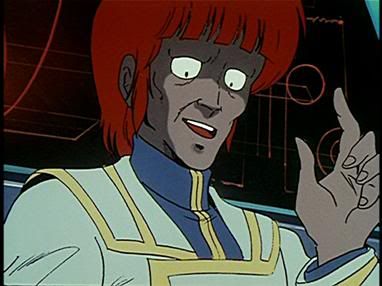
Being a geek myself, it was probably inevitable that I would identify the most strongly with the Zentradi Exedore Formo, the odd-looking and slightly nerdy advisor/historian/archivist. By the tail end of the original series, Exedore seems to be displaying an increasing emotional range, expressing sadness over the two peoples’ inability to coexist, but also a sharp cynicism about the same fact.
Before that, Exedore was a cool-minded strategist, but also had his emotional moments, too. He could be dour, quirky, nebbish, sad, or even show a mean streak. Though a loyal follower of the main antagonist, he was not a smarmy sycophant, either.
These were all traits that captured my interest, and Exedore’s version of the Zentradi evolution was the easiest to relate to of all: a geek becoming aware of the wider world and slightly opening up, just like what I wanted to do. It wasn’t entirely through Minmei-obsessed comic-relief hedonism, but more subtle, even if Exedore had plenty of hilarious moments along the way. I also loved his character design: his garish colour scheme (red hair and reddish-purple skin against a purple, blue, and green uniform) and the expressive way he was drawn and animated, the latter helped by his large eyes and odd face.
My interest in Exedore might be analogous to the kinship most other geeks feel for Spock or other similar characters. Being largely ignorant of Star Trek, I can’t say how true that is, though pop-cultural osmosis hints to me that the two characters aren’t that alike at all: Exedore is much less stoic than Spock, sometimes to the point of being comic relief, and Exedore also doesn’t engage in any explicit struggles between “emotion” and “logic”. However, it is true that my interest in Exedore is not without precedent, as I have been fascinated with many other “nerdy” fictional characters and mythological figures in the past.
Exedore’s best role in either incarnation of the series was episode 26, “The Messenger” (known simply as “Messenger” in the original Macross, she said pedantically), in which he becomes the ambassador to humanity. He has some great sight gags in the episode (including one where he does an impression of Minmei’s singing to explain to the military what he’s talking about), but is not solely a comedic character.
In the same episode, Exedore also has a definite intelligence, a willingness to make peace, and a determination to stand in the face of an impossible goal: helping the humans defeat the four-million strong fleet of the Zentradi authority that is about to arrive. By showing Exedore’s capacities in various aspects, this episode began my proper interest in the character, though I had liked him before.
Another good moment was in the episode “Khyron’s Revenge”, where Exedore is briefly shown as deeply saddened about the nature of the Zentradi as mere “toys of destruction”, though this part is portrayed more effectively in the Japanese version of the episode, called “Satan’s Dolls” (the epithet used against the Zentradi in the original script).
Soon enough, I became a total geek for a geek, possibly writing more about Exedore than anyone else ever had. He became the keystone of my interest in the Zentradi, and thus in the Macross series as a whole.
But just that initial connection with him and hint of his character development was not enough to grant Exedore the unexpectedly high level of attention I ended up paying to him. To become this way to me, Exedore had to have not only that character development, but also the sense of a completed character arc, which I later found in an equally unexpected place.

I also grew attached to Exedore’s commander, Breetai Tul, who might have ended up being merely the brawn to Exedore’s brains, but Breetai was a smart cookie himself, and a calmer, clear-headed character than the stereotype--“manly” but without being boastful or excessively concerned with his reputation. He complemented Exedore nicely.
Out of all my favourite Zentradi, Breetai develops the least: his interactions with humans being the briefest, and he is the least flawed. But Breetai does appear to change in a minor way during the series, becoming more open and friendly, and so fits the ideal.

Rico, Bron, and Konda were a trio of comic-relief male Zentradi who volunteered to shrink down and became spies among human culture. Despite having little in the way of distinct personalities from each other, they also grew on me. I find them utterly cute when they first try to bumble their way through human culture, and I jokingly claim empathy with their bone-headed hedonism.
I never lost sight of their nature as clownish tertiary characters, but at the core of that comic relief and goofy Minmei fanboyism there was a genuine desire to move forward, even if it was only to satisfy their self-indulgence. They became the first Zentradi to be integrated into human culture.
While it was Exedore I grew attached to first, Breetai and the three spies also got to me after a while, since these characters best embodied the ideals I saw in the Zentradi story. As to the other first-series Zentradi characters, my reactions to them were mixed, usually skewing towards the negative.

Khyron Kravshera was the anachronism I loved to hate, a drunken punk who refused to give in to cultural acclimation and continued to be a thorn in the other characters’ sides even after the alliance was established, becoming a rebel against humanity. With that, and his often-antagonistic relationship with Exedore and Breetai, of course Khyron ended up being one of my least favourite characters, although I understood the appeal that he might have had for the other rebellious Zentradi, and that he might have found a genuine cause to believe in.

Dolza, the ultimate lord of the Zentradi group (at least as far as Robotech went), was largely just a device to provide menace or exposition. He can only be disliked for his role in destroying things, and not as a character unto himself.
The Zentradi were sexually segregated, and the original fleet that came to Earth was all-male. Female Zentradi characters did not appear until the episode numbers hit the double digits, and the narrative did very little with them: there were really only two prominent female Zentradi characters, and unfortunately, neither were as interesting as the male ones.

There was Commander Azonia Lamiz, who provided some generic commander stuff, then inexplicably betrayed the human-friendly forces and sided with Khyron, whom she had had a previously hostile relationship with but had become his lover...for some reason. On later viewings, she also strikes me as narrow-minded and weak-willed, only following along with larger groups and being unable to control those under her command, with huge gaps in her own characterization. She was not a favourite, though by actually explaining her shifting alliances and her motivations, Azonia could have been a well-rounded and compelling character.
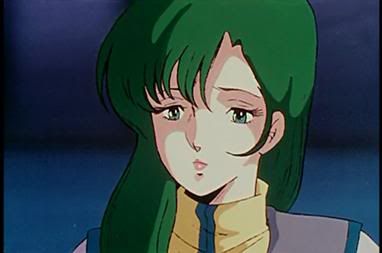
There was Miriya Parino, an arrogant pilot who was obsessed with being the best. When hearing of a human who could defeat her, she organized her missions around finding that one person. Max Sterling, whom she identified as her target, did indeed defeat her in combat, so Miriya threw aside her regular duties to instate herself as a human-sized spy and hunt Max down in the human ship’s internal city.
Max, taken with the mysterious woman’s beauty, has several encounters with her, and manages to defeat Miriya several more times. First it is during one-on-one combat at a video arcade, and the smitten Max uses the occasion to try to pick her up. When he arranges to meet her in a park, Miriya tries to kill him in single combat, only to be defeated by Max again. However, as Miriya collapses at his feet, Max proposes marriage and Miriya accepts, both of them instantly swept up in love and walking happily down the aisle the next day.
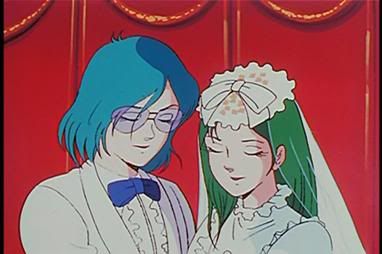
Miriya then becomes part of the human military instead of being “in the kitchen”, and the image of worlds united by two beautiful badasses fighting side by side is an appealing one. However, the fact of Miriya not having the same degree of control over what happened to her as the male characters did, and of falling in love with the man she had first felt destroyed her, made my skin crawl.
I could not accept this part of the story with the same happiness as the males’ character arcs , being that it seemed too close to the fantasy of the hero “taming” an aggressive woman, and of a woman needing to be told what her desires “really” were. There were vague hints that Miriya was interested in Max beforehand, but they were fleeting and she never wavered in her quest--and at any rate, this still would be an attraction inspired by defeat. It all conflicted too strongly with my personal values for me to take it in the spirit it was intended.
Miriya is doubtless the series’ major Zentradi character and the most popular one in both franchises, but she lacked everything that drew me to her male counterparts, and I do not consider myself a fan of her, either.
Other viewers seem to be charmed by how much more attractive and grand the female Zentradi were in comparison to the males, but to me this only made them more boring. With Miriya and Azonia (and several nameless females who appear briefly and are only given a few lines), female Zentradi came off as “perfect” characters: generically strong and generically sexy without much in the way of interesting internal conflicts or acknowledged flaws. I saw flaws in them, certainly, but recognizing and dealing with those flaws was never a major part of their character arcs.
About their only redeeming quality was that initially the female Zentradi’s uniforms and equipment did not look stereotypically feminine or overtly sexualized, but even that token tidbit soon changed....
Ultimately, it was true: I was far more drawn to these second-tier “bad guys” than to anyone else in the series. When viewing the original Super Dimensional Macross, series, my core feelings about these aforementioned characters and their issues remained largely the same, though I viewed SDFM as the superior presentation in terms of plot, dialogue, and characterization.
Being a geek myself, it was probably inevitable that I would identify the most strongly with the Zentradi Exedore Formo, the odd-looking and slightly nerdy advisor/historian/archivist. By the tail end of the original series, Exedore seems to be displaying an increasing emotional range, expressing sadness over the two peoples’ inability to coexist, but also a sharp cynicism about the same fact.
Before that, Exedore was a cool-minded strategist, but also had his emotional moments, too. He could be dour, quirky, nebbish, sad, or even show a mean streak. Though a loyal follower of the main antagonist, he was not a smarmy sycophant, either.
These were all traits that captured my interest, and Exedore’s version of the Zentradi evolution was the easiest to relate to of all: a geek becoming aware of the wider world and slightly opening up, just like what I wanted to do. It wasn’t entirely through Minmei-obsessed comic-relief hedonism, but more subtle, even if Exedore had plenty of hilarious moments along the way. I also loved his character design: his garish colour scheme (red hair and reddish-purple skin against a purple, blue, and green uniform) and the expressive way he was drawn and animated, the latter helped by his large eyes and odd face.
My interest in Exedore might be analogous to the kinship most other geeks feel for Spock or other similar characters. Being largely ignorant of Star Trek, I can’t say how true that is, though pop-cultural osmosis hints to me that the two characters aren’t that alike at all: Exedore is much less stoic than Spock, sometimes to the point of being comic relief, and Exedore also doesn’t engage in any explicit struggles between “emotion” and “logic”. However, it is true that my interest in Exedore is not without precedent, as I have been fascinated with many other “nerdy” fictional characters and mythological figures in the past.
Exedore’s best role in either incarnation of the series was episode 26, “The Messenger” (known simply as “Messenger” in the original Macross, she said pedantically), in which he becomes the ambassador to humanity. He has some great sight gags in the episode (including one where he does an impression of Minmei’s singing to explain to the military what he’s talking about), but is not solely a comedic character.
In the same episode, Exedore also has a definite intelligence, a willingness to make peace, and a determination to stand in the face of an impossible goal: helping the humans defeat the four-million strong fleet of the Zentradi authority that is about to arrive. By showing Exedore’s capacities in various aspects, this episode began my proper interest in the character, though I had liked him before.
Another good moment was in the episode “Khyron’s Revenge”, where Exedore is briefly shown as deeply saddened about the nature of the Zentradi as mere “toys of destruction”, though this part is portrayed more effectively in the Japanese version of the episode, called “Satan’s Dolls” (the epithet used against the Zentradi in the original script).
Soon enough, I became a total geek for a geek, possibly writing more about Exedore than anyone else ever had. He became the keystone of my interest in the Zentradi, and thus in the Macross series as a whole.
But just that initial connection with him and hint of his character development was not enough to grant Exedore the unexpectedly high level of attention I ended up paying to him. To become this way to me, Exedore had to have not only that character development, but also the sense of a completed character arc, which I later found in an equally unexpected place.
I also grew attached to Exedore’s commander, Breetai Tul, who might have ended up being merely the brawn to Exedore’s brains, but Breetai was a smart cookie himself, and a calmer, clear-headed character than the stereotype--“manly” but without being boastful or excessively concerned with his reputation. He complemented Exedore nicely.
Out of all my favourite Zentradi, Breetai develops the least: his interactions with humans being the briefest, and he is the least flawed. But Breetai does appear to change in a minor way during the series, becoming more open and friendly, and so fits the ideal.
Rico, Bron, and Konda were a trio of comic-relief male Zentradi who volunteered to shrink down and became spies among human culture. Despite having little in the way of distinct personalities from each other, they also grew on me. I find them utterly cute when they first try to bumble their way through human culture, and I jokingly claim empathy with their bone-headed hedonism.
I never lost sight of their nature as clownish tertiary characters, but at the core of that comic relief and goofy Minmei fanboyism there was a genuine desire to move forward, even if it was only to satisfy their self-indulgence. They became the first Zentradi to be integrated into human culture.
While it was Exedore I grew attached to first, Breetai and the three spies also got to me after a while, since these characters best embodied the ideals I saw in the Zentradi story. As to the other first-series Zentradi characters, my reactions to them were mixed, usually skewing towards the negative.
Khyron Kravshera was the anachronism I loved to hate, a drunken punk who refused to give in to cultural acclimation and continued to be a thorn in the other characters’ sides even after the alliance was established, becoming a rebel against humanity. With that, and his often-antagonistic relationship with Exedore and Breetai, of course Khyron ended up being one of my least favourite characters, although I understood the appeal that he might have had for the other rebellious Zentradi, and that he might have found a genuine cause to believe in.
Dolza, the ultimate lord of the Zentradi group (at least as far as Robotech went), was largely just a device to provide menace or exposition. He can only be disliked for his role in destroying things, and not as a character unto himself.
The Zentradi were sexually segregated, and the original fleet that came to Earth was all-male. Female Zentradi characters did not appear until the episode numbers hit the double digits, and the narrative did very little with them: there were really only two prominent female Zentradi characters, and unfortunately, neither were as interesting as the male ones.
There was Commander Azonia Lamiz, who provided some generic commander stuff, then inexplicably betrayed the human-friendly forces and sided with Khyron, whom she had had a previously hostile relationship with but had become his lover...for some reason. On later viewings, she also strikes me as narrow-minded and weak-willed, only following along with larger groups and being unable to control those under her command, with huge gaps in her own characterization. She was not a favourite, though by actually explaining her shifting alliances and her motivations, Azonia could have been a well-rounded and compelling character.
There was Miriya Parino, an arrogant pilot who was obsessed with being the best. When hearing of a human who could defeat her, she organized her missions around finding that one person. Max Sterling, whom she identified as her target, did indeed defeat her in combat, so Miriya threw aside her regular duties to instate herself as a human-sized spy and hunt Max down in the human ship’s internal city.
Max, taken with the mysterious woman’s beauty, has several encounters with her, and manages to defeat Miriya several more times. First it is during one-on-one combat at a video arcade, and the smitten Max uses the occasion to try to pick her up. When he arranges to meet her in a park, Miriya tries to kill him in single combat, only to be defeated by Max again. However, as Miriya collapses at his feet, Max proposes marriage and Miriya accepts, both of them instantly swept up in love and walking happily down the aisle the next day.
Miriya then becomes part of the human military instead of being “in the kitchen”, and the image of worlds united by two beautiful badasses fighting side by side is an appealing one. However, the fact of Miriya not having the same degree of control over what happened to her as the male characters did, and of falling in love with the man she had first felt destroyed her, made my skin crawl.
I could not accept this part of the story with the same happiness as the males’ character arcs , being that it seemed too close to the fantasy of the hero “taming” an aggressive woman, and of a woman needing to be told what her desires “really” were. There were vague hints that Miriya was interested in Max beforehand, but they were fleeting and she never wavered in her quest--and at any rate, this still would be an attraction inspired by defeat. It all conflicted too strongly with my personal values for me to take it in the spirit it was intended.
Miriya is doubtless the series’ major Zentradi character and the most popular one in both franchises, but she lacked everything that drew me to her male counterparts, and I do not consider myself a fan of her, either.
Other viewers seem to be charmed by how much more attractive and grand the female Zentradi were in comparison to the males, but to me this only made them more boring. With Miriya and Azonia (and several nameless females who appear briefly and are only given a few lines), female Zentradi came off as “perfect” characters: generically strong and generically sexy without much in the way of interesting internal conflicts or acknowledged flaws. I saw flaws in them, certainly, but recognizing and dealing with those flaws was never a major part of their character arcs.
About their only redeeming quality was that initially the female Zentradi’s uniforms and equipment did not look stereotypically feminine or overtly sexualized, but even that token tidbit soon changed....
Ultimately, it was true: I was far more drawn to these second-tier “bad guys” than to anyone else in the series. When viewing the original Super Dimensional Macross, series, my core feelings about these aforementioned characters and their issues remained largely the same, though I viewed SDFM as the superior presentation in terms of plot, dialogue, and characterization.
Reflections on Macrophilia Part 1: A General Fascination
For me, there is just something about the Zentradi characters: they don’t exactly transcend cliché, but some aspects of their characterization make them stand out among the numerous other examples of the “What is this thing that you humans call love?” type of alien.
For one thing, even before they ally with humanity, the Zentradi seem like “real” characters rather than grim and soulless alien conquerors. They have their own personalities, bicker with each other, have several scenes told from their perspective, and express a range of emotions. They are not just props to show how awesome humanity is, but characters to like for themselves.
Furthermore, because Zentradi were engineered for war rather than that being their natural, evolved culture, they avoided falling into the trap of being cheesy “warrior alien” types, and were instead fairly balanced and normal. Portraying the Zentradi this way enriches the basic humanistic theme of the trope they embodied.
However, while this humanism is a very important aspect to the Zentradi, the core of my interest was that I could empathize with them in some strange way, which began with the fact that the Zentradi’s arc sent two comforting messages. The first was that music and emotion are potentially stronger forces than weapons, for that was what made allies out of some of them. Unrealistic, but as a feel-good metaphor it worked beautifully. The catalyst for the Zentradi transition might just have been the male characters’ infatuation with Minmay, but Minmay’s singing is analogous to any other artistic pursuit, and to the general humanity of it all. She is a stand-in for a larger theme.
And I believed in it, ‘cause I believe that without artistic expression, life is worthless. Not everyone has to be an artist, but the opportunity to be one must exist in some form. Art is essential to human existence, even if it doesn’t seem like a physical necessity at first: without art, you have no heart, and no mind, and all you have is mere survival...just like the Zentradi.
Though I later realized that the intention of the narrative was also to credit Minmay herself with being super-special, my view of Minmay as a metaphor remained, and this perception didn’t really diminish the power of what unfolded.
The second message of the Zentradi transition is that you can become more than what you are. Through serendipity this actually became a minor theme in the other two segments of Robotech, and was seen with later Macross antagonists and even protagonists, but the original Zentradi it were the most compelling example of such a motif.
I also saw an undercurrent of individualism within the Zentradi story arc, since they took an active role in responding to the feelings the humans had engendered and tried to shape their own future themselves. This series of active movements on the part of the Zentradi helped to further differentiate them from their norm, and to appeal more deeply to my own personal values. More obviously, the Zentradi began to desire far more freedom and self-definition than they were used to having. It was not that the humans were intrinsically superior, but that autonomy was, and humans had that first.
I also view the Zentradi story as a childhood’s end. Though clearly the major rite-of-passage themes revolve around the series' protagonist, Hikaru Ichijo/Rick Hunter, they are applicable to the antagonists as well. Because they know of nothing beyond what they have been taught, the Zentradi are undeveloped: official Macross material defines the ordinary soldier as being about as intelligent as a “primary schoolchild”. They are not mindless and passive, can indeed be adaptive and active, but it is all in the framework of war, and so they can never make free adult decisions.
I was not a child when I viewed the series. But I had struggled for years with anxiety regarding my performance and capability in both work and home, with a persistent sense of my own arrested development and an incomplete psyche. I saw many possible mirrors to my own situation in the Zentradi, viewing their story as an inspirational one of breaking free of the constraints of a previous life to build a new one on their own, an action that was prompted by humans but depended just as much on their own initiative. This highlighted my own urges to change rather than created them, but that was enough. It felt good to see an uplifting metaphor for my own desires.
However, I eventually realized that simply being thematically appealing was not enough to make me like the Zentradi as deeply as I did. To really be attached to an image, there must be likable characters through which it is filtered. When it came to the Zentradi, I ended up focusing the most on the eventually human-allied male Zentradi characters from the original series, ones whom I later realized were largely ignored by the fandom and sometimes ill-treated by the narrative.
For one thing, even before they ally with humanity, the Zentradi seem like “real” characters rather than grim and soulless alien conquerors. They have their own personalities, bicker with each other, have several scenes told from their perspective, and express a range of emotions. They are not just props to show how awesome humanity is, but characters to like for themselves.
Furthermore, because Zentradi were engineered for war rather than that being their natural, evolved culture, they avoided falling into the trap of being cheesy “warrior alien” types, and were instead fairly balanced and normal. Portraying the Zentradi this way enriches the basic humanistic theme of the trope they embodied.
However, while this humanism is a very important aspect to the Zentradi, the core of my interest was that I could empathize with them in some strange way, which began with the fact that the Zentradi’s arc sent two comforting messages. The first was that music and emotion are potentially stronger forces than weapons, for that was what made allies out of some of them. Unrealistic, but as a feel-good metaphor it worked beautifully. The catalyst for the Zentradi transition might just have been the male characters’ infatuation with Minmay, but Minmay’s singing is analogous to any other artistic pursuit, and to the general humanity of it all. She is a stand-in for a larger theme.
And I believed in it, ‘cause I believe that without artistic expression, life is worthless. Not everyone has to be an artist, but the opportunity to be one must exist in some form. Art is essential to human existence, even if it doesn’t seem like a physical necessity at first: without art, you have no heart, and no mind, and all you have is mere survival...just like the Zentradi.
Though I later realized that the intention of the narrative was also to credit Minmay herself with being super-special, my view of Minmay as a metaphor remained, and this perception didn’t really diminish the power of what unfolded.
The second message of the Zentradi transition is that you can become more than what you are. Through serendipity this actually became a minor theme in the other two segments of Robotech, and was seen with later Macross antagonists and even protagonists, but the original Zentradi it were the most compelling example of such a motif.
I also saw an undercurrent of individualism within the Zentradi story arc, since they took an active role in responding to the feelings the humans had engendered and tried to shape their own future themselves. This series of active movements on the part of the Zentradi helped to further differentiate them from their norm, and to appeal more deeply to my own personal values. More obviously, the Zentradi began to desire far more freedom and self-definition than they were used to having. It was not that the humans were intrinsically superior, but that autonomy was, and humans had that first.
I also view the Zentradi story as a childhood’s end. Though clearly the major rite-of-passage themes revolve around the series' protagonist, Hikaru Ichijo/Rick Hunter, they are applicable to the antagonists as well. Because they know of nothing beyond what they have been taught, the Zentradi are undeveloped: official Macross material defines the ordinary soldier as being about as intelligent as a “primary schoolchild”. They are not mindless and passive, can indeed be adaptive and active, but it is all in the framework of war, and so they can never make free adult decisions.
I was not a child when I viewed the series. But I had struggled for years with anxiety regarding my performance and capability in both work and home, with a persistent sense of my own arrested development and an incomplete psyche. I saw many possible mirrors to my own situation in the Zentradi, viewing their story as an inspirational one of breaking free of the constraints of a previous life to build a new one on their own, an action that was prompted by humans but depended just as much on their own initiative. This highlighted my own urges to change rather than created them, but that was enough. It felt good to see an uplifting metaphor for my own desires.
However, I eventually realized that simply being thematically appealing was not enough to make me like the Zentradi as deeply as I did. To really be attached to an image, there must be likable characters through which it is filtered. When it came to the Zentradi, I ended up focusing the most on the eventually human-allied male Zentradi characters from the original series, ones whom I later realized were largely ignored by the fandom and sometimes ill-treated by the narrative.
Subscribe to:
Posts (Atom)